South dakota information release 2026

Get Form
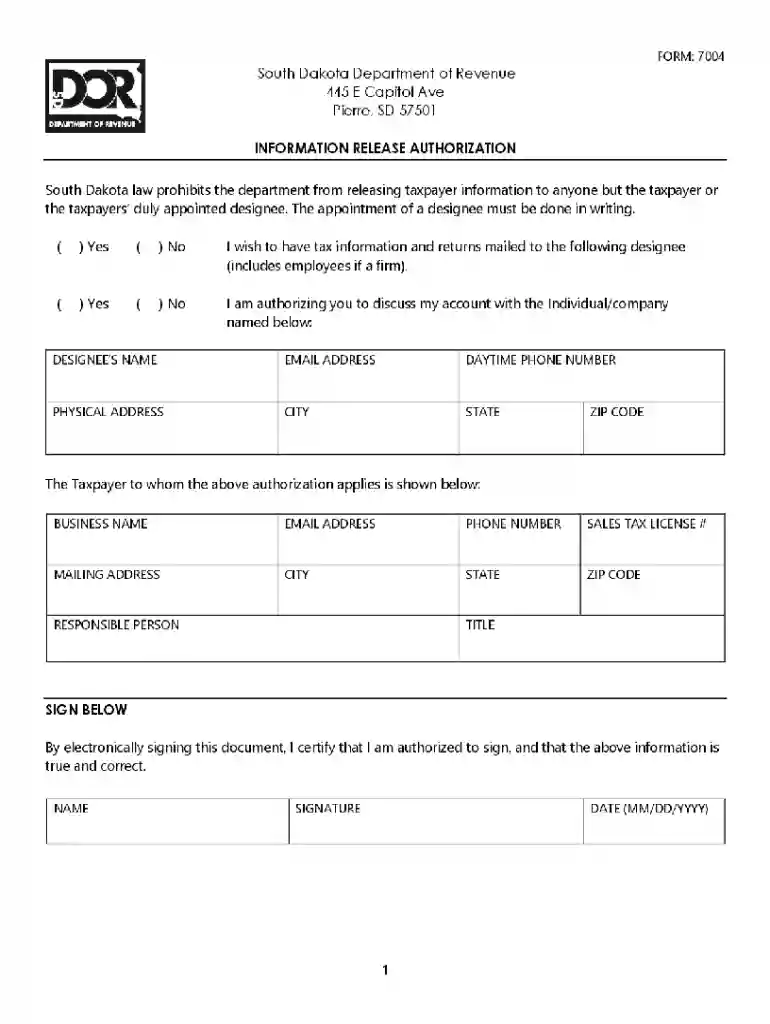
south dakota information release Preview on Page 1

Here's how it works

01. Edit your form online
Type text, add images, blackout confidential details, add comments, highlights and more.

02. Sign it in a few clicks
Draw your signature, type it, upload its image, or use your mobile device as a signature pad.

03. Share your form with others
Send it via email, link, or fax. You can also download it, export it or print it out.

Definition & Meaning

The South Dakota Information Release form is a legal document that grants permission to share specific taxpayer information with a designated third party. This form is typically used when a taxpayer wishes to authorize someone else, such as an accountant or lawyer, to handle or discuss their tax matters with South Dakota's Department of Revenue. By completing this form, taxpayers can ensure confidentiality is maintained while delegating authority for more efficient tax management.


Purpose and Usage

  • The form is essential for taxpayers who require a representative to discuss or manage tax-related issues.
  • It facilitates streamlined communication between taxpayers, their designees, and the Department of Revenue.
  • Ensures legal compliance and maintains data privacy by explicitly outlining consent for information disclosure.

How to Use the South Dakota Information Release

Practical Steps

  1. Identify the need for a representative to manage your tax information.
  2. Complete the South Dakota Information Release form with appropriate details.
  3. Specify the name of the individual or entity authorized to access or discuss your tax information.
  4. Sign and date the form before submitting it to the Department of Revenue.

Examples of Use

  • An individual working overseas may authorize a local accountant to handle their state tax matters.
  • Business owners may allow their legal representatives to access tax documents for compliance reviews.
  • Families with complex estates might appoint financial advisors to coordinate state tax issues.

Steps to Complete the South Dakota Information Release

  1. Download the Form: Obtain the South Dakota Information Release form either online from the Department of Revenue’s website or in person from their office.
  2. Enter Taxpayer Details: Fill in your name, tax license number, and any other identifying information required.
  3. Authorize a Designee: Clearly state the name and details of the person authorized to access your information. Include their contact information and mailing address.
  4. Sign the Form: Ensure the form is signed by you or a legally authorized individual responsible for tax-related matters.
  5. Submit the Form: Mail the completed form to the Department of Revenue or deliver it directly to their office.

Important Considerations

  • Ensure all sections are completed to avoid processing delays.
  • Consider adding a specific expiration date for the authorization to prevent indefinite access.
  • Check for any requirements on notarization or additional documentation when applicable.

Legal Use of the South Dakota Information Release

Ensuring Compliance

  • The form must be completed in full to meet state regulatory standards.
  • Only legally authorized individuals, such as corporate officers or partnership members, can sign on behalf of an entity.
  • Misuse of the form can lead to legal consequences, including penalties or invalidation of the release.

Terms and Conditions

  • Understand the scope of information being released and ensure it aligns with your intentions.
  • Review state privacy laws that govern taxpayer information and consent for additional protections.

Key Elements of the South Dakota Information Release

Form Details

  • Taxpayer Information: Involves personal details, such as names and contact information.
  • Designee Authorization: Includes the name, role, and relationship of the representative.
  • Effective Dates: Specifies the period during which information can be accessed by the designee.
  • Signatures and Dates: Confirms the taxpayer's agreement and the date of authorization.

Important Clauses

  • Be aware of any non-disclosure obligations that the designee might have.
  • Incorporate revocation rights to allow for changes in authorization at the taxpayer's discretion.

State-Specific Rules for the South Dakota Information Release

Unique Considerations

  • South Dakota’s regulations prohibit unauthorized sharing of taxpayer information, making this form essential for any third-party interactions.
  • Residents should be aware of the state's filing deadlines and ensure timely submissions to maintain compliance.

Updates and Amendments

  • Stay informed about changes in state laws that might affect the validity or required content of the information release.

Frequently Asked Questions

Who Typically Uses the South Dakota Information Release?

  • Individuals who are unable to manage their own tax affairs due to location or time constraints.
  • Businesses that require specialized assistance, such as legal or accounting services.
  • Taxpayers involved in audits or disputes needing professional representation.
decoration image ratings of Dochub

What are the Penalties for Non-Compliance?

  • Non-compliance can lead to penalties and limitations on legal recourse for unauthorized information sharing.
  • Failure to provide a valid form may result in delays in processing tax-related requests.

Is There a Digital vs. Paper Version?

  • Both paper and digital versions may exist, but currently, ensure submission aligns with the Department of Revenue’s accepted formats. Check state-specific guidelines for electronic signatures.

This comprehensive coverage ensures readers are informed about every pertinent detail related to the South Dakota Information Release, empowering them to use the form effectively and responsibly.

See more south dakota information release versions

We've got more versions of the south dakota information release form. Select the right south dakota information release version from the list and start editing it straight away!
Versions Form popularity Fillable & printable
2022 4.9 Satisfied (28 Votes)
2018 4.3 Satisfied (44 Votes)
2010 4.4 Satisfied (91 Votes)
be ready to get more

Complete this form in 5 minutes or less

Get form

Got questions?

We have answers to the most popular questions from our customers. If you can't find an answer to your question, please contact us.
Contact us
The South Dakota Sunshine Law is a series of laws designed to guarantee that public has access to public records of governmental bodies. Public records are defined as all records kept by public bodies in South Dakota, no matter the physical form.
Except as otherwise expressly provided by statute, all citizens of this state, and all other persons interested in the examination of the public records, as defined in 1-27-1.1, are hereby fully empowered and authorized to examine such public record, and make memoranda and abstracts therefrom during the hours the
Yes. South Dakota is an open registration state, which means nonresidents from states with higher vehicle registration fees can save money by registering their vehicles here.
Order of States Admission OrderStateDate 40. South Dakota Nov. 2, 1889 41. Montana Nov. 8, 1889 42. Washington Nov. 11, 1889 43. Idaho July 3, 189046 more rows
The Work Release Program Staff will customize a facility or residence curfew based upon that schedule and monitor the inmates activity via electronic monitoring and site inspections. Random alcohol and urinalysis testing will be conducted during the inmates involvement in the program.

Security and compliance

At DocHub, your data security is our priority. We follow HIPAA, SOC2, GDPR, and other standards, so you can work on your documents with confidence.

Learn more
ccpa2
pci-dss
gdpr-compliance
hipaa
soc-compliance
be ready to get more

Complete this form in 5 minutes or less

Get form

People also ask

Yes, South Dakota records are accessible to members of the public unless they are classified as exempt under state laws. The South Dakota Sunshine Law governs all public records requests and determines which records are accessible. Furthermore, it requires custodian agencies to disclose public documents upon request.

Related links