




01. Edit your form online
Type text, add images, blackout confidential details, add comments, highlights and more.

Type text, add images, blackout confidential details, add comments, highlights and more.

Draw your signature, type it, upload its image, or use your mobile device as a signature pad.

Send it via email, link, or fax. You can also download it, export it or print it out.
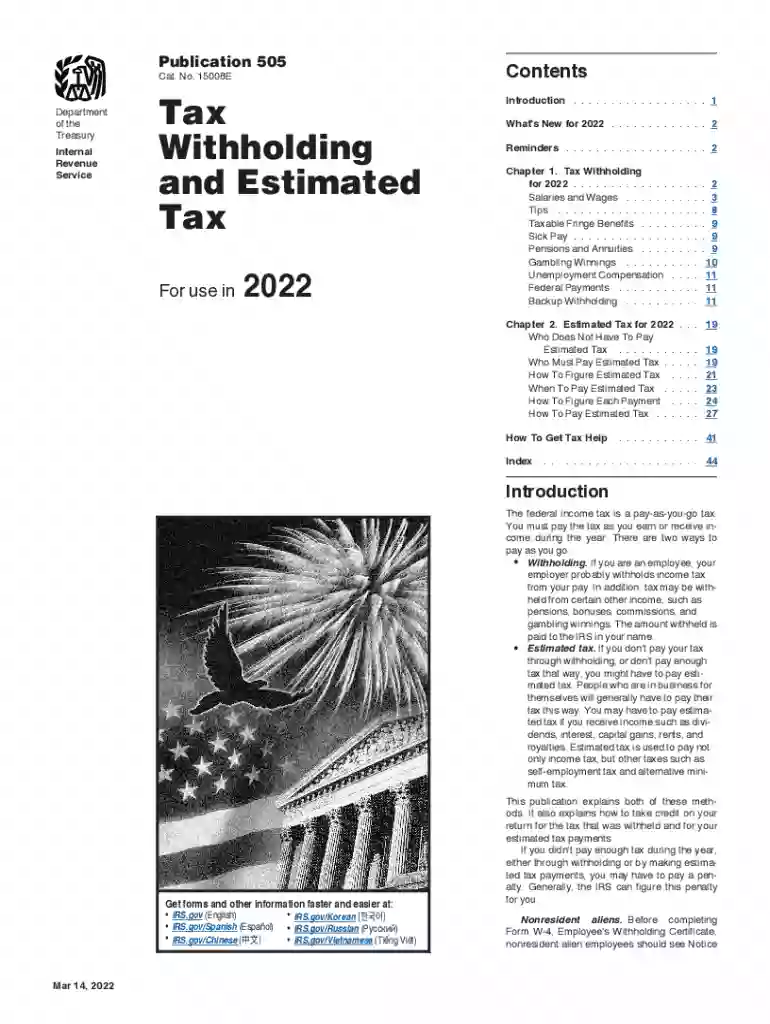
Publication 505 is a crucial document for individuals and businesses in the United States, providing extensive guidance on tax withholding and estimated tax payments. It serves as a comprehensive reference for understanding federal income tax requirements and ensuring compliance with IRS regulations.
Publication 505 can be used to guide taxpayers through the processes of calculating and paying estimated taxes. Here's how you can effectively utilize this IRS resource:
Determine Your Tax Liability: Start by using the worksheets provided in the publication to estimate your annual tax liability.
Withholding Adjustments: Adjust your withholding amounts from wages and salaries using the guidance provided, ensuring you withhold the correct amount to avoid underpayment penalties.
Estimated Tax Payments: Instructions are included on making timely estimated tax payments. Taxpayers can explore various payment options, including online systems like EFTPS.
The publication covers several key elements essential for tax management:
Withholding Rules: Detailed guidance on federal withholding for different income types, including wages and pensions.
Estimated Tax Calculations: Steps for calculating quarterly estimated payments, important for those with income not subject to withholding.
Tax Payment Methods: Various options for tax payments, including electronic payments and traditional forms.
Utilizing Publication 505 involves several critical steps to ensure accurate tax calculations and compliance:
Review Income Sources: Identify all sources of taxable income, including those with irregular earnings.
Use Worksheets: Complete the worksheets in the publication to calculate withholding and projected estimated payments.
Adjust Withholding: Make necessary adjustments to your W-4 Form based on the calculations to optimize withholding amounts.
Schedule Payments: Set up a schedule for making estimated tax payments, considering deadlines and available methods.
Using Publication 505 is beneficial for several reasons:
Avoid Penalties: Correctly managed tax withholding and estimated payments help avoid IRS penalties for underpayment.
Financial Planning: Understanding your tax liabilities enables better budgeting and financial planning.
Legal Compliance: Ensures adherence to IRS guidelines, reducing the risk of audits or legal issues.
Understanding the terminology used in Publication 505 is essential for effective use:
Withholding: The amount of federal income tax withheld from your paycheck by your employer.
Estimated Tax: The method used to prepay taxes on income not subject to withholding.
Tax Liability: The total amount of tax owed to the IRS for the year.
Publication 505 includes specific IRS guidelines to ensure compliance:
Withholding Allowances: Instructions on claiming allowances that reduce the amount withheld.
Safe Harbor Rules: Information on safe harbor provisions that protect taxpayers from penalties under specific conditions.
Penalties and Interest: Details on potential penalties for underpayment and how interest is calculated.
The publication outlines critical dates for tax payment and filing:
Quarterly Estimated Payments: Due on April 15, June 15, September 15, and January 15 of the following year.
Withholding Adjustments: Can be made at any time, but should preferably be adjusted early in the year.
Publication 505 is primarily used by:
Self-Employed Individuals: Those whose income isn't subject to withholding.
Small Business Owners: Ensuring accurate withholding for employees and compliance with tax regulations.
Any Taxpayer with Non-Wage Income: Particularly those with significant income from investments, dividends, or rental properties.
Here are practical scenarios where Publication 505 is applied:
Scenario 1: A freelance graphic designer calculates estimated tax payments using worksheets in the publication to prepay taxes on income from multiple clients.
Scenario 2: A retired individual adjusts pension withholding to account for additional taxable distributions from retirement accounts.
These cases illustrate how diverse users can benefit from the guidance provided in Publication 505.
We've got more versions of the publication 505 form. Select the right publication 505 version from the list and start editing it straight away!
At DocHub, your data security is our priority. We follow HIPAA, SOC2, GDPR, and other standards, so you can work on your documents with confidence.
Mar 30, 2026 Publication 505 explains the two methods for the pay-as-you-go federal income tax, withholding and estimated tax.
IRS Publication 505, Tax Withholding and Estimated Tax(Link for a detailed discussion of the underpayment penalty, for additional information regarding federal
Several recent studies have found elevated levels of perfluorocarboxylic acids (PFCAs) in house dust, suggesting strongly the presence of indoor sources.Read more


