
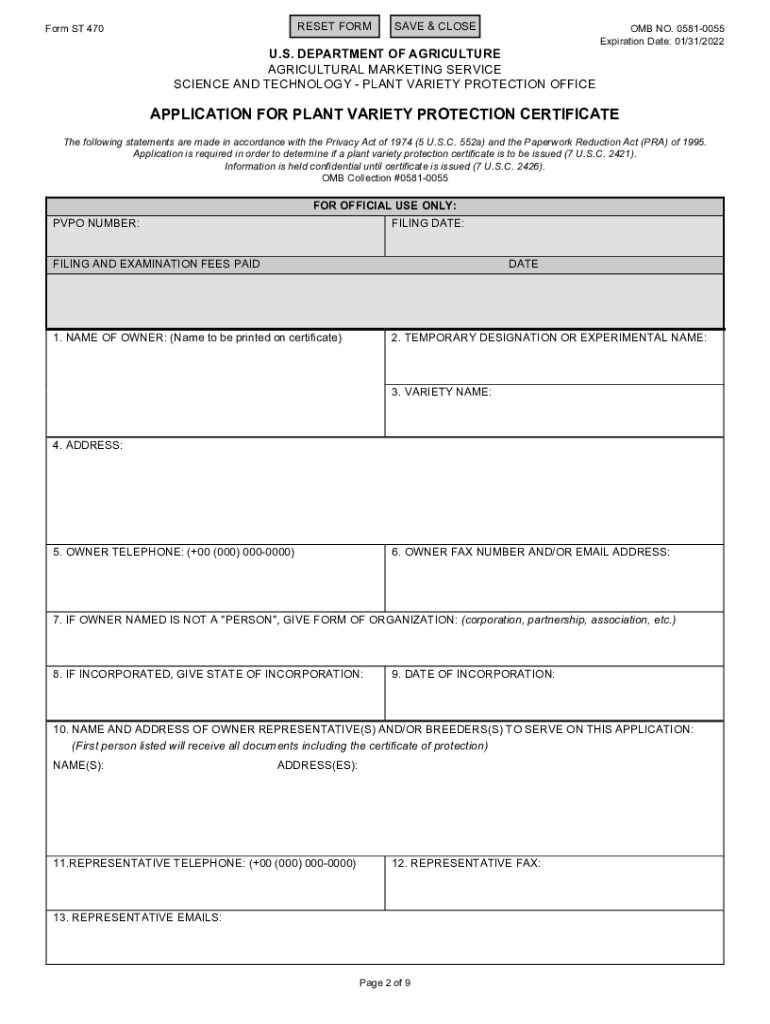







Definition & Purpose of the USDA Plant Variety Protection Certificate
The USDA Plant Variety Protection Certificate is a form administered by the United States Department of Agriculture’s Plant Variety Protection Office (PVPO), designed to offer intellectual property protection to developers of new plant varieties. This certificate ensures that breeders can control the propagation of their new plant variety for up to 20 years. By obtaining this certification, breeders safeguard their investments and encourage continued innovation in agricultural plant production.
Key Roles of the Certificate
- Protection of Breeder Rights: It legally protects breeders from unauthorized reproduction, sale, or marketing of their plant variety.
- Incentivizing Innovation: Provides a stable environment for breeders to recoup research and development costs.
- Market Exclusivity: Allows breeders to capitalize exclusively on their new variety for a specific period.
How to Obtain the USDA Plant Variety Protection Certificate
Acquiring a Plant Variety Protection Certificate involves a detailed process. Applicants must fulfill specific criteria set by the USDA PVPO before they are granted protection.
Steps to Apply
- Eligibility Check: Determine if the plant variety is distinct, uniform, and stable.
- Preparing the Application: Compile documentation on the variety's characteristics, methodology of testing, and clear photographic evidence.
- Submission: Applications can be submitted online via the PVPO Electronic Filing System or through mail with the necessary forms and fees.
- Review Process: The PVPO reviews the application, which may involve additional inquiries or requests for clarification.
- Certificate Issuance: If the application satisfies all requirements, the PVP certificate is issued.
Required Documents
- Breeder’s Declaration: Statement confirming the applicant developed the variety.
- Variety Description: Technical details demonstrating distinctiveness.
- Seed or Plant Specimen: Physical samples for assessment.
Steps to Complete the USDA Plant Variety Protection Application
Completing the USDA PVPO Application for Plant Variety Protection requires careful attention to detail and adherence to the guidelines provided by the USDA.
Detailed Instructions
- Filling Out Personal Information: Start by providing the breeder’s contact information, including name, address, and the organization's details.
- Describing the Plant Variety: Furnish comprehensive descriptions and distinguishable traits that validate its uniqueness.
- Detailing the Propagation Method: Explain the method of reproduction used for the variety.
- Acknowledging Ownership: Include statements of ownership and rights of the variety.
- Confirming Jurisdiction Compliance: Ensure the variety complies with U.S. legal definitions and standards.
Common Mistakes to Avoid
- Incomplete Submissions: Ensure all sections of the form are filled accurately.
- Technical Errors: Missteps in the propagation method description can lead to application rejection.
Legal Use and Importance of the PVP Certificate
The Plant Variety Protection Certificate plays a pivotal role in defining the intellectual property landscape in U.S. agriculture.
Legal Aspects
- Intellectual Property Rights: Grants exclusive control over the new variety's use, enabling legal action against infringers.
- Compliance with ESIGN: Legal documentation and signatures must comply with electronic signature regulations, ensuring authenticity and enforceability.
Economic Impact
- Benefit to Breeders: Facilitates economic growth and innovation, providing leverage in negotiating with commercial partners.
- Industry Stability: Ensures the sustainable development of new agricultural varieties.
Who Typically Uses the USDA Plant Variety Protection Certificate
The certificate is predominantly utilized by agricultural breeders, researchers, and institutions engaged in the development of new plant varieties.


Primary Users
- Commercial Breeders: Large agricultural companies seeking to protect their proprietary varieties.
- University Researchers: Academic institutions developing new species for educational purposes.
- Independent Growers: Small-scale breeders who require protection for niche market varieties.
Industry Sectors Impacted
- Agriculture: Primary sector benefiting from variety development protection.
- Biotechnology Firms: Engage in engineering plant varieties for enhanced traits.
Important Terms and Conditions
Understanding key terminology and conditions associated with the USDA PVPO is crucial for applicants.
Key Terms
- Distinctness: A variety must show clear differences from existing plants.
- Uniformity: The variety must maintain consistent traits across propagation cycles.
- Stability: The variety must remain uniform and consistent over repeated cycles.
Conditions for Protection
- Duration: The protection lasts for 20 years, promoting continued advancement in crop improvements.
- Territorial Limits: Valid within the United States while potentially serving as a basis for international protection.
Examples of Using the USDA PVPO Certificate
The USDA Plant Variety Protection Certificate paves the way for a variety of practical applications in agriculture and research.
Real-World Scenarios
- New Wheat Strains: A breeder develops a wheat strain resistant to drought and obtains certification to prevent unauthorized use.
- Ornamental Plant Varieties: A nursery enhances a flower's color stability and uses PVP for legal protection against reproduction by competitors.
Case Studies
- Successful Niches: Small breeders who focus on unique, high-value plants leverage the PVP system to capitalize on exclusive breeding rights.
Application Process & Approval Time
The USDA PVPO outlines a specific timeline and process for reviewing applications.
Timeline Overview
- Initial Review Phase: Typically one to three months, ensuring all documentation is complete.
- Technical Examination: Additional four to six months, involving detailed assessments.
- Final Decision: Within one year, applicants are notified of approval or need for additional information.
Factors Affecting Approval
- Application Completeness: Thorough and precise submissions reduce processing time.
- Variety Testing: Delays may occur if samples require extensive testing.
By following these step-by-step instructions and understanding the critical aspects of the USDA PVPO Certificate, applicants can navigate the process effectively to secure their intellectual property rights.




