




01. Edit your missouri estimated tax payments online
Type text, add images, blackout confidential details, add comments, highlights and more.

Type text, add images, blackout confidential details, add comments, highlights and more.

Draw your signature, type it, upload its image, or use your mobile device as a signature pad.

Send pay missouri estimated taxes online via email, link, or fax. You can also download it, export it or print it out.
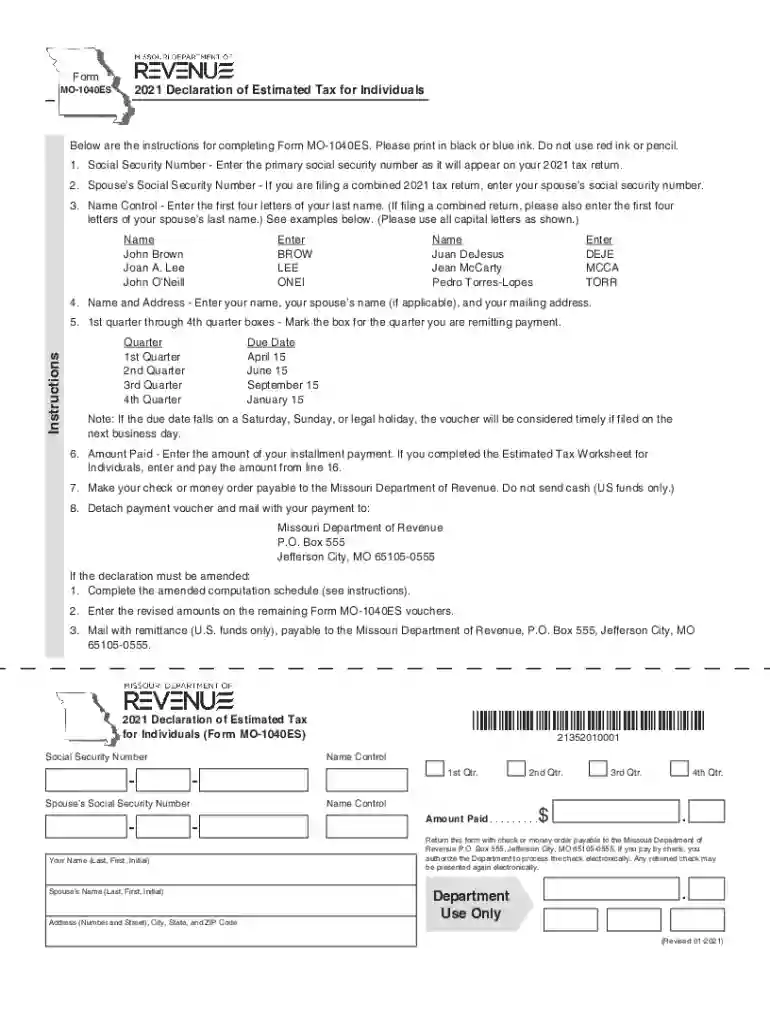
Missouri estimated tax for individuals is a prepayment of income tax on earnings that are not subject to withholding. This typically applies to self-employed individuals, retirees with interest or dividend income, or those with a significant side income. The Missouri Form MO-1040ES is used for this purpose, and it enables taxpayers to spread out tax payments over the year, rather than paying a large sum at tax time. By accurately estimating and paying your taxes quarterly, you can avoid penalties and interest charges that occur from underpayment at the end of the tax year.
Individuals who are likely to owe more than $1000 in taxes that are not withheld typically use Missouri estimated tax forms. This includes self-employed professionals, freelancers, retirees with investment income, and small business owners operating as sole proprietors or within partnerships. Additionally, individuals with substantial income from interest, dividends, alimony, capital gains, or rent might also need to make estimated tax payments. Understanding your income sources and tax obligations is crucial to determine if these payments apply to you.
Gather Necessary Information: You will need your expected income, deductions, and credits for the year. This requires a thorough review of your financial records and an analysis of any changes from previous years.
Calculate Your Estimated Tax: Use the Missouri Estimated Tax Worksheet attached to the form. Include any expected income, calculate total Missouri tax liability, and subtract anticipated withholding and credits.
Complete Payment Vouchers: Missouri Form MO-1040ES comes with payment vouchers for each of the four estimated tax periods. You will fill out a voucher with each payment submission.
Submit Payments on Time: Payments are typically due in April, June, September, and January of the following year. Mark these dates on your calendar to avoid late fees or penalties.
Missouri estimated tax payments are generally due quarterly on the following dates:
These deadlines are critical to avoid penalties for late payments. If the due date falls on a weekend or a public holiday, the deadline is extended to the next business day.
When dealing with Missouri estimated tax, understanding key terms and state-specific rules is essential. Missouri may have different rules compared to the federal government or other states concerning exemptions, deductions, and credits. It’s important to familiarize yourself with terms such as “estimated tax liability,” and “quarterly payments.” You should also know Missouri-specific credits and any recent legislative changes affecting estimated tax calculations.
Failure to comply with Missouri estimated tax requirements can result in significant penalties and interest charges. The state levies penalties for underpayment or failure to pay by the due dates. It’s crucial to estimate accurately and pay your taxes promptly. Errors in reporting or payment can lead to audits or fines, so take care to review calculations and retain documentation for audit purposes.
Here are some practical scenarios where paying Missouri estimated tax is relevant:
Self-Employed Freelancer: Jane is a freelance graphic designer living in Missouri. With no employer withholding income tax, she estimates her income tax quarterly to meet her tax obligations.
Retired Investor: Tom is retired and receives income from stock dividends and rental properties. His income is not directly taxed, requiring him to make quarterly payments.
Small Business Owner: Melissa runs a sole proprietorship and has varying income throughout the year from her business activities. She estimates and pays taxes quarterly to avoid a hefty year-end payment.
Missouri offers several methods for submitting estimated tax payments:
Online Payment: The Missouri Department of Revenue offers electronic payment options via bank transfer or credit card.
Mail Payment: Taxpayers can send payment vouchers along with checks or money orders to the Department of Revenue.
In-Person Payments: Some regional offices allow in-person payments, providing a receipt for documentation purposes.
Each method has its advantages. Online payments are convenient and instantaneous, whereas mail provides a paper trail. Choose the method that best suits your needs and ensures timely receipt of payments.
Missouri estimated tax forms can often be completed using tax preparation software like TurboTax or QuickBooks. These platforms provide step-by-step guidance, automate calculations, and may even file forms electronically. This integration simplifies the process for users by reducing the chance of errors and saving time. It’s especially beneficial for those with complex tax situations requiring precise calculations and documentation.
We've got more versions of the missouri estimated tax payments form. Select the right missouri estimated tax payments version from the list and start editing it straight away!
At DocHub, your data security is our priority. We follow HIPAA, SOC2, GDPR, and other standards, so you can work on your documents with confidence.
The Missouri Department of Revenue accepts online payments including extension and estimated tax payments using a credit card or eCheck.
Feb 1, 2018 The extension will be granted if you complete Form 7004 properly, make a proper estimate of the tax (if applicable), file Form 7004.Read more
Estimated payments, when required, are due quarterly on April 15th, June 15th, September 15th, and January 15th of the following year.Read more


