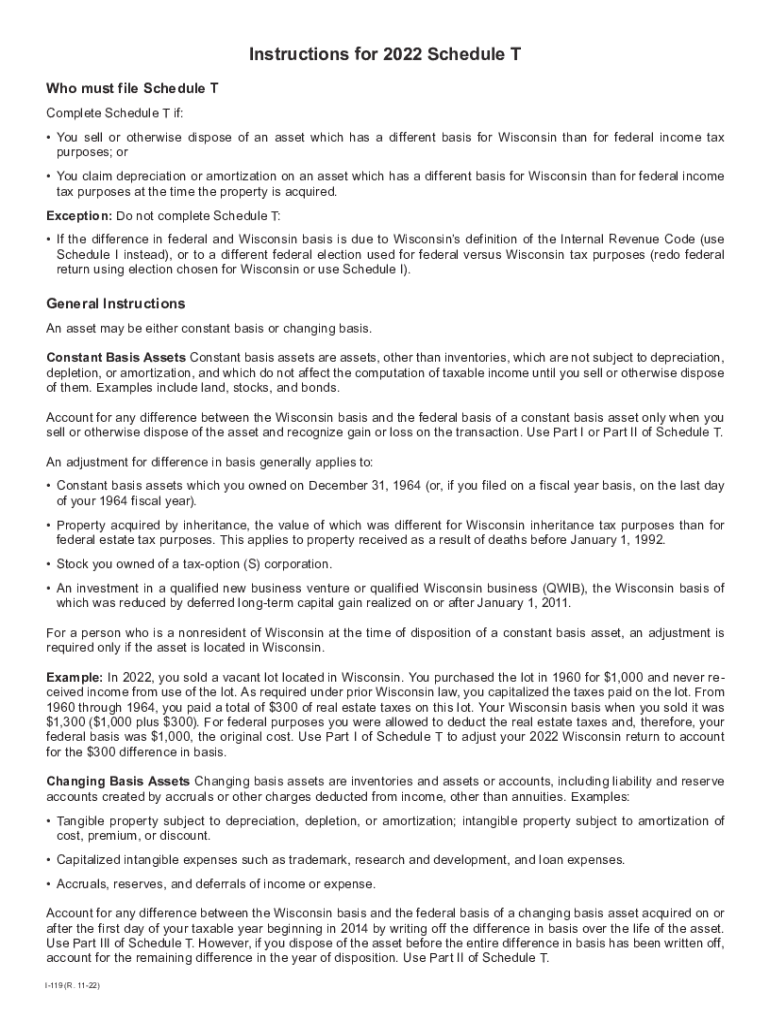
2022 I-119 Instructions for Wisconsin Schedule T. Wisconsin Schedule T Instructions-2026

Get Form
wisconsin schedule t Preview on Page 1

Here's how it works

01. Edit your wisconsin schedule t online
Type text, add images, blackout confidential details, add comments, highlights and more.
02. Sign it in a few clicks
Draw your signature, type it, upload its image, or use your mobile device as a signature pad.
03. Share your form with others
Send wisconsin schedule t 2022 via email, link, or fax. You can also download it, export it or print it out.

How to use or fill out 2022 I-119 Instructions for Wisconsin Schedule T with our platform

Form edit decoration
9.5
Ease of Setup
DocHub User Ratings on G2
9.0
Ease of Use
DocHub User Ratings on G2
  1. Click ‘Get Form’ to open the 2022 I-119 Instructions for Wisconsin Schedule T in the editor.
  2. Begin by reviewing the 'Who must file Schedule T' section. Ensure you meet the criteria for filing based on asset sales or depreciation differences.
  3. Proceed to Part I if you need to adjust capital gains/losses. Fill in the required fields, including holding periods and basis differences, as outlined in the instructions.
  4. If applicable, move to Part II for adjustments related to assets reported on federal Form 4797. Follow the three-step process provided to recompute your figures accurately.
  5. Finally, complete Part III if you have changing basis assets acquired after your taxable year began in 2014. Make sure to document any necessary adjustments over the asset's life.

Start using our platform today for free to streamline your form completion and ensure accuracy!

See more 2022 I-119 Instructions for Wisconsin Schedule T. Wisconsin Schedule T Instructions versions

We've got more versions of the 2022 I-119 Instructions for Wisconsin Schedule T. Wisconsin Schedule T Instructions form. Select the right 2022 I-119 Instructions for Wisconsin Schedule T. Wisconsin Schedule T Instructions version from the list and start editing it straight away!
Versions Form popularity Fillable & printable
2023 4.3 Satisfied (56 Votes)
2022 4.8 Satisfied (21 Votes)
2020 4.2 Satisfied (98 Votes)
2019 4.4 Satisfied (205 Votes)
2018 4.3 Satisfied (166 Votes)
2017 4.1 Satisfied (41 Votes)
be ready to get more

Complete this form in 5 minutes or less

Get form

Got questions?

We have answers to the most popular questions from our customers. If you can't find an answer to your question, please contact us.
Contact us
Persons age 65 or older on December 31, 2023, are allowed an additional personal exemption deduction of $250. Retirees age 62 or older or who are disabled and are full-year residents of Wisconsin may qualify for homestead credit if they meet certain conditions.
As shown in Table 1, for 2022, a single tax- payer with Wisconsin AGI less than $16,990 has a standard deduction of $11,790; for single tax- payers with AGI in excess of $115,240, no standard deduction is provided.
Wisconsin tax on retirement benefits: Wisconsin doesnt tax Social Security or Railroad Retirement benefits. Military pay that is exempt from federal taxation is also exempt in Wisconsin.
Most income is taxable unless its specifically exempted by law. Income can be money, property, goods or services. Even if you dont receive a form reporting income, you should report it on your tax return. Income is taxable when you receive it, even if you dont cash it or use it right away.
Am I required to file a Wisconsin individual income tax return? Filing StatusAge as of the End of YearPart-Year/ Nonresidents Single Under age 65 $2,000 or more Single Age 65 or older $2,000 or more Married filing a joint return Both spouses under 65 $2,000 or more One spouse 65 or older $2,000 or more5 more rows

Security and compliance

At DocHub, your data security is our priority. We follow HIPAA, SOC2, GDPR, and other standards, so you can work on your documents with confidence.

Learn more
ccpa2
pci-dss
gdpr-compliance
hipaa
soc-compliance

People also ask

Who has to file Wisconsin state taxes? Wisconsin requires full-time residents to file a tax return if their gross income in 2024 was $13,930 or more (single filers under age 65), or $25,890 or more (married filing jointly and both spouses are under age 65).
Wisconsin individual income tax rates vary from 3.50% to 7.65%, depending upon marital status and income. Note: Nonresidents and part-year residents must prorate the tax based on the ratio of their Wisconsin income to their federal adjusted gross income.

Related links