
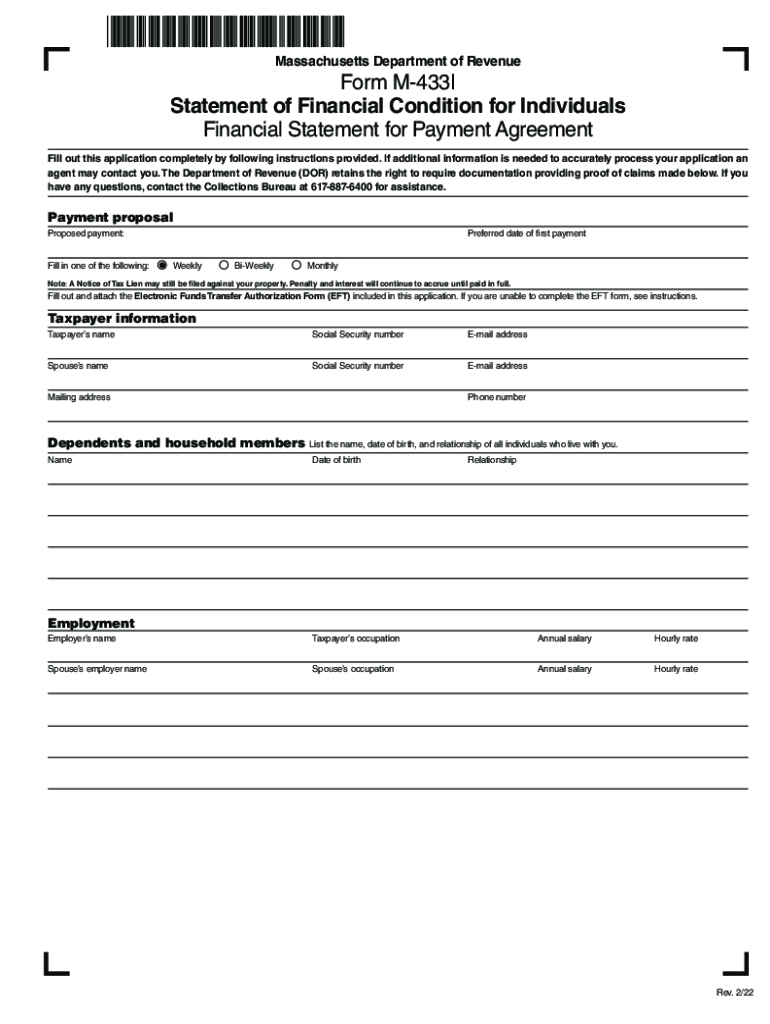







Definition and Meaning of Form 433I
Form 433I, often referred to as the Massachusetts Payment Agreement Application, is an official document used by taxpayers to establish a payment plan for settling tax liabilities with the Massachusetts Department of Revenue. This form is crucial for individuals or businesses facing financial difficulties and unable to pay their full tax debt immediately. It outlines the proposed terms and conditions for payment, including the duration and amount of each installment. Accurate completion of this form is essential, as it influences the acceptance of the payment agreement by the revenue department.
Key Elements of the Form 433I
The Form 433I includes several critical sections that must be completed accurately. The primary components are:
- Financial Information: This section requires detailed data on your income, assets, debts, and expenses. Providing comprehensive and honest details is crucial for assessing eligibility for a payment agreement.
- Monthly Income and Expenses: This part demands a breakdown of monthly earnings and outgoing expenses. It helps the revenue department gauge repayment capacity.
- Proposal Section: Here, taxpayers outline their proposed payment plan, specifying the amount they can regularly pay towards their tax liability.
Each section requires careful attention to detail, as inaccuracies can lead to delays or denial of the payment plan application.
How to Use the Form 433I
Using Form 433I involves several steps. Beginning with the collection of all necessary financial documentation, taxpayers must ensure they have everything required to complete the form. Once the form is filled, it is crucial to review the entire document for accuracy to prevent any potential errors. After submission, taxpayers should routinely track communications from the Massachusetts Department of Revenue to confirm the acceptance of the payment plan or any requested adjustments.
Steps to Complete the Form 433I
- Gather Required Documents: Before starting, collect all financial records, including income proofs, bank statements, and any existing agreements related to debts or credit.
- Accurate Data Entry: Fill in all relevant sections of the Form 433I, ensuring all details are correct and up-to-date.
- Double-check for Errors: Review the completed form for any mistakes or omissions to avoid processing delays.
- Submit the Form: Send the completed form to the Massachusetts Department of Revenue through the specified submission method.
- Follow Up: After submission, respond promptly to any questions or requests for additional information from the department to expedite processing.
Who Typically Uses the Form 433I
The primary users of Form 433I are taxpayers in Massachusetts who owe the Department of Revenue taxes they cannot pay in full by the due date. This typically includes:
- Individuals experiencing financial hardship who cannot cover their tax liabilities.
- Small business owners facing temporary cash flow issues.
- Self-employed individuals who might not have regular income streams and need to spread their tax payments over time.
Understanding who should use the form helps in navigating its application process more effectively.


Legal Use of the Form 433I
Compliance with the legal requirements of Form 433I is fundamental. Taxpayers must ensure that all information provided is truthful and that the proposed payment plan is realistic and within their financial capabilities. Failure to provide accurate information or adhering to the agreed terms may lead to enforcement actions from the Massachusetts Department of Revenue, including garnishments or liens.
Examples of Using the Form 433I
Consider a small business owner, Emily, who faced significant income loss due to unforeseen circumstances and now owes back taxes. By using Form 433I, Emily can propose a payment plan that fits her revised financial capacity, allowing her to spread out her tax debt over a manageable timeline.
Similarly, Mark, a freelancer with varying monthly income, can use Form 433I to accommodate his erratic cash flow, making it easier to pay his taxes without undue financial strain.
These scenarios illustrate how Form 433I can be a valuable tool for individuals and businesses needing to negotiate their tax obligations.
Required Documents for Form 433I
When preparing to complete Form 433I, having the following documents ready will streamline the process:
- Recent pay stubs or income statements: To provide proof of ongoing income.
- Bank statements: For last three months to show available funds and regular withdrawals.
- Current expense bills: Such as utilities, rent, or mortgage, to document monthly outgoings.
- Statements of existing debts: Like loans or credit card balances, to offer a full picture of financial obligations.
These documents are essential for depicting a complete financial profile, critical for Form 433I assessment.




