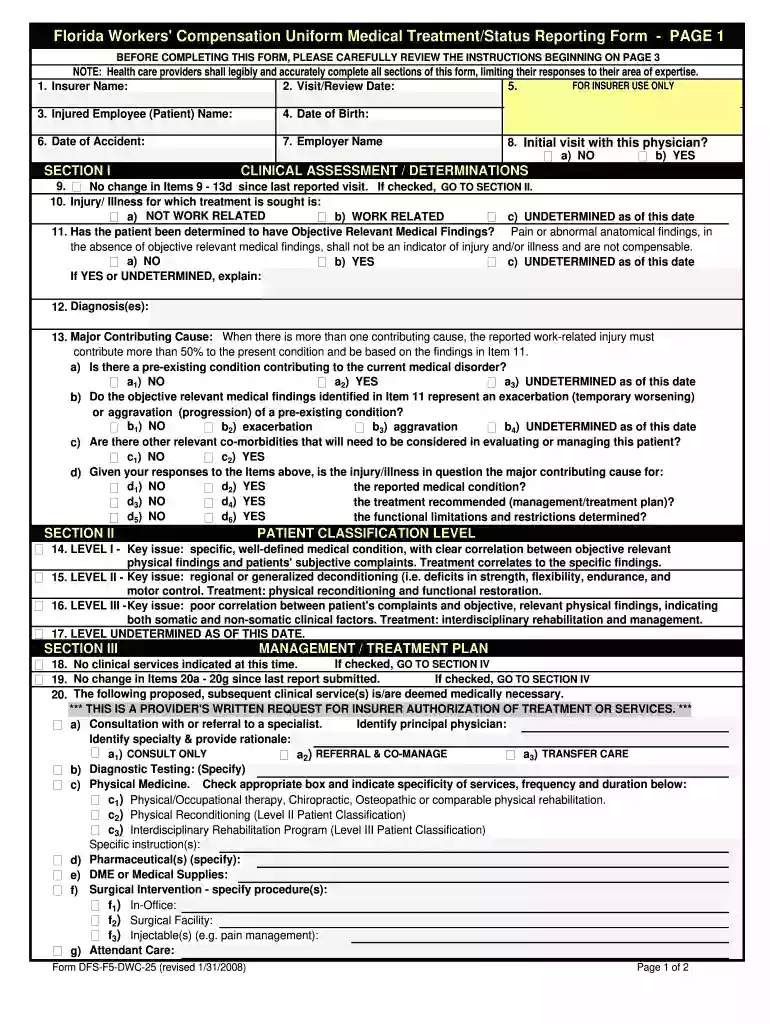
Dwc 25 form 2026

Get Form
dwc 25 form Preview on Page 1

Here's how it works

01. Edit your dwc 25 form online
Type text, add images, blackout confidential details, add comments, highlights and more.

02. Sign it in a few clicks
Draw your signature, type it, upload its image, or use your mobile device as a signature pad.

03. Share your form with others
Send dwc 25 form pdf via email, link, or fax. You can also download it, export it or print it out.

Definition & Meaning of the DWC 25 Form

The DWC 25 form, officially known as the Florida Workers' Compensation Uniform Medical Treatment/Status Reporting Form (DFS-F5-DWC-25), is a critical document in the Florida workers' compensation system. It is utilized by healthcare providers to monitor and report the medical treatment and progress of injured employees. This form plays a vital role in ensuring that insurers and employers can track treatment effectiveness and understand the injury's impact on the employee's ability to work.

The DWC 25 form includes multiple sections that detail various aspects of a patient's treatment. For example, it includes clinical assessments, management or treatment plans, functional limitations, and declarations of maximum medical improvement. By completing this form accurately, healthcare providers facilitate a systematic approach to workers' compensation claims, ensuring compliance with state regulations.

Key Sections of the DWC 25 Form

  • Clinical Assessment: This section provides a summary of the employee's condition and any medical evaluations conducted.
  • Treatment Plans: Detailed documentation of the recommended management strategies is essential for ensuring that the injured worker receives appropriate care.
  • Functional Limitations: Assessment of any restrictions on the employee's ability to perform work-related tasks is documented here.
  • Maximum Medical Improvement (MMI): This vital metric indicates when an employee's condition has stabilized, marking the end of medical treatment.

Steps to Complete the DWC 25 Form

Completing the DWC 25 form involves structured steps to ensure accuracy and compliance with Florida's workers' compensation guidelines.

  1. Gather Required Information: Collect all relevant patient information, including the employee's name, contact details, and claim number.
  2. Clinical Evaluation: Assess the employee's medical status, documenting any diagnoses and treatments received.
  3. Detail Treatment Plan: Clearly outline the management strategies being implemented, including medications, therapies, and follow-up appointments.
  4. Assess Functional Limitations: Identify any work-related restrictions resulting from the injury to inform employers about the employee’s capabilities.
  5. Determine Maximum Medical Improvement: Indicate if the employee has reached MMI and describe any long-term implications for their health and work capacity.

Important Considerations When Filling Out the Form

  • Ensure all sections are filled out completely to avoid delays in the claims process.
  • Utilize clear and concise language to enhance readability.
  • Double-check all numerical data, such as dates and treatment codes, for accuracy.

Who Uses the DWC 25 Form

The DWC 25 form is primarily used by various stakeholders in the workers' compensation ecosystem, including:

  • Healthcare Providers: Physicians, therapists, and other medical professionals complete the form to report on patients’ treatment progress and compliance with medical protocols.
  • Insurers: Workers' compensation insurers rely on this information to evaluate claims, ensure timely medical care, and make compensation decisions.
  • Employers: Employers need to understand the treatment process and anticipate the employee's return to work in a safe and compliant manner.

Legal Use of the DWC 25 Form

The DWC 25 form is legally mandated under Florida workers' compensation law, which requires healthcare providers to submit this documentation as part of the claims process. Failure to use the form correctly could lead to delays in claims processing or potential penalties for non-compliance.

Implications of Non-Compliance

  • Delays in Compensation: Inaccuracies or omissions can result in slowed processing of workers' compensation claims.
  • Legal Consequences: Providers who do not submit the DWC 25 form correctly may face legal ramifications, including fines or sanctions.
  • Impact on Patient Care: Delays in paperwork can prolong the time an employee waits to receive necessary benefits or treatment.

Examples of Using the DWC 25 Form

Consider the following scenarios where the DWC 25 form is critical:

  • A Construction Worker Injury: An employee sustains a back injury on-site. Their physician fills out the DWC 25 form to document the severity of the injury, the treatment regimen involving physical therapy, and the anticipated timeline for recovery.
  • Office Worker with Repetitive Strain: An office employee experiences chronic pain due to repetitive motion. The healthcare provider utilizes the DWC 25 to outline the treatments being administered, such as ergonomic adjustments and therapeutic exercises, while noting the employee’s functional limitations.

Importance of Timely Submission

Timely submission of the DWC 25 form helps expedite necessary benefits for injured workers and ensures that they receive prompt medical attention, thereby enhancing recovery outcomes and reinstating their ability to work.

Key Elements of the DWC 25 Form

Understanding the key elements of the DWC 25 form is crucial for effective completion.

  • Identification Sections: This includes essential details of the injured employee and provider.
  • Medical History: A comprehensive overview of the employee's medical history relevant to the injury being reported.
  • Assessment and Treatment Details: Specific information on assessed conditions and proposed treatment plans.
  • Signature Authorizations: Validation through signatures from the healthcare provider and, in some cases, the employee to ensure authenticity.

Documentation and Record-Keeping

  • Maintain copies of completed DWC 25 forms for record-keeping.
  • Ensure that both electronic and physical versions are stored securely to protect patient privacy and comply with regulatory requirements.

Conclusion

Navigating the intricacies of the DWC 25 form can significantly influence the workers' compensation process for both employees and employers. Familiarity with its structure and purpose not only aids in compliance but also promotes effective communication among all parties involved. Understanding this document is pivotal for ensuring that employees receive the requisite medical attention and benefits following an injury.

See more dwc 25 form versions

We've got more versions of the dwc 25 form form. Select the right dwc 25 form version from the list and start editing it straight away!
Versions Form popularity Fillable & printable
2008 4.8 Satisfied (85 Votes)
2006 4.4 Satisfied (417 Votes)
be ready to get more

Complete this form in 5 minutes or less

Get form

Got questions?

We have answers to the most popular questions from our customers. If you can't find an answer to your question, please contact us.
Contact us
The purpose of obtaining an exemption is for officers of a corporation or members of a limited liability company to exclude themselves as employees from workers compensation insurance laws.
The provider must complete form DFS-F5-DWC-25 to request authorization for a medical treatment plan, to communicate to the carrier an injured employees medical status, to document the injured employees date of Maximum Medical Improvement (MMI date), and to document a Permanent Impairment Rating (PI Rating).
Employers with four (4) or more employees, including business owners who are corporate officers or Limited Liability Company (LLC) members, must have workers compensation coverage.
Form DWC-1 Employers First Report of Injury or Occupational Disease . The employer is required to submit this form with EMPLOYERS and the injured employee or the injured employees attorney within eight days after the employees absence from work or notice of the Injury or Occupational Disease.
7 Common Workers Compensation Claim Injuries Lacerations. Deep cuts or tears in skin or flesh. Sprains and strains. Sprains are stretched or torn ligaments, while strains are stretched or torn muscles and tendons. Contusions. Burns. Eye Injuries. Fractures. Cumulative or Continuous Trauma.

People also ask

Division of Workers Compensation (DWC)
(DWC-25): Department of Financial Services form used by the authorized treating healthcare provider to document the physicians independent or consultative opinion related to an injured employees disability, which assist in determining compensability, request authorization of treatment or services, reports injured
Following the Workers Comp Claim Process Request an Employees Claim for Workers Compensation Benefits form from your supervisor (its also known as a DWC 1 form). Your employer must give or mail you a claim form within one working day after learning about your injury or illness.

blank dwc 25