Hawaii affidavit 2026

Get Form
affidavit for proof of residence hawaii Preview on Page 1

Here's how it works

01. Edit your affidavit for proof of residence hawaii online
Type text, add images, blackout confidential details, add comments, highlights and more.

02. Sign it in a few clicks
Draw your signature, type it, upload its image, or use your mobile device as a signature pad.

03. Share your form with others
Send hawaii affidavit via email, link, or fax. You can also download it, export it or print it out.

How to use or fill out Hawaii Affidavit with our platform

Form edit decoration
9.5
Ease of Setup
DocHub User Ratings on G2
9.0
Ease of Use
DocHub User Ratings on G2
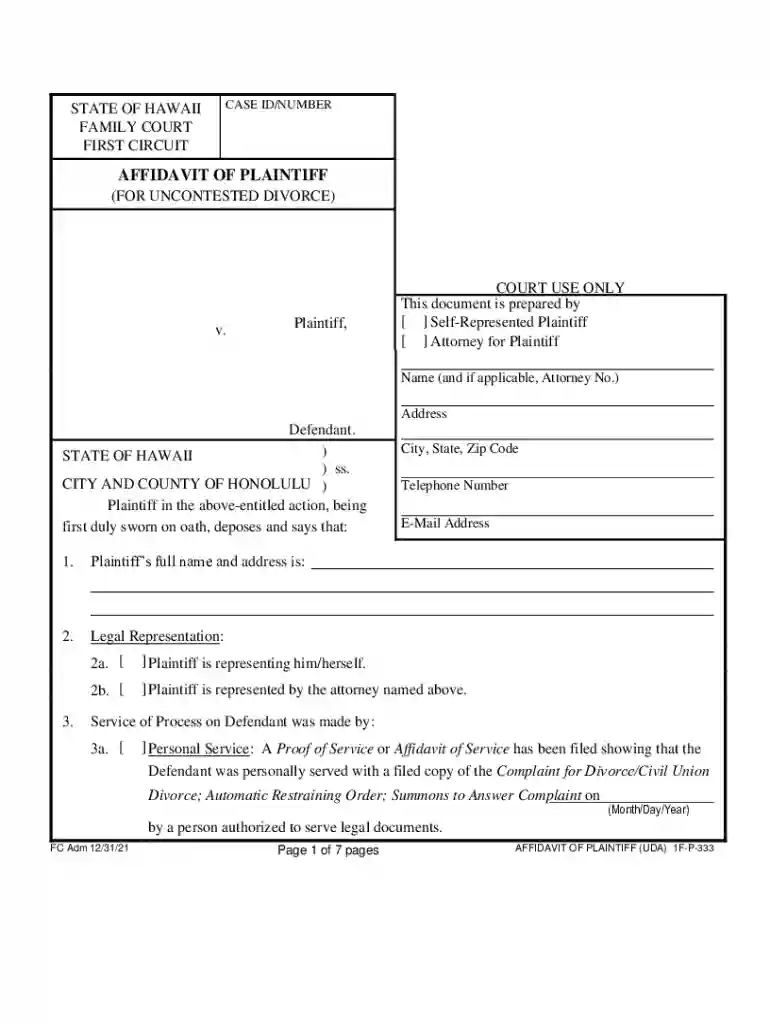
  1. Click ‘Get Form’ to open the Hawaii Affidavit in the editor.
  2. Begin by entering your case ID/number at the top of the form. This helps in identifying your specific case.
  3. Fill in your full name and address in the designated fields. Ensure accuracy as this information is crucial for court records.
  4. Indicate whether you are self-represented or have an attorney by checking the appropriate box.
  5. Complete the service of process section, detailing how the defendant was served, whether by personal service, mail, or publication.
  6. Proceed to fill out sections regarding jurisdiction and details about your marriage or civil union, including dates and locations.
  7. Review financial statements and ensure all necessary documents are acknowledged and signed where required.
  8. Finally, sign the affidavit before a notary public to validate your statements and submit it as instructed.

Start using our platform today for free to streamline your document editing and signing process!

See more hawaii affidavit versions

We've got more versions of the hawaii affidavit form. Select the right hawaii affidavit version from the list and start editing it straight away!
Versions Form popularity Fillable & printable
2021 4.8 Satisfied (126 Votes)
2014 4.3 Satisfied (60 Votes)
be ready to get more

Complete this form in 5 minutes or less

Get form

Got questions?

We have answers to the most popular questions from our customers. If you can't find an answer to your question, please contact us.
Contact us
An affidavit is a written statement made by an affiant. It is a legal document detailing knowledge the person has or facts as they know them to be. Above all, an affidavit is done voluntarily without coercion. In California, an affidavit is signed in the presence of a notary public.
Each notarization of an affidavit must be logged with: Entry number. Date and time of notarization. Type of document docHubd (i.e., an affidavit) Name, address, and competent evidence of identity of the affiant. Signatures of the affiant and the notary public.
3. What are the requirements of an Affidavit? Full name of the deponent and their signature. Statement indicating whether the affidavit has been sworn or not. Date and place where the affidavit is being signed. Designation and full name of the Notary or Magistrate (person attesting the affidavit)
When you need an affidavit you will need to have the document docHubd in order for it to be legally binding. This can be done with a traditional in-person or mobile notary, or an affiant can provide their statement using Remote Online Notarization (RON).
What to include in your affidavit. Title. This is either your name (Affidavit of Jane Doe) or the specific case information. Statement of identity. The next paragraph tells the court about yourself. Statement of truth. Statement of facts. Closing statement of truth. Sign and docHub.

Security and compliance

At DocHub, your data security is our priority. We follow HIPAA, SOC2, GDPR, and other standards, so you can work on your documents with confidence.

Learn more
ccpa2
pci-dss
gdpr-compliance
hipaa
soc-compliance
be ready to get more

Complete this form in 5 minutes or less

Get form

People also ask

You can make an affidavit at any police station, where an officer will provide you with a standard form and help you complete the process.
The legal significance of affidavits The written statement generally is signed both by the person making the statement (the affiant) and by the person attesting the document, usually a person who is legally authorized, such as a notary public or certain court or government officers.

Related links