




01. Edit your ma w4p form online
Type text, add images, blackout confidential details, add comments, highlights and more.

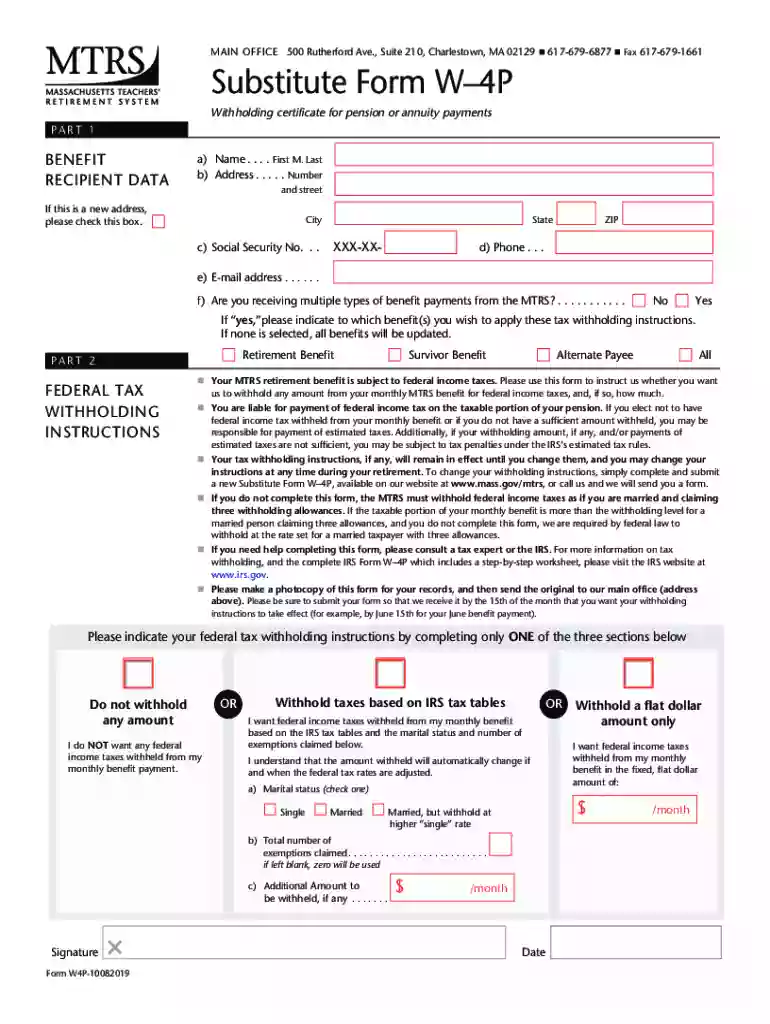
Type text, add images, blackout confidential details, add comments, highlights and more.

Draw your signature, type it, upload its image, or use your mobile device as a signature pad.

Send it via email, link, or fax. You can also download it, export it or print it out.
The Substitute Form W-4P is used primarily for tax withholding purposes related to pension or annuity payments. It serves as a certificate allowing individuals, particularly benefit recipients like retirees, to specify federal tax withholding preferences. The Massachusetts Teachers' Retirement System (MTRS) adopts this form to facilitate the proper deduction of taxes from monthly benefits. Understanding the form’s purpose is crucial for ensuring accurate withholding, avoiding unexpected tax bills, and complying with federal regulations.
Filling out the MA W-4P involves several critical steps to ensure accurate tax withholding:
The process is straightforward but requires attention to detail to avoid mistakes that could lead to incorrect tax withholding.
Several components are essential to correctly completing the MA W-4P:
Each segment of the W-4P has a distinct function and contributes to the form's overall effectiveness in ensuring precise tax deductions.
The form must be used in accordance with both federal and state regulations. It serves to legally document an individual's tax withholding directives concerning pension and annuity incomes. The W-4P aligns with the IRS guidelines under the ESIGN Act, making electronic submissions valid. Massachusetts state law incorporates the form's use within the scope of public retirement benefits. It is critical to acknowledge how these legal frameworks impact the form’s use and compliance.
While the W-4P serves a federal function, Massachusetts implements specific provisions:
Understanding these nuances allows for a more tailored approach when completing your W-4P forms in Massachusetts.
The IRS provides standards for completing the W-4P to guarantee coherence with national tax systems. These guidelines ensure that pension and annuity withholdings meet expected requirements and help avoid penalties. Highlights from the IRS requirements include:
Ensuring compliance with these guidelines is essential for preventing tax issues.
Failing to accurately complete or submit the MA W-4P can lead to several consequences:
Remaining vigilant in completing the form can help avoid these legal and financial repercussions.
There are various ways to submit the MA W-4P, offering flexibility:
Selecting the correct submission method is essential for ensuring your withholding instructions are processed promptly and accurately.
The W-4P form does not have a fixed deadline like tax returns, but certain timelines are critical:
Being aware of these timeframes enhances compliance and financial planning.
To complete the MA W-4P, certain documents may be necessary:
Having these documents ready streamlines the form completion process, ensuring all required information is available.
We've got more versions of the ma w4p form form. Select the right ma w4p form version from the list and start editing it straight away!
At DocHub, your data security is our priority. We follow HIPAA, SOC2, GDPR, and other standards, so you can work on your documents with confidence.
HOW TO CLAIM YOUR WITHHOLDING EXEMPTIONS. 1. Your personal exemption. Write the figure 1. If you are age 65 or over or will be before next year,Read more
APPLICATION PROCESS. If you are actively employed or on a leave of absence you may file your application to retire up to 120 days before you plan to retire.Read more


