







Definition & Meaning
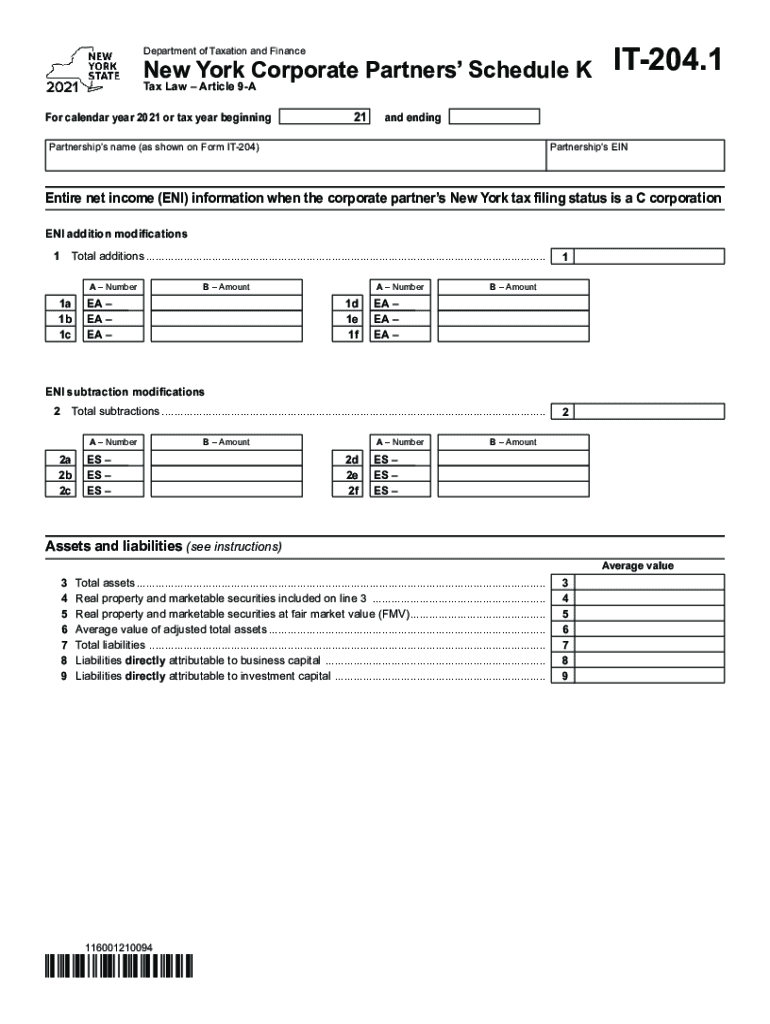
The IT-204.1, also known as the New York Corporate Partners' Schedule K, is a tax form used for reporting by partnerships. It is specific to New York's tax code under Article 9-A and is utilized to outline a partnership's entire net income (ENI), asset and liability information, investment capital, and apportionment data. This form is critical for partnerships aiming to comply with state tax regulations, ensuring that they provide a comprehensive view of their financial activities, which includes detailing various income sources and applicable deductions. Partnerships must understand the full scope of this form to accurately report their financials.
Steps to Complete the IT-204.1
-
Gather Necessary Documents: Begin by collecting all relevant financial documents, including income statements, balance sheets, and other records that detail the partnership's annual financial activities.
-
Calculate Entire Net Income (ENI): Use the details from your financial documents to compute the ENI. This involves adjusting federal income according to New York-specific tax rules.
-
Detail Investment Capital: Report any investment capital the partnership holds. This includes stocks, bonds, and other securities, along with their acquisition and market values.
-
List Additions and Subtractions to ENI: Identify and document any items that need to be added or subtracted from the ENI as per state guidelines.
-
Complete Sections on Interest Deductions: Allocate and deduct interest expenses from income as specified in the form's instructions.
-
Verify Apportionment Data: If applicable, provide details about how income is apportioned across states to ensure precise tax liability calculation.
-
Review for Accuracy: Double-check all entered data for any errors or omissions before submitting the form.
Important Terms Related to IT-204.1
-
Entire Net Income (ENI): This is the base measure of a partnership's income for tax purposes after adjustments required by state taxing authorities.
-
Investment Capital: Refers to assets the partnership holds for investment purposes, which bear an impact on taxable income.
-
Apportionment: A method of dividing income among different jurisdictions for tax purposes, crucial for partnerships operating in multiple states.
-
Article 9-A: The section of New York State tax law concerning franchise taxes on business corporations, under which the IT-204.1 operates.
State-Specific Rules for the IT-204.1
New York's tax code under Article 9-A predominantly governs the IT-204.1 requirements. Partnerships must adhere to state-specific regulations concerning adjustments to federal income figures to calculate the ENI. Additionally:
-
Apportionment for Multi-State Operations: Partnerships conducting business in multiple states need to accurately apportion their income according to New York's statutory guidelines.
-
Interest Expense Deductions: Partnerships must adhere to specific state rules determining how much of their interest expenses are deductible from their taxable income.
IRS Guidelines
The IT-204.1 is aligned with IRS regulations but includes New York-specific modifications. Partnerships must proceed with:
-
Federal Adjustments Compliance: Ensuring that the federal income is adjusted in line with New York standards.
-
Coordination with IRS Filings: Maintaining consistency with federal filings while incorporating state-required changes for the IT-204.1.
Filing Deadlines / Important Dates
Compliance with filing deadlines is crucial. The IT-204.1 should typically be submitted along with the partnership's tax returns by the 15th day of the third month following the end of the partnership's taxable year. Partners should account for:
- State Extensions: If needed, requesting a filing extension from New York State to avoid penalties for late submission.
Required Documents
For successful completion, partnerships need to prepare:
-
Financial Statements: Income, balance sheets, and cash flow statements.
-
Records for Investment Capital: Documentation supporting asset valuations.
-
Interest Expense Documentation: Records to substantiate deductions claimed.
-
Apportionment Details: Evidence supporting any multi-jurisdictional income claims.
Penalties for Non-Compliance
Failure to accurately file the IT-204.1 can lead to:
-
Monetary Penalties: Financial fines for late or incorrect filings.
-
Interest on Unpaid Taxes: Accrual of interest on taxes due resulting from filing inaccuracies or underpayments.
Understanding the implications of non-compliance is critical for partnerships to mitigate potential financial risks.




