
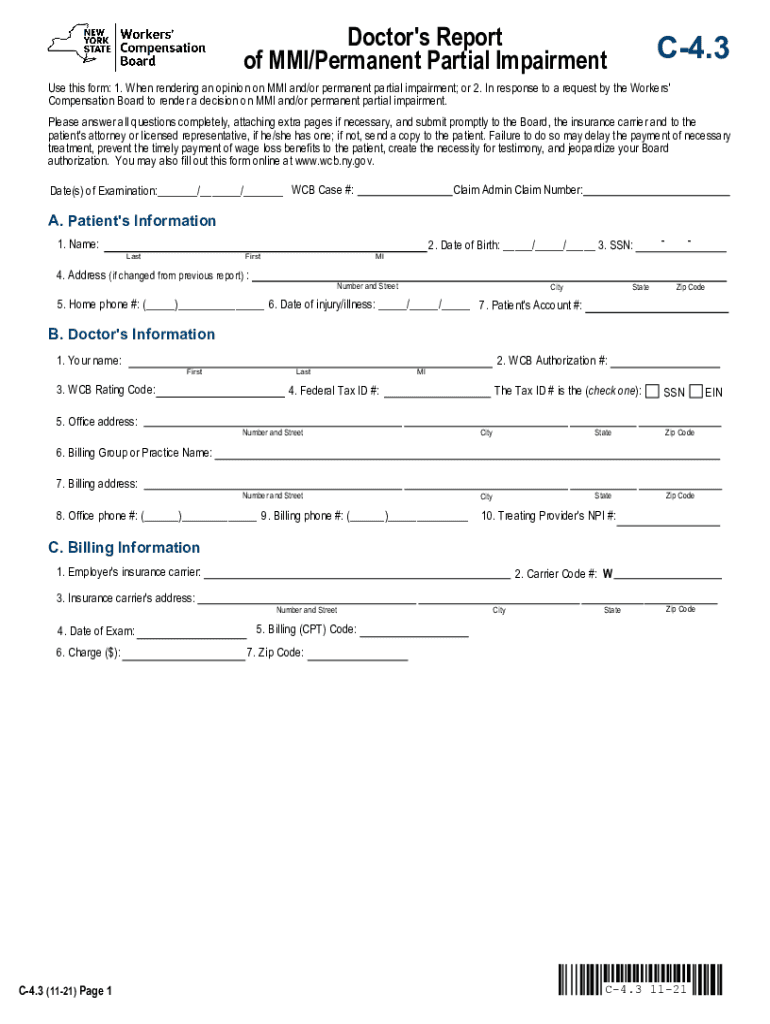







Definition and Purpose of the C-4.3 Form
The C-4.3 form, officially known as the Doctor's Report of MMI/Permanent Impairment, plays a vital role in workers' compensation cases. It is used to document a patient's Maximum Medical Improvement (MMI) and any resulting Permanent Partial Impairment. This form serves as a comprehensive record of a worker's recovery progress and any permanent limitations resulting from a workplace injury. The attending physician is responsible for completing this form, which includes detailed assessments of the patient's current medical status, anticipated recovery, and expected long-term outcomes.
Obtaining the C-4.3 Form
Obtaining the C-4.3 form often involves collaboration between medical practitioners, patients, and employers. These forms are typically distributed by state workers' compensation boards and may be available for download from their official websites. Medical facilities and practitioners who frequently deal with work-related injuries usually have copies readily available. Additionally, employers might provide this form as part of the process when a claim is filed, ensuring that injured workers have access when needed.
Steps to Complete the C-4.3 Form
- Patient Details: Start by filling in the patient's personal information, including their full name, date of birth, and contact details.
- Case Information: Include specific details of the workers' compensation case, like claim number and employer information.
- Medical History and Examination: Detail the patient's medical history relevant to the current injury or condition, including dates and findings from recent examinations.
- MMI Assessment: Provide an evaluation of whether the patient has reached MMI, explaining the reasoning and citing evidence or diagnostics that support this assessment.
- Impairment Evaluation: Describe any permanent impairments resulting from the injury, including specific functional limitations.
- Recommendations and Signatures: Conclude with the physician's recommendations for ongoing treatment or rehabilitation and obtain the necessary signatures from the attending physician.
Importance of the C-4.3 Form
The C-4.3 form is crucial in the workers' compensation process as it directly impacts compensation decisions. It provides the necessary documentation to determine the extent of an employee's recovery and any permanent impairments, influencing the benefits they may receive. Timely and accurate completion of this form can expedite the settlement process and ensure that workers receive the necessary support and coverage for their ongoing medical needs. Furthermore, it helps prevent disputes by offering a thorough medical analysis that all parties can reference.
Key Elements of the C-4.3 Form
- Patient and Case Information: Foundational details identifying the worker and their case.
- Medical Assessment: In-depth analysis of medical findings and status.
- MMI and Impairment Ratings: Determination of recovery status and any long-term impairments.
- Physician's Evaluation and Recommendations: Professional insights and suggestions for future care.
- Signatures and Dates: Verification by the healthcare provider completing the report.
Legal Use and Compliance
The C-4.3 form must adhere to strict guidelines to maintain legal integrity. All information should be accurate and provided by an authorized medical professional. Compliance with these requirements ensures the form is admissible in workers' compensation hearings and proceedings. Failure to comply with submission guidelines or intentional inaccuracies can lead to legal penalties, affecting both the medical provider and the claimant.
State-Specific Rules and Variations
Different states may implement variations of the C-4.3 form based on regional workers' compensation laws. These differences might include specific sections related to state-specific medical evaluations or additional documentation requirements. It is critical for both medical professionals and claimants to be aware of these variations to ensure compliance and accuracy in submissions. Consulting state workers' compensation boards or legal professionals can provide clarity on specific state requirements.
Digital vs. Paper Version of the C-4.3 Form
The C-4.3 form can be completed in both digital and paper formats. The digital version offers advantages such as easy modification, cleaner submissions, and more streamlined sharing between parties involved. Many healthcare facilities are transitioning to digital report submissions, minimizing the chances of errors associated with handwriting and manual entries. However, in some regions or specific cases, a paper version may still be required due to local administrative practices or technological limitations. Always verify the accepted format with the relevant authorities or your organization's protocols.
By addressing these core aspects of the C-4.3 form, medical professionals and claimants can ensure accurate and effective submissions, thereby facilitating a smoother workers' compensation process.




