
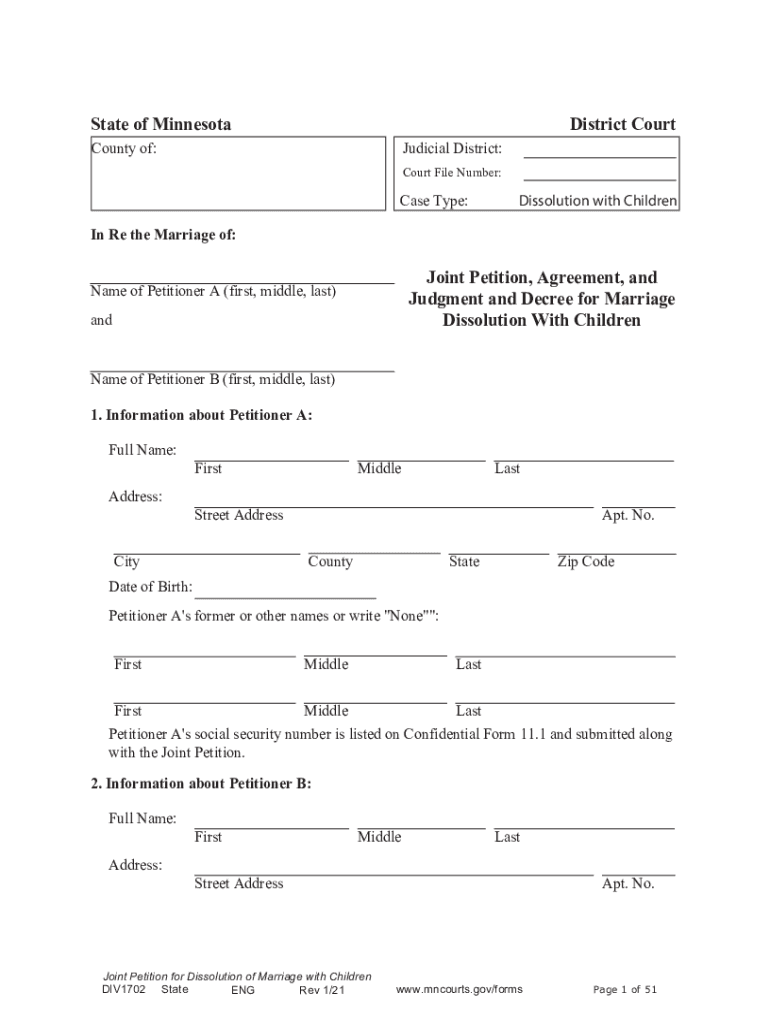







Definition and Meaning of the Minnesota Petition Judgment
A Minnesota Petition Judgment is a formal legal document used in the state of Minnesota to request the court's final decision on specific matters related to family law. This judgment is often associated with the dissolution of marriage, including details about custody arrangements, division of property, spousal support, and other critical elements that require judicial approval. It outlines the terms agreed upon by both parties or, in cases of disagreement, the court's determination.
The significance of this document lies in its legal authority. Once entered by the court, the judgment becomes a binding decree, enforceable by law. It provides both parties with clarity and enforceable terms, ensuring legal compliance and protection of the rights and responsibilities outlined within.
How to Use the Minnesota Petition Judgment
Using the Minnesota Petition Judgment involves understanding its sections and effectively navigating each part to ensure all legal aspects are addressed. Here’s how to make the most of this document:
- Consult Legal Counsel: Engaging with an attorney is advisable to interpret complex legal language and ensure the judgment aligns with state laws.
- Review Relevant Details: Carefully evaluate each section, including property division, custody agreements, and support obligations to ensure accuracy and fairness.
- Negotiate Terms: Parties can negotiate the terms before finalizing the judgment, either independently or through mediation, to reach a mutually satisfactory resolution.
By completing the Minnesota Petition Judgment accurately and submitting it to the court, individuals can make sure that their rights and duties are legally upheld.
Steps to Complete the Minnesota Petition Judgment
Completing a Minnesota Petition Judgment requires meticulous attention to detail and adherence to procedural requirements. Follow these steps:
- Gather Necessary Information: Assemble all pertinent information about personal details, financial statements, child custody arrangements, and any previously agreed-upon terms.
- Draft the Initial Petition: Create a draft using the appropriate legal language and format, focusing on completeness and accuracy.
- Seek Legal Review: Present the draft to a qualified attorney for review and necessary adjustments to meet legal standards.
- File with the Court: Submit the completed petition to the appropriate Minnesota district court, ensuring all supporting documents are included.
- Attend Hearing (if required): Be prepared to attend any court hearings where the judge reviews and approves the judgment terms.
Attention to detail and thorough preparation are critical for successfully completing the petition judgment.
Key Elements of the Minnesota Petition Judgment
Understanding the key elements of the Minnesota Petition Judgment is crucial for compliance and accuracy. The primary components include:
- Personal Information: Details about both parties, including names, addresses, and dates of birth.
- Children’s Details: Information on any children involved, including custody and visitation schedules.
- Asset and Debt Division: Outline of how marital property and debts will be divided.
- Spousal Maintenance: Agreement on any alimony payments, specifying amounts and payment schedules.
- Insurance and Benefits: Provisions for maintaining health insurance and dividing retirement benefits.
Each element must be addressed with precision to ensure a legally sound judgment.
Legal Use of the Minnesota Petition Judgment
The legal use of a Minnesota Petition Judgment extends to various contexts, primarily within family law. It serves as the legal authority for:
- Enforcing Custody and Support Orders: Ensuring compliance with child custody, visitation rights, and support payments.
- Resolving Disputes: Utilizing the judgment as a reference in post-divorce disputes to resolve disagreements.
- Modifying Terms: As life circumstances change, parties may request modifications to the judgment through legal channels.
Judges, mediators, and legal practitioners often use this document to guide decisions and enforce state family laws.
Important Terms Related to the Minnesota Petition Judgment
Familiarity with specific terminology can help in understanding and completing the Minnesota Petition Judgment:
- Petitioner/Respondent: The person initiating the petition and the person responding.
- Dissolution: The legal term for ending a marriage, synonymous with divorce.
- Custodian: The person awarded legal or physical custody of the child.
- Spousal Maintenance: Often referred to as alimony, it is the support one spouse pays to another post-divorce.
These terms help clarify actions and obligations within the judgment context.
State-Specific Rules for the Minnesota Petition Judgment
Minnesota has specific regulations governing the petition judgment process. Key rules include:
- Residency Requirements: One or both parties must meet the residency conditions of living in Minnesota for a specified duration before filing.
- Mandatory Mediation: In cases involving minor children, the state may require mediation before accepting the petition.
- Formal Notifications: Legal requirements demand that both parties receive adequate notice of proceedings and judgment terms.
Understanding these state-specific rules ensures procedural compliance and legal recognition of the judgment.
Examples of Using the Minnesota Petition Judgment
Real-world examples can illustrate the practical application of a Minnesota Petition Judgment:
- Divorce with Children: A couple files a joint petition outlining shared custody arrangements and equal division of assets, later approved by the court.
- Disputed Child Support: An individual petitions for a modification in support payments, citing changes in employment status, which the court updates in the judgment.
These scenarios demonstrate how the judgment functions as a resolution tool for various familial and financial disputes.




