




01. Edit your employment development department california online
Type text, add images, blackout confidential details, add comments, highlights and more.

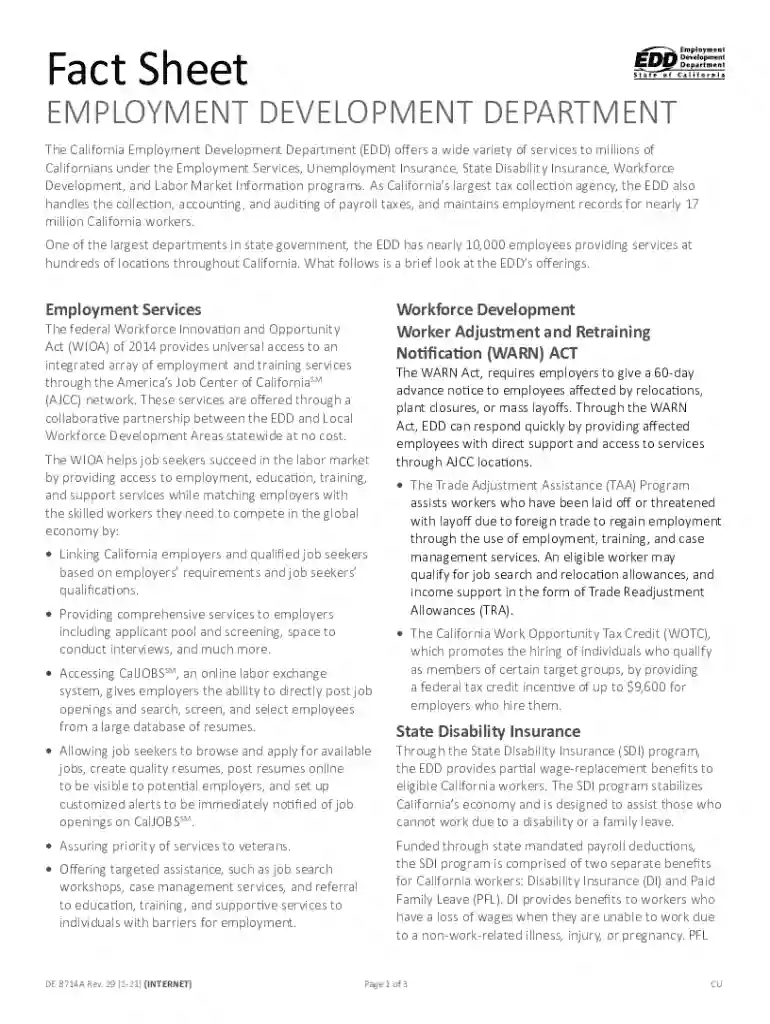
Type text, add images, blackout confidential details, add comments, highlights and more.

Draw your signature, type it, upload its image, or use your mobile device as a signature pad.

Send it via email, link, or fax. You can also download it, export it or print it out.
The California Employment Development Department (EDD) plays a crucial role in managing various programs that impact employment and economic growth. As a state-operated entity, its primary focus is on facilitating job placements, providing financial assistance through programs like Unemployment Insurance and State Disability Insurance, and conducting labor market analysis to inform workforce and economic trends. This department serves as a vital resource for Californians in transition between jobs, seeking workforce development, and requiring assistance to overcome employment-related challenges.
For individuals needing assistance from the EDD, understanding the steps involved in navigating its services is essential.


The EDD operates under the laws and guidelines established by the state of California to ensure fair and legal provision of employment services. It adheres to regulations such as the California Unemployment Insurance Code and State Disability Insurance Code to protect both job seekers and employers. Legal compliance ensures that eligible individuals receive their benefits in a timely fashion and that employers contribute correctly to state payroll taxes.
Understanding the core components of the EDD can improve engagement with its services.
Understanding these terms ensures that individuals and employers correctly interpret EDD communications and the legal framework of their applications.
Operating within California, the EDD follows unique state regulations that differ from federal employment departments.
These state-specific guidelines provide a framework within which both claimants and employers must operate when interacting with the EDD.
Real-world scenarios can illustrate the variety of ways individuals and businesses utilize EDD resources:
By exploring these practical applications, individuals and employers can better understand how the EDD supports economic stability and workforce readiness.
We've got more versions of the employment development department california form. Select the right employment development department california version from the list and start editing it straight away!
At DocHub, your data security is our priority. We follow HIPAA, SOC2, GDPR, and other standards, so you can work on your documents with confidence.
by U Insurance Cited by 1 This publication provides information about programs offered by the. Employment Development Department (EDD) for unemployed Californians. This is for generalRead more
The Employment Development Department (EDD) is one of the largest state departments with employees at hundreds of service locations throughout the state.
From sustainability to jobs, you can expect more from Target. Learn about our history, values and mission.


