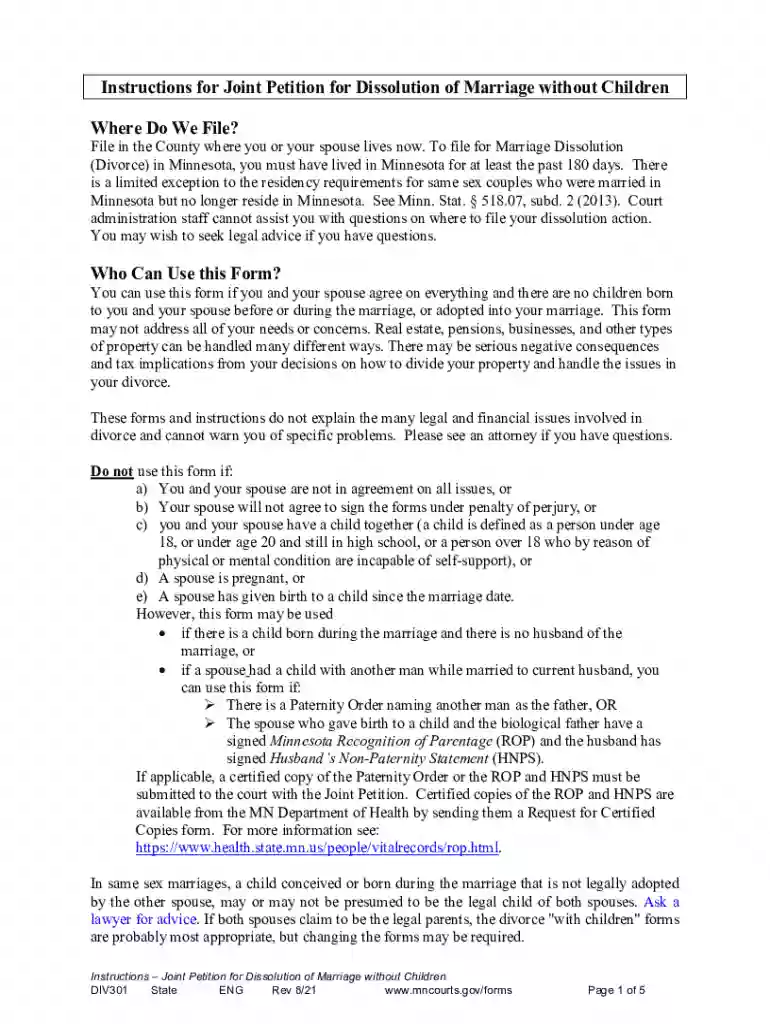
Instructions for Joint Petition for Dissolution of Marriage Without Children:Form 12 2026

Get Form
Instructions for Joint Petition for Dissolution of Marriage Without Children:Form 12 Preview on Page 1

Here's how it works

01. Edit your form online
Type text, add images, blackout confidential details, add comments, highlights and more.

02. Sign it in a few clicks
Draw your signature, type it, upload its image, or use your mobile device as a signature pad.

03. Share your form with others
Send it via email, link, or fax. You can also download it, export it or print it out.

Definition & Context for Form 12

The "Instructions for Joint Petition for Dissolution of Marriage Without Children: Form 12" is a legal document used in Minnesota to guide couples through the process of dissolving a marriage without involving child custody or support issues. This form is specifically designed for instances where both parties are in agreement about the termination of the marriage and do not have children together. Understanding the form's context is crucial as it sets the foundation for navigating the divorce process with clear expectations and requirements.

Key Purposes and Scope

  • Primary Function: To facilitate the legal dissolution of a marriage between parties who mutually agree to separation and have no children.
  • Eligibility: Applicable to couples residing in Minnesota who meet specific residency and agreement criteria.
  • Legal Grounding: It aligns with Minnesota's legal framework for no-fault divorce, emphasizing agreement on property division without court intervention.

Steps to Complete the Form

Completion of Form 12 involves several critical steps that ensure compliance and accuracy. This section provides a detailed guide on how to address each part of the form.

Step-by-Step Guidance

  1. Residency Confirmation: Begin by confirming that both parties meet Minnesota's residency requirements—both must have resided in the state for at least 180 days before filing.
  2. Personal Information: Fill out personal details for both spouses, including names, addresses, and contact information.
  3. Property and Asset Disclosure: Clearly list all marital and non-marital assets and debts. This part requires both parties' agreement on how to divide these assets.
  4. Signatures: Both parties must sign under penalty of perjury, affirming all information is accurate and agreed upon.

Cross-Verification

  • Legal Support: Consider seeking legal advice to verify that asset division complies with legal standards.
  • Witness Requirement: Although not mandatory for the initial filing, having a witness might expedite further legal processes.

Legal Use and Implications

Form 12 carries significant legal implications and responsibilities. Understanding these can prevent potential conflicts and ensure the process is smooth.

Legal Considerations

  • Binding Agreement: Once completed and filed, the terms within the form become legally binding.
  • Court Approval: The agreement may still require court approval, especially where real estate or significant financial distribution is involved.
  • Legal Advice Importance: Consulting a legal professional can help clarify obligations and rights, especially concerning property division.

State-Specific Rules in Minnesota

Minnesota's family law has specific requirements for a divorce without children that are reflected in Form 12.

Key Requirements

  • Residency Law: At least one spouse must have been a resident for 180 days.
  • No Children Clause: The form is strictly for divorces without children from the marriage.
  • Agreement on Division: Both spouses must agree on asset and debt distribution, documented clearly in the form.

Variations and Exceptions

  • Disputed Claims: If there’s a disagreement afterward, the form's legal status may be challenged, making understanding of local law essential.
  • Additional Property: For cases involving shared business assets, additional legal documents might be required.

Required Documents for Submission

Several documents must accompany your completed Form 12 to ensure full compliance with filing requirements.

Document Checklist

  • Identification: Both parties’ government-issued ID copies.
  • Financial Statements: Copies of recent tax returns, pay stubs, and bank statements for accurate asset documentation.
  • Proof of Residency: Utility bills or rental agreements as evidence of Minnesota residency.

Form Submission Methods

Submitting Form 12 can be done in various ways, and understanding these options can streamline the process.

Available Methods

  • Online Submission: Some jurisdictions within Minnesota allow for electronic filing; check local availability.
  • Mail: Submit via certified mail to ensure receipt confirmation.
  • In-Person: Direct submission to the relevant family court can facilitate immediate processing.

Pros and Cons of Each Method

  • Online: Offers convenience and faster processing.
  • Mail: Provides documented proof of submission.
  • In-Person: Allows for direct interaction and immediate feedback from court officials.

Important Terms and Definitions

Familiarity with legal and procedural terminology used in Form 12 is essential for accurate completion and understanding.

Critical Terms

  • Petitioner: The spouse who initiates the filing process.
  • Respondent: The other spouse involved in the filing.
  • Marital Assets: Property and financial assets acquired during the marriage.

Definitions

  • Dissolution: Legal term for divorce or termination of marriage.
  • Non-Marital Property: Assets owned before the marriage or acquired by gift or inheritance.

Examples of Utilizing the Form

Understanding scenarios where Form 12 is applicable can clarify its use and importance.

Practical Use Cases

  • Mutual Agreement Divorce: When both parties amicably agree to part ways, with asset division settled beforehand.
  • Property Division Focused Divorce: Used primarily for couples looking to resolve property and financial issues without child considerations.

Hypothetical Scenarios

  • Spousal Property Agreement: A couple agreeing on dividing their jointly-owned home and individual retirement accounts.
  • Debt Settlement: Agreements on how to handle joint credit card debts and car loans post-divorce.

See more Instructions for Joint Petition for Dissolution of Marriage Without Children:Form 12 versions

We've got more versions of the Instructions for Joint Petition for Dissolution of Marriage Without Children:Form 12 form. Select the right Instructions for Joint Petition for Dissolution of Marriage Without Children:Form 12 version from the list and start editing it straight away!
Versions Form popularity Fillable & printable
2021 4.8 Satisfied (177 Votes)
2019 4.4 Satisfied (134 Votes)
2017 4.2 Satisfied (46 Votes)
2013 4.3 Satisfied (121 Votes)
be ready to get more

Complete this form in 5 minutes or less

Get form

Got questions?

We have answers to the most popular questions from our customers. If you can't find an answer to your question, please contact us.
Contact us
What is the definition of being divorced with no children? A person who has been legally married but whose marriage has been legally dissolvedmeaning a court has issued a judgment of divorce, sometimes called a judgment of dissolution of marriage or a similar termis a divorced person.
The family courts will not grant an uncontested divorce without establishing financial support for children. Both spouses have to support their minor children until they docHub adulthood or become emancipated. Even if one parent has sole custody, it does not relieve the other parent from paying their share of support.
Even if you dont have child support and custody to worry about in your divorce, youll probably have to deal with dividing the property you own with your spouse, including assets such as a home or condo, retirement accounts, savings, and maybe custody of the family pet.

Security and compliance

At DocHub, your data security is our priority. We follow HIPAA, SOC2, GDPR, and other standards, so you can work on your documents with confidence.

Learn more
ccpa2
pci-dss
gdpr-compliance
hipaa
soc-compliance