



Cisa sitesdefaultThe Risk Management Process for Federal Facilities 2026

Get Form
cisa sitesdefaultThe Risk Management Process for Federal Facilities Preview on Page 1

Here's how it works

01. Edit your form online
Type text, add images, blackout confidential details, add comments, highlights and more.

02. Sign it in a few clicks
Draw your signature, type it, upload its image, or use your mobile device as a signature pad.

03. Share your form with others
Send it via email, link, or fax. You can also download it, export it or print it out.

How to use or fill out cisa sitesdefaultThe Risk Management Process for Federal Facilities with DocHub

Form edit decoration
9.5
Ease of Setup
DocHub User Ratings on G2
9.0
Ease of Use
DocHub User Ratings on G2
  1. Click ‘Get Form’ to open it in the editor.
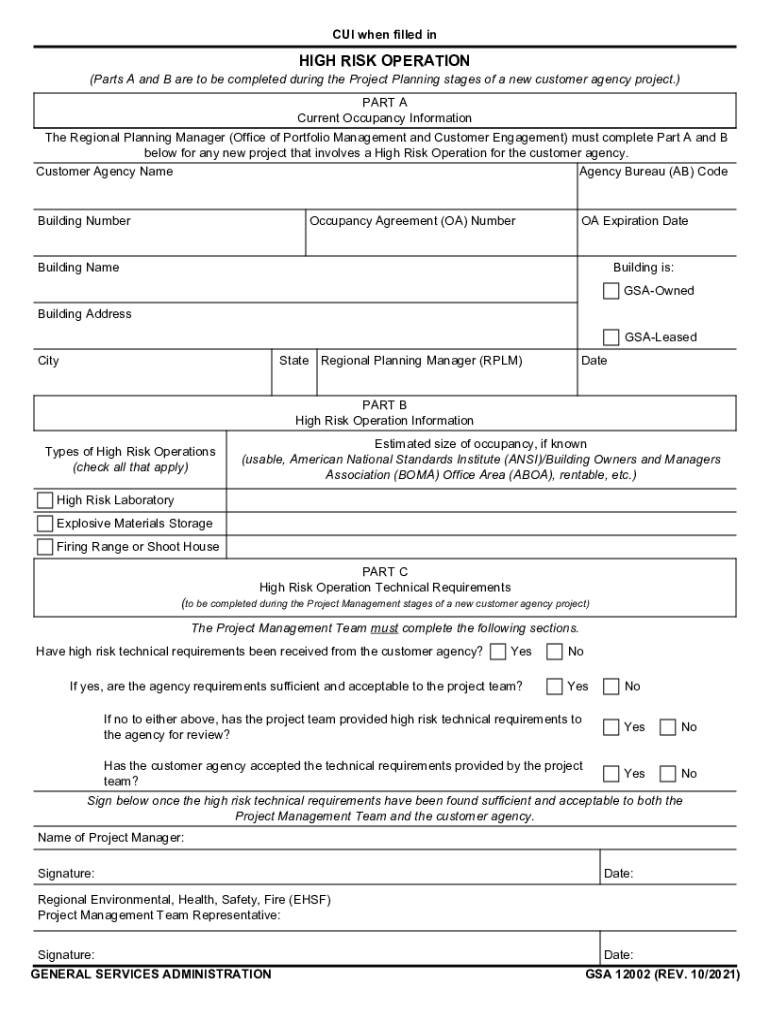
  2. Begin with Part A, where you will input the Current Occupancy Information. Fill in the Customer Agency Name, Agency Bureau (AB) Code, Building Number, OA Expiration Date, and Occupancy Agreement (OA) Number. Specify whether the building is GSA-Owned or GSA-Leased and provide the Building Name and Address along with the City and State.
  3. Proceed to Part B to detail High Risk Operation Information. Check all applicable types of high-risk operations and estimate the size of occupancy if known, using ANSI/BOMA standards.
  4. In Part C, during Project Management stages, confirm if high-risk technical requirements have been received from the customer agency. Answer 'Yes' or 'No' accordingly and ensure that both parties accept these requirements before signing off.

Start using our platform today to streamline your document editing and form completion for free!

See more cisa sitesdefaultThe Risk Management Process for Federal Facilities versions

We've got more versions of the cisa sitesdefaultThe Risk Management Process for Federal Facilities form. Select the right cisa sitesdefaultThe Risk Management Process for Federal Facilities version from the list and start editing it straight away!
Versions Form popularity Fillable & printable
2021 4.8 Satisfied (91 Votes)
2019 4.1 Satisfied (51 Votes)
be ready to get more

Complete this form in 5 minutes or less

Get form

Got questions?

We have answers to the most popular questions from our customers. If you can't find an answer to your question, please contact us.
Contact us
What is the Risk Management Framework (RMF)? Prepare (this step) Categorize. Select. Implement. Assess. Authorize. Monitor.
Welcome to Risk Management for DoD Security Programs. The goal of this course is to provide security professionals with a risk management process that incorporates five steps: asset assessment, threat assessment, vulnerability assessment, risk assessment, and countermeasure determination.
The 7 key principles of risk managementa proactive approach, systematic process, informed decisions, integrated framework, resource allocation, transparency and communication, and continuous monitoring and reviewprovide the blueprint for an effective risk management program.
In order, the risk management steps are: Risk identification. Risk analysis or assessment. Controls implementation. Resource and budget allocation. Risk mitigation. Risk monitoring, reviewing, and reporting.
The risk management process begins by outlining the approach necessary to identify, assess, and prioritize the risks to Federal facilities. The process provides the method for determining the facility security level (FSL) based on the characteristics of each facility and the Federal occupant(s).

Security and compliance

At DocHub, your data security is our priority. We follow HIPAA, SOC2, GDPR, and other standards, so you can work on your documents with confidence.

Learn more
ccpa2
pci-dss
gdpr-compliance
hipaa
soc-compliance

People also ask

Types Of Risk Management Liquidity Risk Management. Banks must safeguard long-term asset funding using short-term liabilities. Interest Rate Risk Management. Market Risk Management. Credit Risk Management. Operational Risk Management. ESG Risk Management. Reputational Risk Management.
The seven NIST RMF steps lay out the process your organization can follow: Prepare; Categorize; Select; Implement; Assess; Authorize; and Monitor. Each step builds from its predecessor, ideally culminating in a fully realized system that encumbers enough SPSCR but no more! to function well over time.

