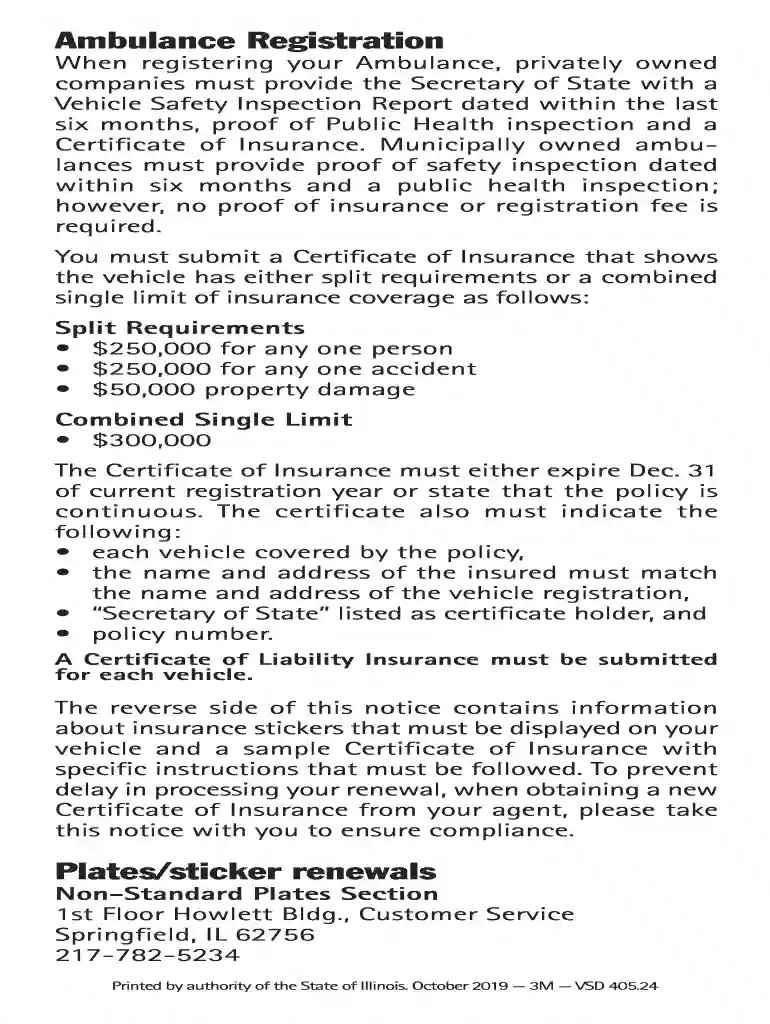
Ambulance registration 2026

Get Form
ambulance registration Preview on Page 1

Here's how it works

01. Edit your ambulance registration online
Type text, add images, blackout confidential details, add comments, highlights and more.

02. Sign it in a few clicks
Draw your signature, type it, upload its image, or use your mobile device as a signature pad.

03. Share your form with others
Send ambulance registration form via email, link, or fax. You can also download it, export it or print it out.

How to use or fill out ambulance registration with our platform

Form edit decoration
9.5
Ease of Setup
DocHub User Ratings on G2
9.0
Ease of Use
DocHub User Ratings on G2
  1. Click ‘Get Form’ to open the ambulance registration document in the editor.
  2. Begin by entering your company name and address in the designated fields. Ensure that this information matches your Certificate of Insurance.
  3. For privately owned ambulances, upload the Vehicle Safety Inspection Report dated within the last six months. If you are registering a municipally owned ambulance, simply confirm that you have proof of safety inspection.
  4. Next, provide proof of Public Health inspection. This is required for both privately and municipally owned ambulances.
  5. Fill out the Certificate of Insurance section. Make sure it reflects either split requirements or a combined single limit as specified: $250,000 per person, $250,000 per accident, and $50,000 for property damage or a total of $300,000.
  6. Finally, review all entries for accuracy before submitting your completed form to prevent any delays in processing.

Start using our platform today to streamline your ambulance registration process for free!

See more ambulance registration versions

We've got more versions of the ambulance registration form. Select the right ambulance registration version from the list and start editing it straight away!
Versions Form popularity Fillable & printable
2019 4.8 Satisfied (173 Votes)
2018 4.4 Satisfied (288 Votes)
2016 4.3 Satisfied (258 Votes)
be ready to get more

Complete this form in 5 minutes or less

Get form

Got questions?

We have answers to the most popular questions from our customers. If you can't find an answer to your question, please contact us.
Contact us
0:00 1:54 Service starting an ambulance service requires a lot of preparation. And investment. You need toMoreService starting an ambulance service requires a lot of preparation. And investment. You need to have a business plan secure funding and obtain licenses. And permits.
Patients who are covered by Medicaid or Medicare programs generally will have no out-of-pocket expenses related to ambulance bills. Patients who are covered by private healthcare insurance may be required to pay a co-pay or deductible expense, and/or the difference in coverage.
A basic ambulance service requires $150,000-$300,000 minimum startup capital, while comprehensive services can exceed $600,000. The largest expenses include ambulance vehicles ($20,000-$300,000), medical equipment ($30,000-$60,000), and first-year staffing costs ($80,000-$100,000).
0:05 1:54 Service starting an ambulance service requires a lot of preparation. And investment. You need toMoreService starting an ambulance service requires a lot of preparation. And investment. You need to have a business plan secure funding and obtain licenses. And permits.
0:14 1:39 If youre interested in driving an ambulance youll need to obtain a class C commercial driversMoreIf youre interested in driving an ambulance youll need to obtain a class C commercial drivers license CDL.

Security and compliance

At DocHub, your data security is our priority. We follow HIPAA, SOC2, GDPR, and other standards, so you can work on your documents with confidence.

Learn more
ccpa2
pci-dss
gdpr-compliance
hipaa
soc-compliance
be ready to get more

Complete this form in 5 minutes or less

Get form

People also ask

Emergency Medical Technician (EMT) The Emergency Medical Technician certification is the minimum level needed to transport patients in ambulances. The EMT is similar to the EMR; however, a state-approved EMT course lasts 11-12 weeks and involves 120 hours of instruction.

Related links