




Definition and Purpose of the Florida 12.1 Form
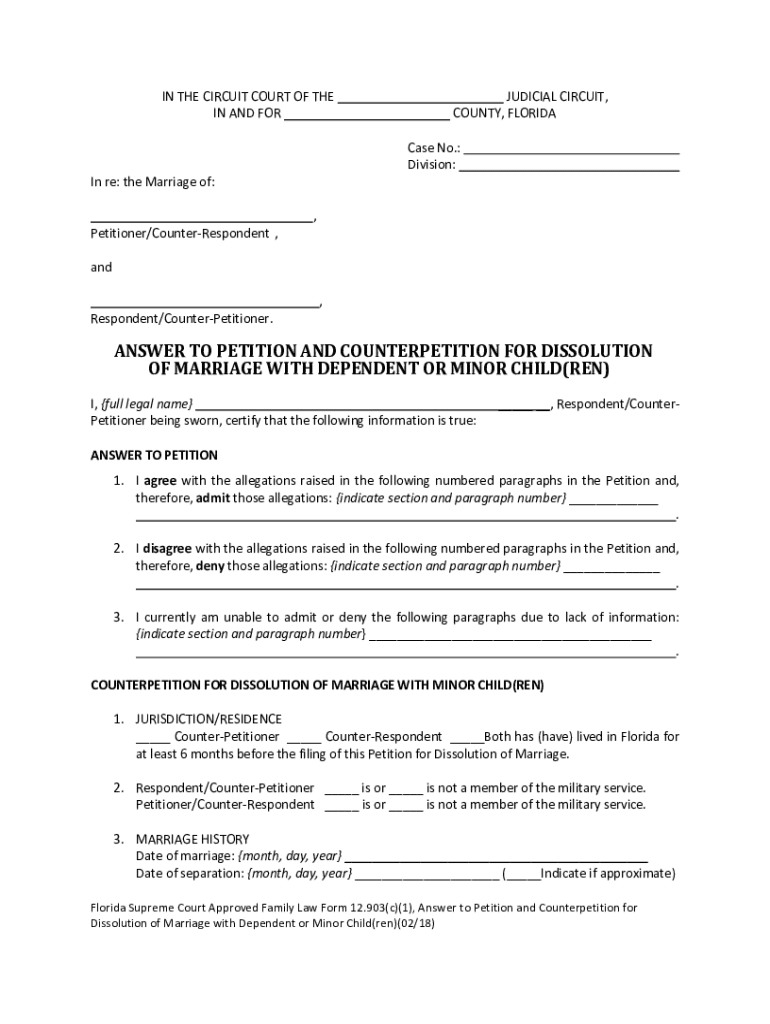
The Florida 12.1 Form is a critical legal document utilized in family law cases involving the dissolution of marriage with children. It is officially known as Florida Supreme Court Approved Family Law Form 12.903(c)(1). This form is used primarily to respond to a petition for the dissolution of marriage where the couple has dependent or minor children. The form serves to either agree or contest the points listed in the initial petition, making it an essential component of family law proceedings in the state of Florida. It ensures that the rights and responsibilities concerning children, such as child support, custody, and visitation, are clearly addressed in any divorce proceedings.
How to Use the Florida 12.1 Form
When utilizing the Florida 12.1 Form, the respondent must carefully address all allegations in the original divorce petition. This involves indicating whether they admit or deny each point listed. Additionally, the respondent can file a counterpetition for issues not covered by the initial document, which might include their own requests concerning child support or custody arrangements. Importantly, the form must be completed accurately to ensure it properly reflects the respondent’s stance and desired outcomes regarding the divorce and related family matters.
Steps to Complete the Florida 12.1 Form
- Review the Original Petition: Before starting, thoroughly read the initial petition for dissolution of marriage to understand each allegation.
- Address Allegations: In the form, explicitly state whether you admit, deny, or are without sufficient knowledge to answer each point.
- Include a Counterpetition if Necessary: If there are additional requests or disputes, draft a counterpetition highlighting these matters.
- Attach Required Documents: Include any necessary documents, such as financial affidavits or parenting plans, which support your responses.
- Sign and Date the Form: Ensure the form is signed and dated, and that you have enough copies for filing with the court and serving the other party.
- File with the Court: Submit the completed form to the appropriate family court.
- Serve the Opponent: Legally serve a copy to the other party involved in the divorce proceedings.
Key Elements of the Florida 12.1 Form
The form includes significant sections that demand careful attention:
- Personal Information: Ensure accurate completion of your personal details, including your name, address, and contact information.
- Response to Allegations: Each allegation in the original petition must have a corresponding checkbox indicating if it is admitted, denied, or requires further information.
- Counterpetition Section: Space is provided for any counterclaims regarding child custody or support that ought to be considered by the court.
- Verification and Signature: The document must be signed in front of a notary public, as legal verification of the information provided.
Important Terminology Related to the Form
Understanding key terms in the Florida 12.1 Form is crucial:
- Petitioner: The individual who initially filed for divorce.
- Respondent: The person responding to the petition.
- Counterpetition: Additional claims or disputes raised by the respondent.
- Dependent or Minor Children: Children under 18, or others under supervision or financially reliant on either party.
- Alimony: Financial support paid to a former spouse post-divorce.
- Parenting Plan: A detailed arrangement focusing on how the children’s needs will be met during and after the divorce.
Legal Use of the Florida 12.1 Form
The Florida 12.1 Form is a legal tool to formalize an individual's response to a divorce petition involving children. It is an essential document that must be filed as part of the legal requirements in Florida divorce proceedings. The form provides a structured way to agree or contest the terms of the initial petition and can significantly influence decisions related to child custody, support, and post-divorce financial arrangements. Compliance with Florida’s family law guidelines is mandatory to ensure the smooth progression of divorce proceedings.
State-Specific Rules for the Florida 12.1 Form
Under Florida law, the 12.1 Form must be used in accordance with state-specific guidelines:
- Filing Requirement: The form must be filed in the correct circuit court based on the residency of the children involved.
- Mandatory Parenting Courses: Completion of a parenting course may be necessary when minors are involved.
- Electronic Filing: Florida courts require electronic filing of documents, but exceptions may apply based on individual circumstances.
Examples of Using the Florida 12.1 Form
Consider this practical application scenario:
- Scenario: Jane is the respondent in a divorce case where her spouse has filed a petition for dissolution of marriage involving their two children.
- Use of Form: Jane uses the Florida 12.1 Form to respond to the custody terms presented by her spouse. In the counterpetition, she requests joint custody and specific visitation schedules. She ensures all financial disclosures are attached and penalizes appropriately if any term is agreed upon but not adhered to by her spouse.
This form becomes a foundational document in the resolution of Jane’s case, allowing both parties to clearly communicate their positions and facilitating a court-mediated settlement.
These comprehensive details ensure a clear understanding of the Florida 12.1 Form, its purposes, and applications in divorce proceedings involving children, thereby supporting effective legal and personal outcomes.


