




01. Edit your dl4 form online
Type text, add images, blackout confidential details, add comments, highlights and more.

Type text, add images, blackout confidential details, add comments, highlights and more.

Draw your signature, type it, upload its image, or use your mobile device as a signature pad.

Send dl4 exemption via email, link, or fax. You can also download it, export it or print it out.
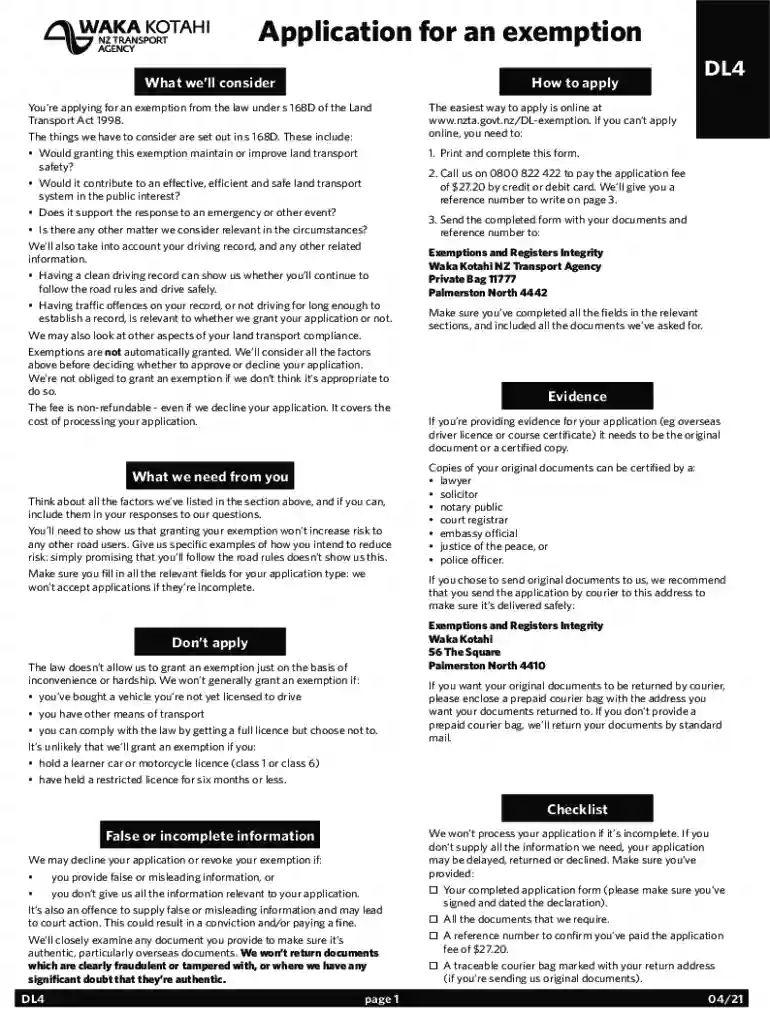
The New Zealand Exemption Form refers to a specific document that allows applicants to request an exemption from certain regulations under the Land Transport Act 1998. This form is crucial for individuals seeking relief from standard rules that do not accommodate their particular circumstances. The exemptions are typically considered when they pose no increased risk to road users and are judged against criteria that include safety, public interest, and the individual’s driving record.
Imagine a logistics company that has drivers who need to operate vehicles outside the usual legal parameters to meet urgent supply demands. Such a company might apply for this exemption to legally allow their drivers to operate under those conditions without facing penalties.
Using the New Zealand Exemption Form involves several steps that enable applicants to submit a valid request:
Determine Eligibility: Assess whether your situation meets the criteria set for exemptions under the Land Transport Act.
Gather Required Documents: Prepare documentation that supports your need for an exemption. This may include driving records, business cases, or safety assessments.
Complete the Application: Accurately fill out the form, ensuring all sections are completed with clear and detailed information.
Submit the Application: Decide on the submission method that suits you best – online, by mail, or potentially in person.
Await Approval: Once submitted, applications are reviewed to ensure compliance with safety and legal standards. Approval times may vary.
A freelance contractor who needs to operate heavy machinery at night due to client requirements would fill out this form to apply for the necessary legal permissions.
To effectively complete the New Zealand Exemption Form, follow these detailed steps:
Read Instructions Carefully: Thoroughly read all instructions provided with the form to understand the requirements and expectations.
Provide Personal Details: Fill out sections that require your personal and contact information accurately.
State Reason for Exemption: Clearly articulate the reason for your request, detailing how the exemption aligns with legal requirements and safety considerations.
Attach Supporting Documents: Ensure all pertinent documents are attached which support your exemption request.
Review and Submit: Double-check all entries for accuracy, completeness, and clarity before submission.
Filing the New Zealand Exemption Form necessitates specific documents that corroborate your application:
For instance, a ride-sharing service might attach their operational plans to demonstrate how an exemption would optimize service delivery without compromising safety.
Understanding these terms is vital when dealing with the New Zealand Exemption Form:
The application process for a New Zealand Exemption Form involves a series of steps designed to ensure compliance and safety:
Approval times can vary based on complexity, completeness of the application, and workload of reviewing officials.
If a transport company needs exceptions for specific vehicle operations during significant national events, their applications may be expedited due to the broader public interest involved.
Non-compliance with the regulations or failure to apply for necessary exemptions can lead to various penalties:
A delivery service operating without the appropriate exemptions might face substantial fines, impacting their financial stability and market reputation.
Eligibility for an exemption under the New Zealand Exemption Form is contingent on specific criteria:
Understanding eligibility ensures that only qualified applications proceed, maintaining road safety throughout the exemption process.


We've got more versions of the dl4 form form. Select the right dl4 form version from the list and start editing it straight away!
At DocHub, your data security is our priority. We follow HIPAA, SOC2, GDPR, and other standards, so you can work on your documents with confidence.


