







Definition & Meaning
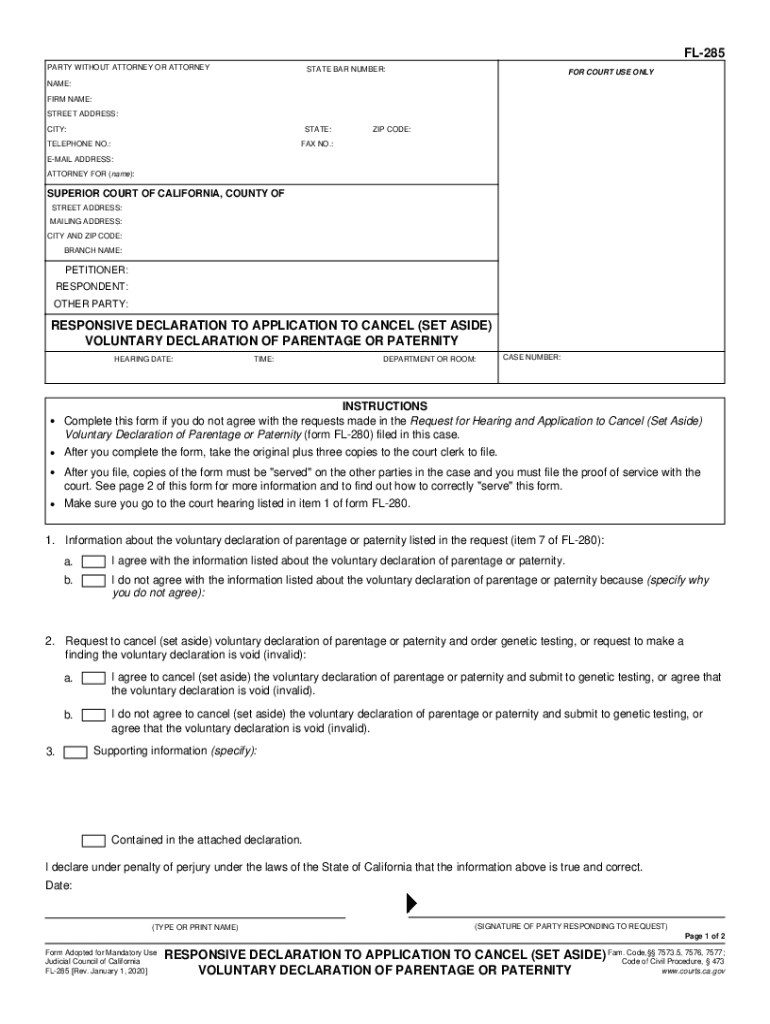
The California Declaration Set Voluntary form relates to legal proceedings concerning the acknowledgment or disestablishment of parentage. Specifically, it serves as a mechanism for individuals to contest or affirm a Voluntary Declaration of Parentage (VDP) in California. The VDP is a legally binding document that establishes parental rights based solely on the voluntary acknowledgment by both parents. This form becomes crucial when one party seeks to contest the existing declaration, providing a structured process to either uphold or revoke the legal recognition of parentage.
The form is critical as it addresses both the procedural and legal intricacies involved in family law, particularly focusing on child custody, support, and parental rights. Its issuance falls under the jurisdiction of California family courts, where respondents are required to provide detailed information supporting their case.
How to Use the California Declaration Set Voluntary
The California Declaration Set Voluntary form is used by individuals contesting a previously signed Voluntary Declaration of Parentage. To initiate the process, the respondent must carefully fill out the form sections, ensuring all details are accurately presented. Here are specific steps on how to use this form:
-
Read the Instructions: Begin by thoroughly reviewing any instructional guidelines provided with the form. This typically includes filing protocols and deadlines.
-
Fill Out Personal Information: Include all necessary personal details, such as your full name, contact information, and legal identification.
-
State Your Case: Clearly outline the reasons for contesting the VDP. This involves detailing any discrepancies or new evidence supporting your viewpoint.
-
Attach Supporting Documents: Accompany the completed form with required documentation that substantiates your claims.
-
File with the Court: Submit the completed form and supporting documents to the relevant family court. Adhere to prescribed filing procedures and deadlines.
-
Serve Other Parties: Ensure all parties involved in the original declaration are served with a copy of the completed form and supporting documents.
Steps to Complete the California Declaration Set Voluntary
Completing the California Declaration Set Voluntary form involves several intricate steps that require careful attention:
-
Identify the Purpose: Determine whether the form is being filled out to support or contest the existing declaration.
-
Compile Necessary Information: Gather all relevant personal information and legal identifiers necessary for the form.
-
Detail the Request: Use the designated sections to articulate your argument, highlighting specific reasons and evidence.
-
Include Legal References: Where applicable, reference any relevant statutes or legal precedents that support your case.
-
Attach Documentation: Securely attach copies of supporting evidence like birth certificates, previous legal agreements, or new affidavits.
-
Double-Check for Accuracy: Review the form for any errors, as inaccuracies can delay processing or weaken your case.
-
Submit Form: File the form with the court, ensuring compliance with all submission guidelines.
Legal Use of the California Declaration Set Voluntary
The California Declaration Set Voluntary form is embedded within the legal framework governing family relationships, particularly where the legitimacy of parental claims is at issue. The form's primary legal function is to facilitate a formal request for the correction or validation of a Voluntary Declaration of Parentage.
-
Custody and Support: The form can affect decisions relating to child custody and support, making it integral during disputes.
-
Adjudication: Used during court adjudications to present counterclaims or defenses in context to the VDP.
-
Parental Rights and Obligations: Alters or affirms parental rights and duties, like inheritance or decision-making power over the child.
Key Elements of the California Declaration Set Voluntary
The form is composed of critical elements that ensure thoroughness and validity:
-
Respondent and Declarant Information: Includes names, contact details, and relevant personal identifiers.
-
Declaration Details: Provides sections for dates and descriptions pertaining to the initial voluntary declaration.
-
Reasons for Challenge/Support: A dedicated portion allows for an explanation of the reasons supporting or contesting the declaration.
-
Additional Evidence: Sections for attaching proof or substantiation like affidavits, witness statements, or any legal documentation.
State-Specific Rules for the California Declaration Set Voluntary
California has specific rules governing the execution and filing of this form:
-
Exclusive Jurisdiction: Only recognized within California's legal system, with all proceedings taking place in California family courts.
-
Filing Deadlines: Mandatory adherence to specific timelines set by the state for filing the form, typically depending on when the initial declaration was signed.
-
Notarization: Some portions may require notarization to validate signatory authenticity.
Who Typically Uses the California Declaration Set Voluntary
Various individuals may require the use of this form, primarily those involved in parentage disputes:
-
Parents: Individuals seeking to affirm or contest a Voluntary Declaration of Parentage.
-
Legal Guardians: Legal representatives acting on behalf of minors impacted by the parentage declaration.
-
Social Services: In instances where the state has vested interest in the child's welfare.


Important Terms Related to the California Declaration Set Voluntary
Understanding specific legal terminology related to this form is essential:
-
Voluntary Declaration of Parentage (VDP): An initial document establishing legal parentage recognized by the state.
-
Respondent: The party submitting the form in response to the original declaration.
-
Petitioner: The individual who initiates or contests the parentage declaration.
Form Submission Methods (Online / Mail / In-Person)
Filing the California Declaration Set Voluntary form is flexible, often done through:
-
Online Filing: Allows electronic submission through designated legal service portals.
-
Mail Submission: Submit the form via certified mail to the appropriate family court, ensuring proof of delivery.
-
In-Person: Direct filing at the court clerk’s office, which can afford immediate processing confirmation.
Penalties for Non-Compliance
Failing to properly utilize or file the California Declaration Set Voluntary form can result in:
-
Loss of Rights: Failure to contest or support a declaration within the prescribed timeframe can lead to forfeited parental rights.
-
Legal Sanctions: Non-compliance with court orders associated with the form could result in fines or further legal action.
-
Delayed Proceedings: Mistakes in filing can lead to significant delays in resolving custody or parentage disputes.




