
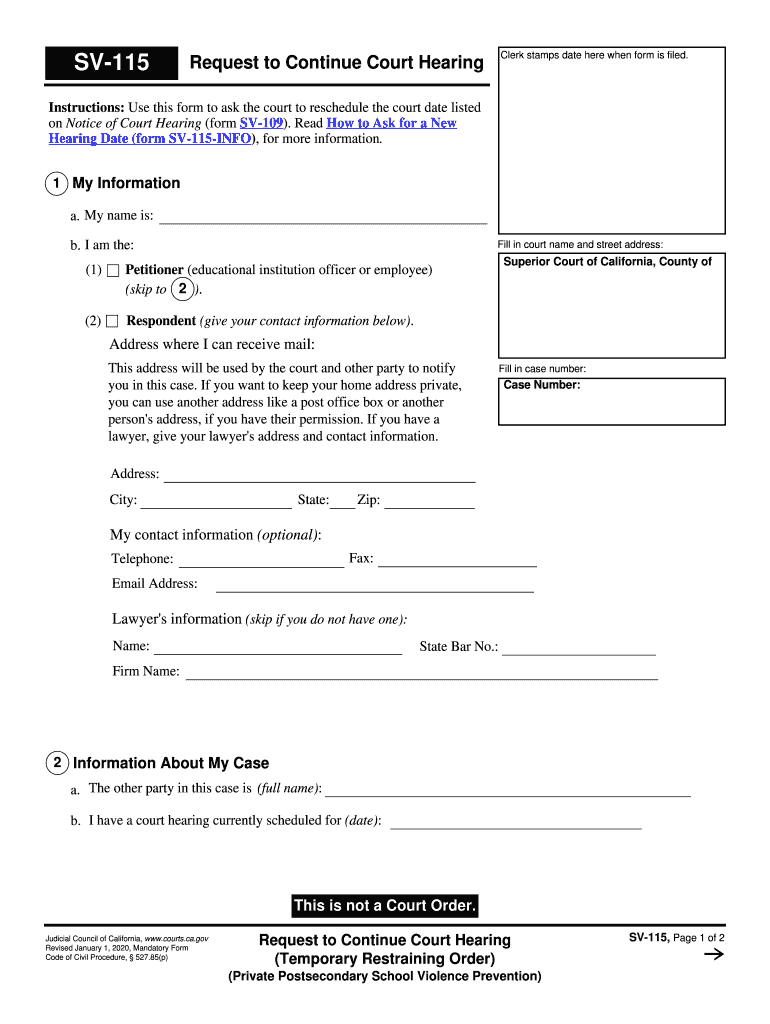







Definition and Meaning of SV-115 Form
The SV-115 form, commonly known as the "SV Continued Form," is utilized in California legal proceedings to request the rescheduling of a court hearing related to a Temporary Restraining Order. This form is essential in ensuring that involved parties have the opportunity to attend a court hearing at a more feasible time if they encounter conflicts with the initially scheduled date. The SV-115 allows individuals to formally present their reasons for rescheduling, which could include personal emergencies, scheduling conflicts with legal representation, or other legitimate justifications. It's a vital tool for maintaining fairness and flexibility in legal proceedings, ensuring that all parties can be adequately represented.
How to Use the SV-115 Continued Form
Utilizing the SV-115 form involves several critical steps to ensure that the request for hearing rescheduling is processed smoothly and effectively:
-
Identify the Need to Reschedule:
- Review your calendar and prior commitments to determine if you can attend the initially scheduled hearing.
- Consider consulting with legal counsel to discuss potential conflicts and the necessity of rescheduling.
-
Complete the Form:
- Fill in accurate personal details as required, including your name, case number, and contact information.
- Clearly articulate the reason for requesting a reschedule, ensuring that the explanation is concise and substantiated with valid reasoning.
-
Submit the Form:
- File the completed form with the appropriate court department. Depending on the jurisdiction, submission might be possible online, by mail, or in person.
-
Follow Up:
- Maintain communication with the court to receive confirmation or updates regarding your request.
Steps to Complete the SV-115 Form
Completing the SV-115 requires careful attention to detail and adherence to protocol:
-
Gather Required Information:
- Current case number.
- Existing court hearing date and details.
- Personal identification data (full name, address).
-
Outline Reasons for Rescheduling:
- Provide a clear, concise explanation of your conflict and any evidence or documentation that supports your request.
-
Consent and Acknowledgement:
- Ensure you understand the consequences of rescheduling, including any ongoing protective measures remaining in place.
-
Legal Assistance:
- Seek legal advice if necessary to ensure the form is completed correctly and all legal requirements are met.
Legal Use of the SV-115 Continued Form
The SV-115 form serves a significant role in the legal proceedings surrounding Temporary Restraining Orders (TROs). Its primary legal purpose is to ensure that justice is delivered in a fair manner, allowing defendants and petitioners equal opportunity to represent themselves in court. By providing a formal mechanism for rescheduling, the court can accommodate legitimate conflicts without jeopardizing the continuance of protective orders. The form is an acknowledgment by the judiciary of the logistical challenges parties may face in attending set court dates and helps uphold the integrity of the legal process by ensuring all voices can be heard at an appropriate time.
Who Typically Uses the SV-115 Form
The SV-115 form is primarily used by individuals involved in cases concerning Temporary Restraining Orders in California. Common users include:
- Respondents: Who may need to reschedule due to conflicting commitments or inability to attend.
- Petitioners: Wishing to ensure their own availability and representation for the scheduled hearing.
- Legal Representatives: Acting on behalf of clients who face genuine scheduling challenges.
- Court Administrators: Facilitating the rescheduling process within the logistical framework of the court calendar.


Key Elements of the SV-115 Form
Understanding key elements of the SV-115 form is crucial for its successful utilization:
- Personal Information Section: Accurate inputs are essential for the court to identify and process the request.
- Case Details Section: Includes specifics like the case number and the initial hearing date.
- Reason for Rescheduling: Persuasively presenting the reasons necessitating rescheduling.
- Acknowledgment and Consent: Confirming an understanding of the form’s implications and the continuation of any protective orders.
State-Specific Rules for the SV-115 Continued Form
As the SV-115 is a specific California form, it's crucial to understand the nuances of California state law regarding Temporary Restraining Orders:
- Jurisdiction Specificities: Each county in California may have slight variations in how the process is conducted or the supplementary documentation required.
- Deadline for Filing: Courts typically require filing a set period before the hearing date, necessitating proactive action from the filer.
- Court Clerk Consultation: Consultation with the court clerk may provide guidance or clarify county-specific requirements or steps.
Required Documents for the SV-115 Form Submission
When submitting the SV-115 form, various documents may be required to support the rescheduling request:
- Existing Restraining Order: A copy to verify the current status and conditions.
- Conflict Documentation: Evidence demonstrating scheduling conflicts, such as work commitments or medical appointments.
- Identification Proof: Government-issued ID to ensure the validity of the form’s submitter’s identity.
- Legal Representation Documents: If applicable, indicating that an attorney is representing the filer and undersigned.
Selection of these blocks provides an in-depth understanding of the SV-115 form, delivering comprehensive coverage suitable for individuals navigating the California legal system in relation to Temporary Restraining Orders.




