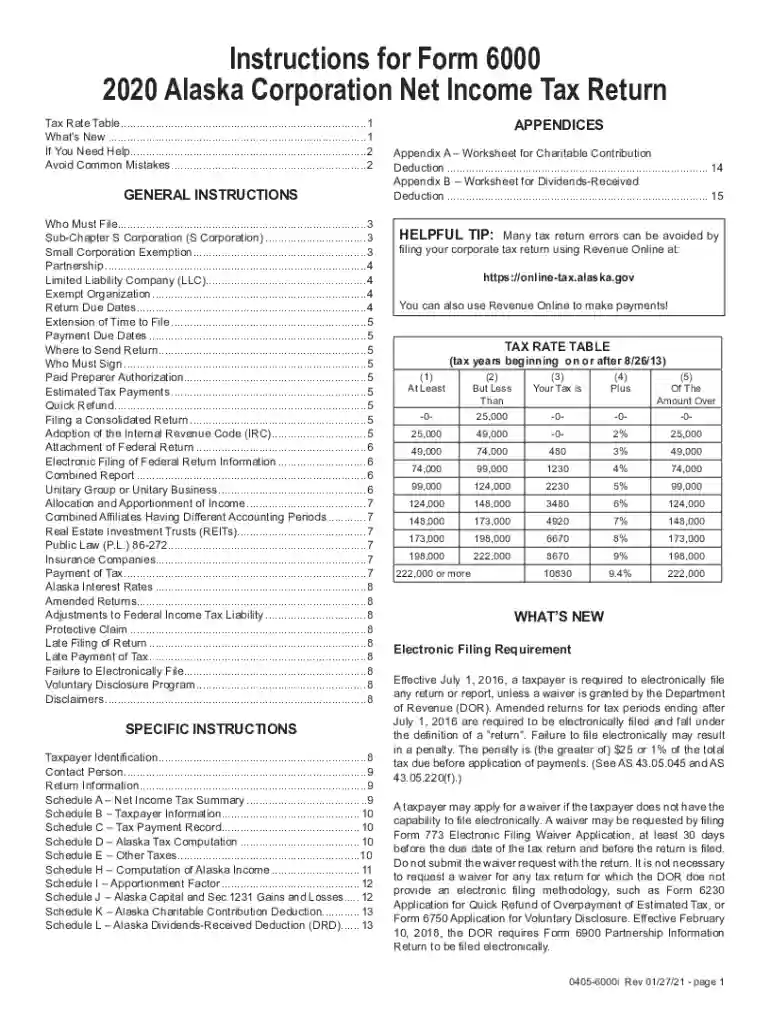
Ak return 2026

Get Form
ak return Preview on Page 1

Here's how it works

01. Edit your form online
Type text, add images, blackout confidential details, add comments, highlights and more.

02. Sign it in a few clicks
Draw your signature, type it, upload its image, or use your mobile device as a signature pad.

03. Share your form with others
Send it via email, link, or fax. You can also download it, export it or print it out.

How to use or fill out ak return with our platform

Form edit decoration
9.5
Ease of Setup
DocHub User Ratings on G2
9.0
Ease of Use
DocHub User Ratings on G2
  1. Click 'Get Form' to open the ak return in the editor.
  2. Begin by entering your Taxpayer Identification information, including your name and federal Employer Identification Number (EIN). Ensure this matches the details on your federal return.
  3. Provide a Contact Person's details. This should be an authorized individual who can respond to any inquiries regarding the return.
  4. In the Return Information section, check all applicable boxes such as 'Final Alaska return', 'Consolidated Alaska return', or 'Amended return' based on your filing status.
  5. Complete Schedule A for Net Income Tax Summary. Enter any Alaska net operating loss deductions and ensure you attach Form 6385 if applicable.
  6. Fill out Schedule B with taxpayer information if filing a consolidated return, listing all members of the group.
  7. Proceed to Schedule D for Alaska Tax Computation. Use the provided tax rate table to calculate your tax liability accurately.

Start filling out your ak return today using our platform for a seamless experience!

See more ak return versions

We've got more versions of the ak return form. Select the right ak return version from the list and start editing it straight away!
Versions Form popularity Fillable & printable
2022 4.2 Satisfied (55 Votes)
2021 4.8 Satisfied (77 Votes)
2020 4.8 Satisfied (132 Votes)
2019 4.3 Satisfied (190 Votes)
2019 4.4 Satisfied (98 Votes)
2017 4.3 Satisfied (76 Votes)
2015 4.4 Satisfied (158 Votes)
be ready to get more

Complete this form in 5 minutes or less

Get form

Got questions?

We have answers to the most popular questions from our customers. If you can't find an answer to your question, please contact us.
Contact us
If youre the beneficiary of a trust or estate, you might receive a Schedule K-1. The Schedule K-1 tax form is for inheritance recipients who need to report their share of income, deductions, or credits from the trust or estate. Get the clarity you need to file your income taxes correctly as a beneficiary.
To enter a Schedule K-1 into an individual tax return, from the Main Menu of the tax return (Form 1040) select: Income. Rents, Royalties, Entities (Sch E, K-1, 4835, 8582) K-1 Input - Depending on your needs, select either New or Pull.
Is Schedule K-1 considered income? A Schedule K-1 lists taxable income, similar to a W2 or a Form 1099, but only for the particular types of business entities outlined above. As far as K-1 distributions are concerned, they are generally not considered taxable income.
Purpose of Schedule K-1 The partnership uses Schedule K-1 to report your share of the partnerships income, deductions, credits, etc. Keep it for your records. Dont file it with your tax return unless youre specifically required to do so.
How does Schedule K-1 affect personal taxes? In general, a K-1 can affect personal taxes in two ways: either by increasing a partners tax liability or by providing them with a tax deduction. It will likely increase their total tax liability for the year if the K-1 is associated with an income.

Security and compliance

At DocHub, your data security is our priority. We follow HIPAA, SOC2, GDPR, and other standards, so you can work on your documents with confidence.

Learn more
ccpa2
pci-dss
gdpr-compliance
hipaa
soc-compliance
be ready to get more

Complete this form in 5 minutes or less

Get form

People also ask

How Does Schedule K-1 Affect Personal Taxes? A Schedule K-1 can impact your personal taxes in key ways. It reports income from partnerships, S-corporations, and trusts. This income is often considered pass-through, meaning it goes directly to you without being taxed at the entity level.
For the purpose of income tax, there are mainly three types of returns which can be filed: Original. Revised. Belated. Updated.
While individual taxpayers typically dont file K-1 forms, you can use the information you receive from a K-1 on your personal income tax return. There are four main types of entities that are required to file a K-1: business partnerships. LLCs that have at least two partners or elect to be taxed as corporations.

Related links