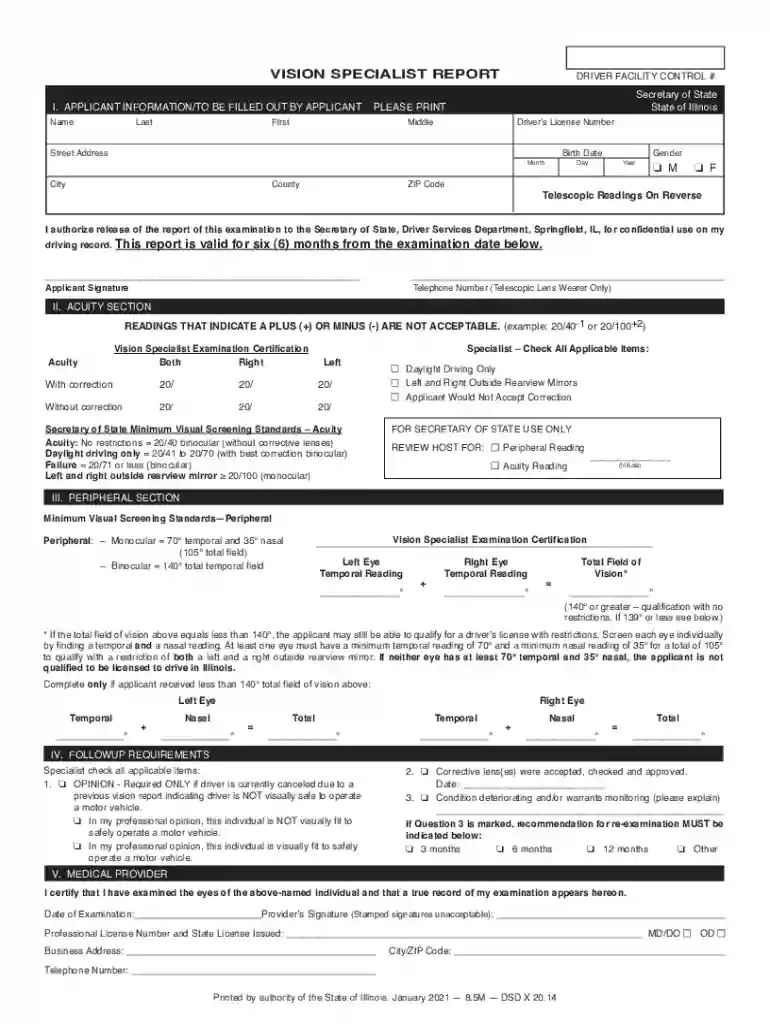
Illinois vision form 2026

Get Form
illinois dmv vision test waived Preview on Page 1

Here's how it works

01. Edit your illinois dmv vision test waived online
Type text, add images, blackout confidential details, add comments, highlights and more.

02. Sign it in a few clicks
Draw your signature, type it, upload its image, or use your mobile device as a signature pad.

03. Share your form with others
Send illinois dmv vision test online free via email, link, or fax. You can also download it, export it or print it out.

Definition and Meaning of the Illinois Vision Form

The Illinois vision form, often referred to as the Vision Specialist Report, is a crucial document used to assess an applicant's visual acuity and peripheral vision. This evaluation determines an individual's eligibility for obtaining or renewing a driver’s license in the state of Illinois. The form captures relevant personal information, acuity readings, and necessary medical certifications from a licensed vision specialist.

Key Components of the Form

  • Acuity Readings: Measures clarity of vision using Snellen charts or similar methods.
  • Peripheral Vision Assessment: Determines the applicant’s side vision, critical for safe driving.
  • Personal Information: Includes name, address, and date of birth, which are necessary for identification.
  • Medical Provider’s Certification: Acknowledgment from a licensed professional that the applicant meets the visual standards.

This form is essential for individuals whose vision may be impaired but still wish to qualify for a driver's license with certain restrictions, particularly if they utilize devices like telescopic lenses.

Steps to Complete the Illinois Vision Form

Completing the Illinois vision form involves several clear steps to ensure all necessary information is provided.

  1. Obtain the Form: Acquire the Illinois vision form from a licensed vision specialist or download it from the official DMV website.
  2. Fill in Personal Information: Accurately input your name, address, date of birth, and contact information at the top of the document.
  3. Get Tested: Schedule an appointment with a licensed optometrist or ophthalmologist to evaluate your vision.
  4. Document Results: The vision specialist will record your acuity readings and peripheral vision measurements directly onto the form.
  5. Obtain Certification: Ensure the form is signed and certified by the examining medical provider to validate the results.
  6. Submit the Form: Present the completed form at your local DMV office or include it with your driver’s license application or renewal.

Important Considerations

  • Make sure the vision specialist's certification is current and from an approved provider.
  • Double-check for accuracy to avoid delays in processing your driver’s license.

Who Typically Uses the Illinois Vision Form

The Illinois vision form is primarily utilized by individuals undergoing the evaluation process to obtain or renew a driver's license in the state. Specific groups that may frequently require this form include:


  • New Drivers: Individuals seeking their first driver’s license must meet specific visual standards.
  • Seniors: Older adults may be subject to more rigorous visual assessments before license renewal.
  • Drivers with Impairments: Those with known vision issues or conditions, such as amblyopia or glaucoma, may need to complete this form to comply with Illinois driver licensing regulations.
decoration image ratings of Dochub

Important Terms Related to the Illinois Vision Form

Understanding key terminology related to the Illinois vision form can clarify its purpose and requirements:

  • Acuity: Refers to the clarity or sharpness of vision, usually tested with a standardized chart.
  • Peripheral Vision: The ability to see objects outside of your direct line of sight, critical for avoiding hazards while driving.
  • Certification: The formal acknowledgment from a medical provider that the applicant has met the necessary visual standards.

State-Specific Rules for the Illinois Vision Form

Navigating the rules governing the Illinois vision form is crucial for compliance with driving regulations. Important points include:

  • Minimum Standards: The Illinois Secretary of State outlines specific visual acuity and peripheral vision standards that must be met.
  • Restrictions for Disqualification: Applicants with significant visual impairments may still qualify for a driver’s license with restrictions, such as the use of corrective lenses or specific driving conditions.
  • Submission Requirements: The completed form must be submitted alongside the driver’s license application for processing and approval.

Additional Considerations

  • Regular updates to visual standards may occur, requiring applicants to stay informed about any changes that could affect their eligibility.
  • Certain conditions or diagnoses may necessitate additional documentation or evaluations.

Examples of Using the Illinois Vision Form

Understanding how to effectively utilize the Illinois vision form can be illustrated through practical scenarios:

  • Case of a First-Time License Applicant: A young adult applying for their first driver's license will need a vision assessment form completed post-examination by a licensed optometrist to prove they meet the required visual standards.
  • Renewal for Seniors: An elderly driver may need to submit a certified vision form every two years to renew their license, ensuring their visual acuity remains compliant with state regulations.
  • Conditional License for Visual Impairments: A driver with limited peripheral vision may submit their vision report and receive a conditional license, allowing them to drive only during daylight or with specific corrective devices.

These examples demonstrate that the Illinois vision form is tailored to accommodate various circumstances, ensuring that all drivers can access the road safely while meeting state requirements.

See more illinois vision form versions

We've got more versions of the illinois vision form form. Select the right illinois vision form version from the list and start editing it straight away!
Versions Form popularity Fillable & printable
2022 4.3 Satisfied (38 Votes)
2021 4.9 Satisfied (48 Votes)
2020 4.1 Satisfied (61 Votes)
2018 4.1 Satisfied (38 Votes)
2018 4.3 Satisfied (120 Votes)
2015 4.3 Satisfied (180 Votes)
2013 4.1 Satisfied (53 Votes)
be ready to get more

Complete this form in 5 minutes or less

Get form

Got questions?

We have answers to the most popular questions from our customers. If you can't find an answer to your question, please contact us.
Contact us
You may submit a Vision Specialist Report completed by a licensed optometrist, ophthalmologist or physician, instead of an in-person vision screening at a Driver Services facility. Visual reading requirements are as follows: The minimum requirement for visual acuity is 20/40 acuity with or without corrective lenses.
DMV Visual Acuity (Vision) Screening Standard required for a DL: 20/40 with both eyes together. 20/40 in one eye and at least 20/70 in the other eye.
20/20 vision is normal vision acuity (the clarity or sharpness of vision) measured at a distance of 20 feet. If you have 20/20 vision, you can see clearly at 20 feet what should normally be seen at a distance.
3 years old: the critical line to pass screening is the 20/50 line. 4 years old: the critical line to pass screening is the 20/40 line. 5 years and older: the critical line to pass screening is the 20/32 line for Sloan and LEA/HOTV (or 20/30 in Snellen chart).
Acuity readings through the lenses must be 20/40 or better in both eyes. Peripheral readings must be 140 degrees binocular or 70 degrees temporal and 35 degrees nasal monocular.

Security and compliance

At DocHub, your data security is our priority. We follow HIPAA, SOC2, GDPR, and other standards, so you can work on your documents with confidence.

Learn more
ccpa2
pci-dss
gdpr-compliance
hipaa
soc-compliance