






Definition & Purpose of BIR Form 2000
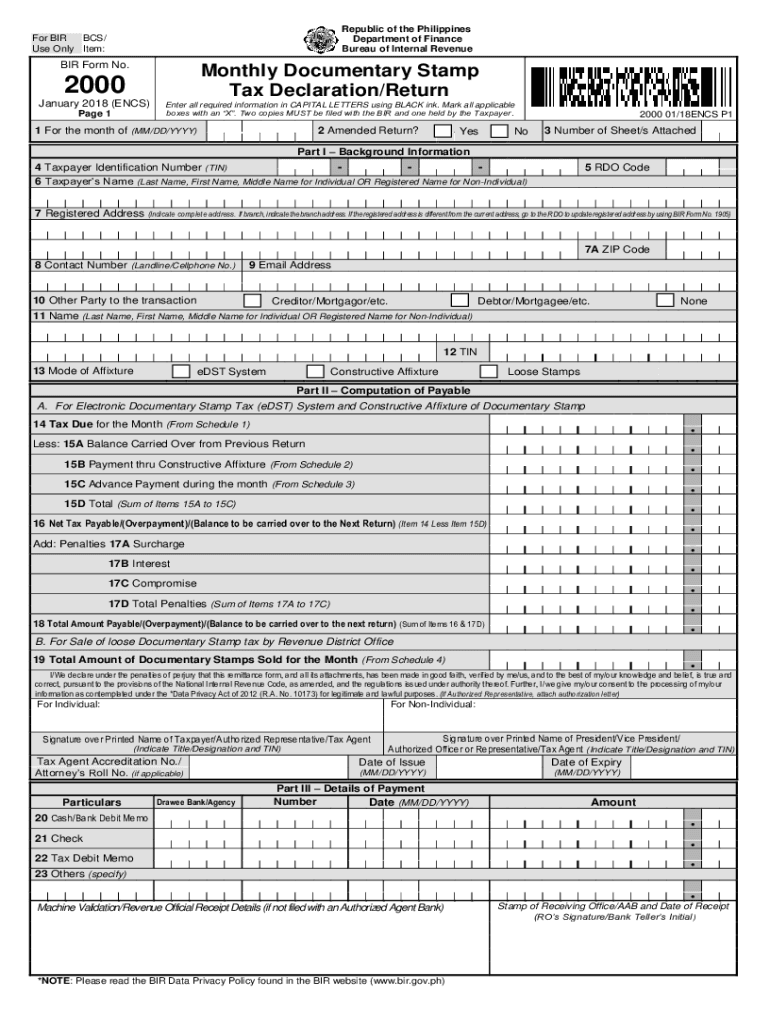
BIR Form 2000 is a tax form issued by the Bureau of Internal Revenue in the Philippines, primarily used for reporting and paying the documentary stamp tax (DST). This tax applies to various documents, including contracts, sales of real property, and other transactions specified by tax regulations. Understanding the form's purpose is essential for taxpayers who need to comply with legal requirements and avoid penalties related to documentary stamp taxes.
The form's significance lies in its requirement for taxpayers to file accurately and timely. Properly completed forms ensure that the correct tax amount is reported and paid to the government. Users of the form include individuals and businesses, especially those engaged in activities that result in taxable documents.
Key Uses of BIR Form 2000
- Reporting documentary stamp taxes for specific transactions.
- Ensuring legal compliance to avoid penalties.
- Facilitating documentation for real estate transactions.
How to Obtain BIR Form 2000 Excel Format Download
Obtaining the BIR Form 2000 in excel format is straightforward and can be done through various online resources. The form is often available for free download in an editable format, which allows users to fill in the required information digitally.
Steps to Get the BIR Form 2000
- Visit the official website of the Bureau of Internal Revenue or authorized tax-related portals.
- Navigate to the section that provides downloadable tax forms.
- Look for "BIR Form 2000" and select the option for the Excel format.
- Download the file onto your device.
This process ensures that taxpayers have access to the most current and compliant version of the form for their needs.
Steps to Complete the BIR Form 2000 Excel Format Download
Completing the BIR Form 2000 requires careful attention to detail to ensure accuracy and compliance. The Excel format allows for a more manageable approach to data entry.
Instructions for Filling Out the Form
- Open the Downloaded Excel File: Ensure that you have a compatible program to edit Excel files.
- Fill in the Required Information: Enter details such as:
- Taxpayer Identification Number (TIN)
- Name of the taxpayer
- Nature of the transaction
- Calculate the Documentary Stamp Tax: Use the provided fields to compute the total DST based on the type of transaction.
- Review All Entries: Ensure that all information is correct and complete.
- Save the Completed Form: Store both digital and printed versions as needed for submission.
This structured approach helps in ensuring that all necessary information is reported correctly, reducing the risk of errors that could lead to penalties.
Why Use BIR Form 2000?
Using the BIR Form 2000 is essential for any individual or business involved in transactions subject to documentary stamp tax. It helps maintain compliance with tax laws while ensuring that appropriate taxes are paid on applicable documents.
Benefits of Completing the Form
- Legal Compliance: Filing the form properly helps businesses avoid legal issues and financial penalties.
- Tax Documentation: Serves as a crucial document in financial records and audits.
- Transparency: Helps maintain clear records for both the taxpayer and the government.
Failure to use the form or inaccuracies in filing can lead to penalties, making it a critical component of good financial practice.
Important Terms Related to BIR Form 2000
Understanding key terms related to BIR Form 2000 is vital for proper completion and compliance. These terms help demystify the filing process and provide clarity on what is being reported.
Key Terminology
- Documentary Stamp Tax (DST): A tax imposed on documents that transfer rights or evidence transactions.
- Taxpayer Identification Number (TIN): A unique identifier assigned to taxpayers for tax purposes.
- Compliance: Adherence to tax laws and regulations regarding documentation and payment.
Being familiar with these terms will assist users in navigating the tax documentation process more effectively.
Penalties for Non-Compliance with BIR Form 2000
Understanding the potential penalties associated with failing to properly file BIR Form 2000 is crucial. Taxpayers must adhere to deadlines and requirements to avoid monetary penalties or legal action.
Types of Penalties
- Late Filing Penalties: Fees imposed for filing after the deadline, which can accrue over time.
- Incorrect Filing: Filing incorrect information may lead to fines or the need to correct and re-file.
- Legal Consequences: Continued non-compliance can result in more severe penalties, including legal action.
Staying informed about these potential repercussions encourages timely and accurate completion of BIR Form 2000.
Examples of Using BIR Form 2000
Examining practical examples provides context for when and how BIR Form 2000 is utilized. Various scenarios can illustrate the form's application in real-world situations.
Scenarios Involving BIR Form 2000
- A business sells commercial property and must report the transaction via the form to pay the applicable DST.
- An individual enters into a lease agreement that also requires the declaration of documentary stamp tax.
By understanding these scenarios, users can see the form's importance in various transactions, reinforcing their need to utilize it correctly.