Jd cl 121 2026

Get Form
jd cl 121 Preview on Page 1

Here's how it works

01. Edit your form online
Type text, add images, blackout confidential details, add comments, highlights and more.

02. Sign it in a few clicks
Draw your signature, type it, upload its image, or use your mobile device as a signature pad.

03. Share your form with others
Send it via email, link, or fax. You can also download it, export it or print it out.

How to use or fill out jd cl 121 with our platform

Form edit decoration
9.5
Ease of Setup
DocHub User Ratings on G2
9.0
Ease of Use
DocHub User Ratings on G2
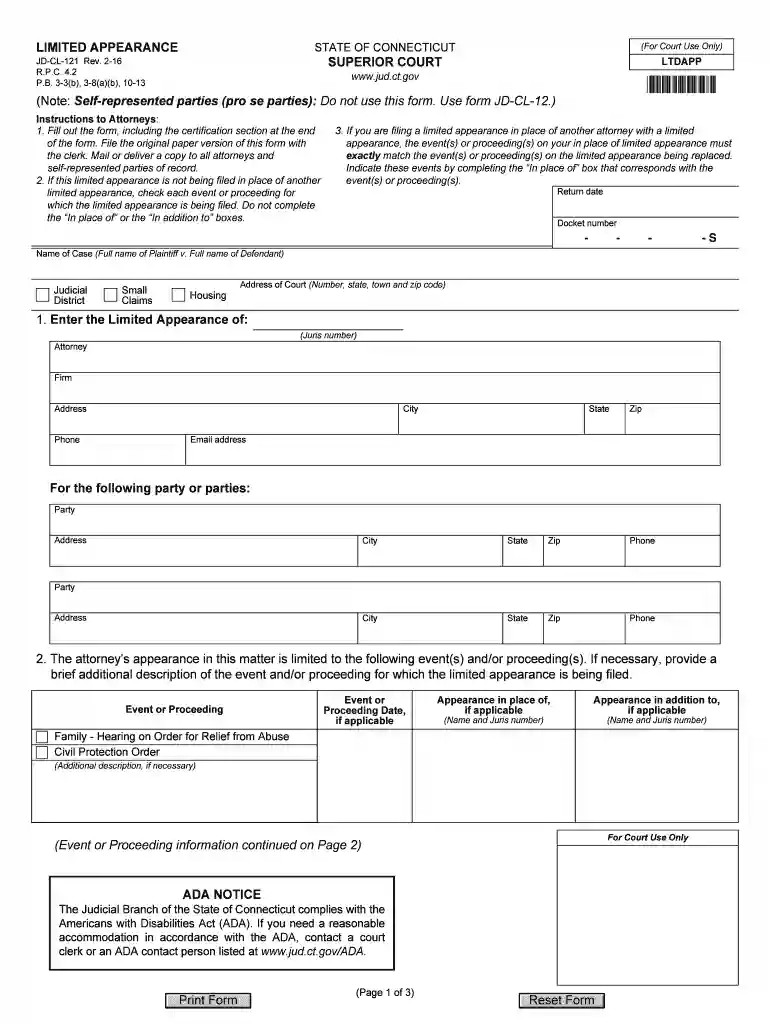
  1. Click ‘Get Form’ to open the JD-CL-121 in the editor.
  2. Begin by entering the return date and docket number at the top of the form. This information is crucial for identifying your case.
  3. Fill in the full name of the case, including both plaintiff and defendant names, followed by the judicial district and court address.
  4. In section one, provide your details as the attorney: include your juris number, firm name, address, phone number, and email.
  5. List all parties you are representing along with their addresses and contact information in section one.
  6. Specify the event(s) or proceeding(s) for which this limited appearance is being filed. If applicable, complete any additional descriptions required.
  7. Complete the certification section at the end of the form to confirm that copies have been sent to all relevant parties.

Start using our platform today to streamline your document editing and signing process for free!

See more jd cl 121 versions

We've got more versions of the jd cl 121 form. Select the right jd cl 121 version from the list and start editing it straight away!
Versions Form popularity Fillable & printable
2016 4.8 Satisfied (55 Votes)
2014 4.3 Satisfied (57 Votes)
be ready to get more

Complete this form in 5 minutes or less

Get form

Got questions?

We have answers to the most popular questions from our customers. If you can't find an answer to your question, please contact us.
Contact us
Court rules state that defendants should file an appearance within 2 days after the Return date.
Filing an Answer waives, or takes away, the right of a Defendant to file any of these defensive pleadings. If a Defendant chooses to file an Answer as the first response to the Complaint, the Answer must be filed within 30 days of the return date on the summons.
In Connecticut, you can expect it to take a minimum or about six months to probate even a relatively simple estate if that estate is required to go through formal probate. Creditors have three months from the date notice was provided within which to file claims against the estate.
The statute of limitations for most personal injury claims in Connecticut requires filing within two years from the date of the injury or accident. Personal injury lawsuits with a two-year time limit encompass cases of car accidents and slip-and-fall incidents alongside other negligence-related incidents.
Statutes of Limitations by Case Type Medical Malpractice: 2 years from the injury or discovery of the injury, with a maximum of 3 years from the act of negligence. Property Damage: 3 years from the date of the damage. Wrongful Death: 2 years from the date of death, but no later than 5 years from the negligent act.

Security and compliance

At DocHub, your data security is our priority. We follow HIPAA, SOC2, GDPR, and other standards, so you can work on your documents with confidence.

Learn more
ccpa2
pci-dss
gdpr-compliance
hipaa
soc-compliance
be ready to get more

Complete this form in 5 minutes or less

Get form

People also ask

Limited scope representation is when a lawyer agrees to take on only some part of a clients matter. In the litigation context, attorneys providing limited scope representation must often file a notice with the court that they are representing the client only for a limited purpose.
A: A limited appearance for document assistance is an appearance that practitioners must enter when they provide document assistance to pro se respondents with documents intended to be filed in proceedings before the BIA or the immigration court, and the practitioner is not already or is not seeking to become the

Related links