






Definition and Meaning
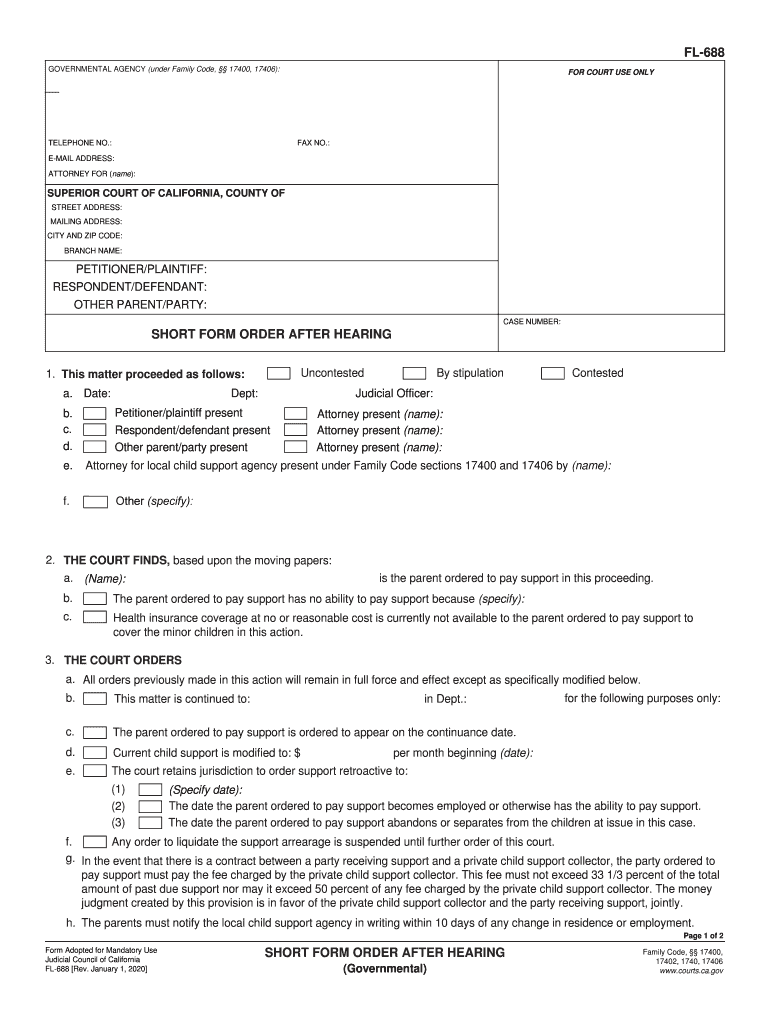
A short form order after a hearing is a legal document often used within the judicial system to briefly summarize the decisions made by a court following a hearing. Predominantly used in family law, especially in the context of child support or custody hearings, this form provides an essential record of the court's determinations on pertinent issues. It concisely outlines the court's findings regarding financial responsibilities, custody arrangements, and other relevant mandates arising from the hearing. In California, this is manifested through document FL-688, which specifies obligations and changes applicable to both parents involved in post-hearing matters.
How to Use the Short Form Order After Hearing
To effectively utilize a short form order after a hearing, one must first understand its purpose. The order formalizes the decisions made by a judge and ensures compliance. Once received, relevant parties should:
- Carefully review the contents to understand the decisions.
- Ensure all stipulated parties comply with the orders.
- Keep the document on hand for future reference or to support compliance arguments.
- Notify involved parties of changes, such as adjustments in child support payments or custody arrangements.
How to Obtain the Short Form Order After Hearing
Acquiring a short form order after a court hearing typically involves a few straightforward steps:
- Attend the scheduled court hearing regarding your case.
- Post-hearing, the court will draft the short form order, summarizing its decisions.
- The court clerk or your legal representative will provide a copy of this order.
- In some jurisdictions, you may access this document via the court's online portal or need to request it through formal channels at the court office.
Steps to Complete the Short Form Order After Hearing
While the completion of a short form order is primarily handled by court officials, here’s a simplified overview of the process:
- The judge dictates the order's terms based on hearing proceedings.
- Clerks document the order, ensuring all legal standards are met.
- Copies are distributed to involved parties or their legal representatives.
- Recipients must verify that the document reflects the court's verbal decisions.
- Correct inaccuracies through direct communication with the court.
Important Terms Related to the Short Form Order After Hearing
Understanding key terms associated with a short form order after hearing aids in its comprehension and application:
- Custodial Responsibility: Defines which parent retains primary care and decision-making for a child.
- Modification: Changes to existing court orders potentially arising from new evidence or circumstances.
- Compliance: Adherence to the terms set out within the court order.
- Service: The formal process by which orders and legal documents are delivered to involved parties.
Legal Use of the Short Form Order After Hearing
Legally, the short form order serves as an enforceable document that supports compliance with judicial decisions. It provides a formal, documented structure for:
- Emphasizing compliance in ongoing court-supervised matters.
- Allowing parties to address disputes or appeals with documented reference points.
- Protecting the legal and financial interests of involved parties.
- Assisting law enforcement or other authorities in executing court-ordered actions.
Key Elements of the Short Form Order After Hearing
The critical components of a short form order often include:
- Parties Involved: Identification of individuals directly affected by the order.
- Findings and Rulings: A succinct summary of the court's decisions.
- Obligations: Specific actions or changes imposed on each party.
- Timeframes: Deadlines for compliance or implementation of changes.
- Signatures: Authorization by the presiding judge and sometimes acknowledgment by the parties involved.
State-Specific Rules for the Short Form Order After Hearing
Rules governing the structure and implementation of short form orders can vary significantly by state, impacting:
- The form's format.
- Distribution procedures.
- Compliance enforcement mechanisms.
- Variances in contestation or amendment processes depending on local statutes.
Understanding these state-specific nuances is crucial for legal professionals and individuals involved in legal proceedings, ensuring comprehensive compliance and awareness of potential legal recourses.