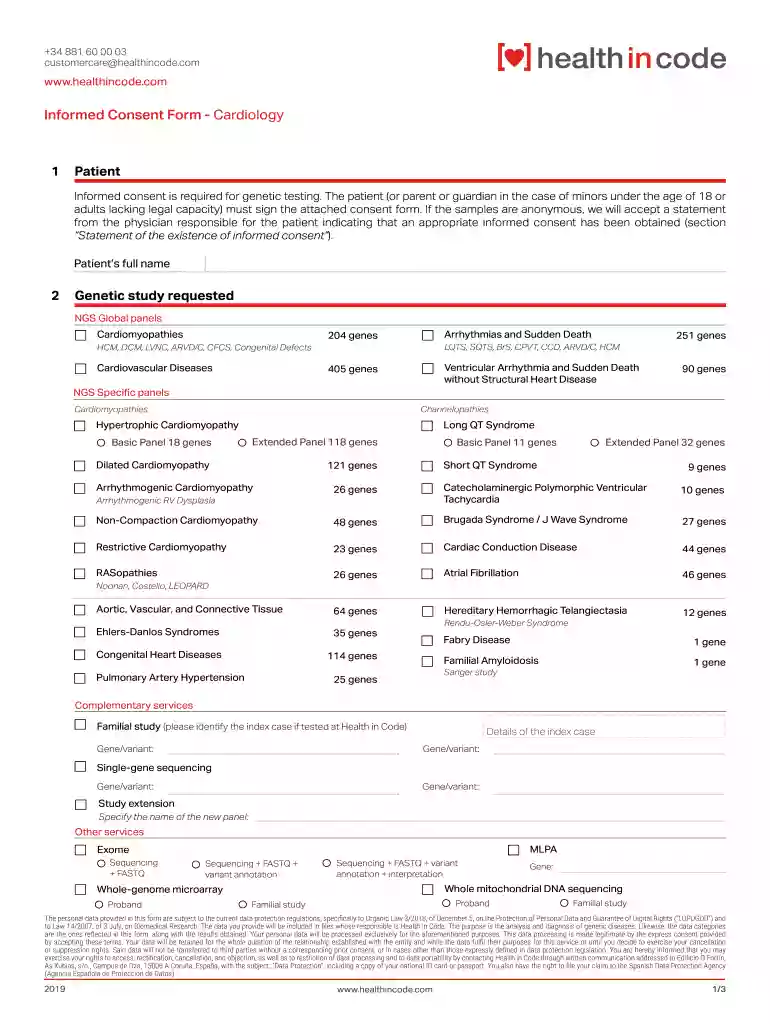
Informed Consent Form - Cardiology 2026

Get Form
high risk consent Preview on Page 1

Here's how it works

01. Edit your high risk consent online
Type text, add images, blackout confidential details, add comments, highlights and more.

02. Sign it in a few clicks
Draw your signature, type it, upload its image, or use your mobile device as a signature pad.

03. Share your form with others
Send high risk consent form via email, link, or fax. You can also download it, export it or print it out.

Definition & Meaning

The "Informed Consent Form - Cardiology" is a crucial document used in the medical field to ensure that patients give their informed consent for genetic testing related to cardiovascular diseases. It involves obtaining the patient's or their legal guardian's signature to authorize various genetic studies. Informed consent is a process by which a patient voluntarily agrees to undergo a particular medical procedure or treatment after being informed of all the potential risks, benefits, and alternatives.

Purpose of the Form

  • Ensures Patient Understanding: The form provides detailed information about the genetic tests offered, allowing patients to make informed decisions.
  • Authorizes Genetic Testing: The primary function of the form is to secure legal authorization from the patient for conducting specific genetic studies.
  • Outlines Patient Rights: It specifies the rights of patients concerning their personal data and test results, ensuring transparency and control over their information.

Key Elements of the Informed Consent Form - Cardiology

The form comprises several critical components designed to provide comprehensive information to the patient, ensuring they fully understand the nature of the tests and their potential outcomes.

Essential Components

  • Types of Genetic Tests: Lists the specific tests available, along with a description of what each test analyzes.
  • Implications of Test Results: Explains the potential findings, including both expected and unexpected genetic disorders.
  • Confidentiality Assurance: Details the data protection measures in place, ensuring the privacy of patient information.

Steps to Complete the Informed Consent Form - Cardiology

Completing the Informed Consent Form involves several meticulous steps to ensure accuracy and compliance with legal and medical standards.

  1. Review Information: Thoroughly read all provided information, focusing on the types of genetic tests and their implications.
  2. Consult with a Healthcare Provider: Discuss any questions or concerns with your cardiologist or another qualified healthcare professional.
  3. Provide Personal Information: Fill in required fields with accurate personal details, ensuring consistency with medical records.
  4. Acknowledge Understanding: Sign or initial sections that confirm understanding of the information provided.
  5. Authorize Testing: Provide a signature to authorize the specific genetic tests outlined in the form. If a legal guardian is involved, ensure they complete their required sections as well.

Legal Use of the Informed Consent Form - Cardiology

The legal framework surrounding the Informed Consent Form is designed to protect both the patient and the healthcare provider.

Legal Considerations

  • Regulatory Compliance: Ensures adherence to relevant federal and state laws governing genetic testing and patient rights.
  • Binding Agreement: Once signed, the form becomes a legally binding document indicating patient consent for the procedures outlined.
  • Patient Autonomy: Legally supports the patient's right to make informed decisions regarding their health care and genetic testing.

Important Terms Related to Informed Consent Form - Cardiology

Understanding key terms related to the form can significantly aid in comprehending its implications and requirements.

  • Genetic Testing: A medical test that identifies changes in chromosomes, genes, or proteins, often used to detect genetic disorders.
  • Cardiovascular Diseases: A range of heart and blood vessel disorders that genetic tests may help diagnose or predict.
  • Data Protection Regulations: Legal mandates, including HIPAA in the U.S., which safeguard patient health information.

Who Typically Uses the Informed Consent Form - Cardiology?

This form is primarily utilized within the cardiology and broader medical fields involving genetic testing for diseases.


decoration image ratings of Dochub

Typical Users

  • Patients: Individuals undergoing genetic testing for cardiology-related conditions.
  • Healthcare Providers: Cardiologists and other medical professionals offering genetic tests.
  • Researchers: Occasionally used in clinical research involving genetic studies in cardiology.
  • Legal Guardians: Required for minors or adults unable to provide consent independently.

Why Should You Use the Informed Consent Form - Cardiology?

The necessity of using an informed consent form is multifaceted, offering protections and assurances for both patients and providers.

Benefits of Using the Form

  • Informed Decision-Making: Equips patients with the knowledge needed to make educated choices about their medical care.
  • Legal Protection: Shields healthcare providers from legal repercussions by documenting informed patient consent.
  • Quality of Care: Enhances the quality of patient care by ensuring all parties understand the procedures and potential outcomes.

Examples of Using the Informed Consent Form - Cardiology

This form can be contextualized through various scenarios to demonstrate its utility and application.

Practical Scenarios

  • Pre-Surgical Testing: Used when genetic testing is necessary prior to surgical procedures to assess risk factors.
  • Research Participation: Required when patients partake in research studies focusing on genetic predispositions to heart disease.
  • Clinical Diagnostics: Integral in diagnostic settings where genetic information may refine or confirm a cardiological diagnosis.

These sections ensure that patients and healthcare professionals comprehensively understand, utilize, and safeguard the informed consent process within cardiology-related genetic testing.

See more Informed Consent Form - Cardiology versions

We've got more versions of the Informed Consent Form - Cardiology form. Select the right Informed Consent Form - Cardiology version from the list and start editing it straight away!
Versions Form popularity Fillable & printable
2020 4.8 Satisfied (60 Votes)
2019 4.3 Satisfied (64 Votes)
2018 4.2 Satisfied (51 Votes)
be ready to get more

Complete this form in 5 minutes or less

Get form

Got questions?

We have answers to the most popular questions from our customers. If you can't find an answer to your question, please contact us.
Contact us
Elements of Informed Consent Title of the Study. Names and Affiliations of the Primary Investigator. If a student is conducting the study, state the students information first. Purpose of the Study. Subject Selection Criteria. Study Procedures. Potential Risks and Discomforts. Potential Benefits. Cost and Compensation.
Invasive cardiac catheterization and invasive coronary angiography (CA) are the gold standards to diagnose relevant coronary artery disease [12], [13]. For elective catheterization, patients with stable angina pectoris give their written informed consent usually the day before the procedure.
The informed consent process involves three key features: (1) disclosing to potential research subjects information needed to make an informed decision; (2) facilitating the understanding of what has been disclosed; and (3) promoting the voluntariness of the decision about whether or not to participate in the research.
Its also important to remember the 4 Cs of consent: clear, continuous, conscious, coercion-free: Clear: Communication, both verbal and nonverbal, with a partner is crucial.
Informed Consent, psychologists inform participants about (1) the purpose of the research, expected duration and procedures; (2) their right to decline to participate and to withdraw from the research once participation has begun; (3) the foreseeable consequences of declining or withdrawing; (4) reasonably foreseeable

Security and compliance

At DocHub, your data security is our priority. We follow HIPAA, SOC2, GDPR, and other standards, so you can work on your documents with confidence.

Learn more
ccpa2
pci-dss
gdpr-compliance
hipaa
soc-compliance

People also ask

The entire informed consent process involves giving a subject adequate information concerning the study, providing adequate opportunity for the subject to consider all options, responding to the subjects questions, ensuring that the subject has comprehended this information, obtaining the subjects voluntary agreement
Instructions for Developing an Informed Consent Document General Information. Describe the purpose(s) of this research study in lay terms. Purpose of the Study. Procedures. Risks. Benefits. Compensation, Costs and Reimbursement. Withdrawal or Termination from Study. Confidentiality.

high risk consent form for icu