




01. Edit your form online
Type text, add images, blackout confidential details, add comments, highlights and more.

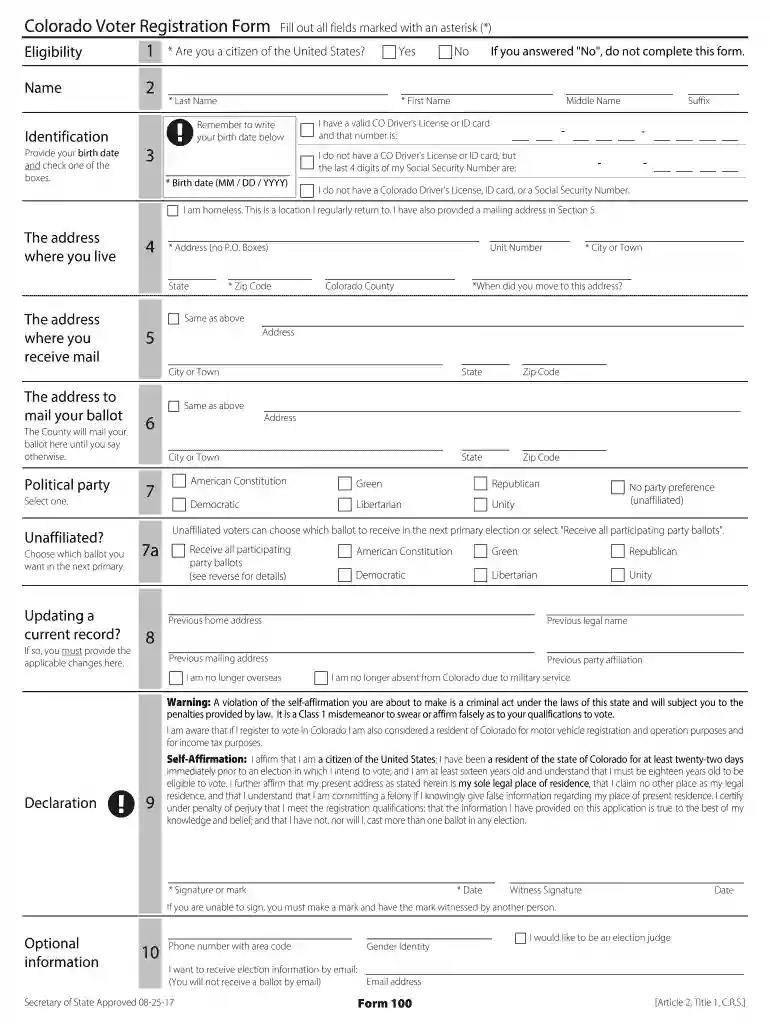
Type text, add images, blackout confidential details, add comments, highlights and more.

Draw your signature, type it, upload its image, or use your mobile device as a signature pad.

Send it via email, link, or fax. You can also download it, export it or print it out.
CO Form 100 is primarily known as the Colorado Corporation Income Tax Return. This form is used by corporations operating within the state of Colorado to report their income and calculate the amount of state tax owed. The form includes sections for reporting the corporation's income, deductions, credits, and any applicable adjustments, which are essential for determining the final tax liability.
Corporations are required to complete this form annually and submit it to the Colorado Department of Revenue. The purpose of CO Form 100 is to ensure that corporate taxpayers accurately report their income and comply with their state tax obligations. Understanding the importance of this form is crucial for corporations seeking to maintain good standing with state tax authorities.
Gather Financial Documentation: Before starting, ensure that you have all necessary financial documents, including income statements, balance sheets, and records of any relevant deductions or credits.
Report Income: Enter the corporation's income as detailed in the federal tax return on the appropriate lines. This typically includes gross receipts or sales, less any returns or allowances.
Calculate Deductions: Complete the section for deductions, which may include operating expenses, cost of goods sold, and other allowable deductions.
Apply Credits: Identify any applicable tax credits that the corporation may be eligible for and enter them accordingly. This can include credits for economic development or renewable energy investments.
Determine Tax Liability: Calculate the net income after deductions and apply the appropriate Colorado tax rates to determine the state tax liability.
Submit the Form: Ensure that the form is signed by an authorized officer of the corporation and submit it by the designated method (mail, electronic filing, or in-person), ensuring adherence to the state deadline.
CO Form 100 can be obtained from multiple sources:
Colorado Department of Revenue Website: The most reliable source is the official website of the Colorado Department of Revenue, where you can download the latest version of the form and any accompanying instructions.
Online Tax Software: Many commercial tax filing software programs, like TurboTax or QuickBooks, include CO Form 100 as part of their state returns package, allowing for digital preparation and filing.
Tax Professionals: Corporations may also seek the services of tax professionals or certified public accountants (CPAs) who can provide paper or electronic copies of the form, as well as guidance on accurately completing and submitting it.
Filing CO Form 100 is a legal requirement for corporations operating in Colorado. The submission must be accurate and timely to avoid penalties or interest for late filing or underreported income. Corporations must maintain records of income, deductions, and credits for several years in case of audit.
Additionally, federal tax return information is often used as the starting point for completing the Colorado form. It is important for corporations to ensure consistency between their state and federal tax returns to avoid discrepancies that could trigger an audit.
Identifying Information: This includes the corporation’s name, address, and federal employer identification number (EIN).
Income and Deductions: Sections for reporting total income and allowable deductions are crucial for calculating tax liability.
Credits: Details of any applicable state tax credits that reduce the overall tax owed.
Payment Details: Information on tax payments made throughout the year, including estimated payments and credits carried over from previous years.
Declaration and Signatures: A statement declaring the accuracy of the information provided, which must be signed by an authorised officer.
Colorado tax law includes specific regulations regarding the filing of corporate taxes. For instance, the state adheres to certain federal tax concepts but may apply unique rates and credits. Colorado also mandates that corporations conduct a reconciliation of certain income and expense items due to differences between federal and state tax laws.
Understanding Colorado-specific rules is essential for corporations to prepare their state tax return accurately. Regulations might include unique filing thresholds, special credits, or deductions exclusive to the state.
Corporations will typically require several supporting documents to accompany CO Form 100, including:
Federal Tax Return Copies: These are needed to provide a comparative basis for the state return.
Financial Statements: Detailed reports of income, expenses, and any relevant adjustments.
Receipts for Deductions and Credits: Documentation supporting claims on the return for audit purposes.
Corporations must ensure accuracy in aligning these documents with their state return submissions.
The deadline for filing CO Form 100 generally aligns with the federal corporate tax filing deadline, which is typically April 15, unless affected by holidays or weekends. Corporations can file for an extension if more preparation time is needed, prolonging the deadline by six months. However, extensions allow more time to file, not to pay any taxes due.
Corporations should promptly adhere to these deadlines to avoid penalties, and proactively seek extensions if necessary to ensure complete and accurate reporting.
We've got more versions of the co form 100 form. Select the right co form 100 version from the list and start editing it straight away!
At DocHub, your data security is our priority. We follow HIPAA, SOC2, GDPR, and other standards, so you can work on your documents with confidence.
Nonprofit, Reimbursable, and Government Employers should complete and submit Form UITL-100, Application for Unemployment Insurance Account and DeterminationRead more
The RP-5217-PDF Real Property Transfer Report (RPL Article 9, Section 333) is a one-part, downloadable, barcoded, pdf form used to document the informationRead more


