




Here's how it works

01. Edit your form online
Type text, add images, blackout confidential details, add comments, highlights and more.

02. Sign it in a few clicks
Draw your signature, type it, upload its image, or use your mobile device as a signature pad.

03. Share your form with others
Send it via email, link, or fax. You can also download it, export it or print it out.
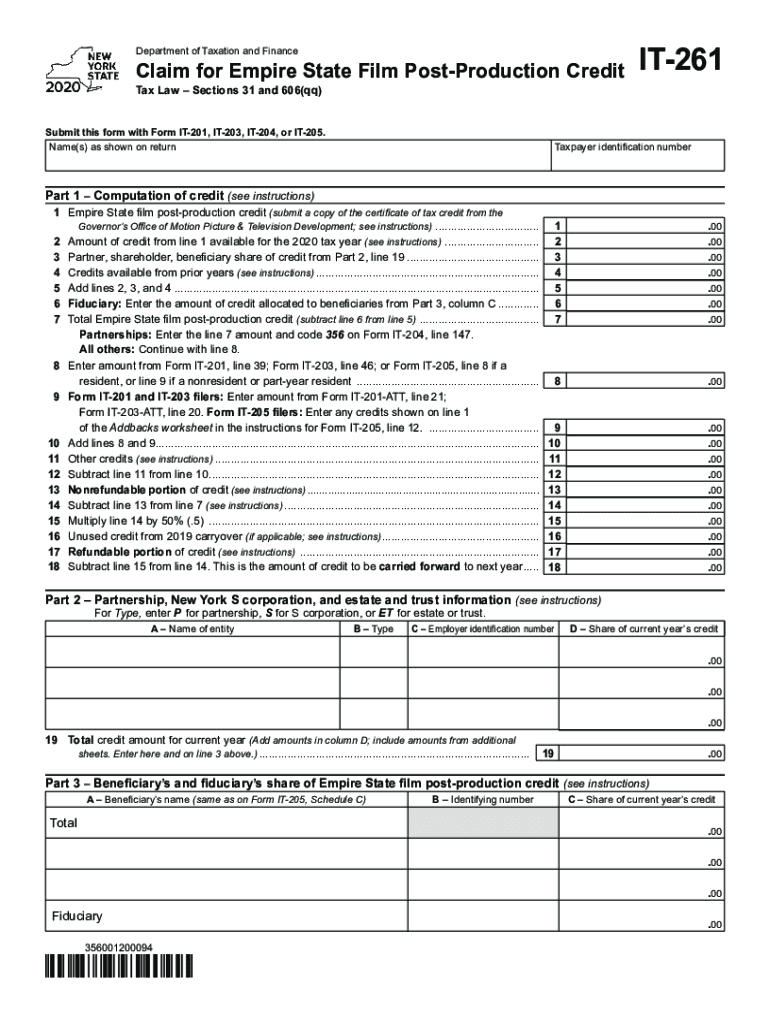
How to use or fill out ny it 261 with our platform

- Click ‘Get Form’ to open the ny it 261 in the editor.
- Begin by entering your name(s) as shown on your tax return and your taxpayer identification number at the top of the form.
- In Part 1, compute your Empire State film post-production credit. Start with line 1 by submitting a copy of the certificate from the Governor’s Office. Follow through lines 2 to 7, ensuring you accurately add any credits available from prior years.
- For line 8, enter the amount from your relevant IT form based on your residency status. Continue filling out lines 9 through 18, subtracting and multiplying as instructed to determine your nonrefundable and refundable portions.
- In Part 2, provide details for partnerships or S corporations, including names and employer identification numbers. Calculate total credits in line 19.
- Complete Part 3 by listing beneficiaries' names and their share of credits. Finally, fill out Part 4 for amounts to be claimed in future tax years.
Start using our platform today for free to streamline your ny it 261 form completion!
Fill out ny it 261 online
It's free
See more ny it 261 versions
We've got more versions of the ny it 261 form. Select the right ny it 261 version from the list and start editing it straight away!
Got questions?
We have answers to the most popular questions from our customers. If you can't find an answer to your question, please contact us.
Contact us
What is the NY IT 2104 E exemption?
If you have more than one employer, you may submit Form IT‑2104‑E to each employer to claim exemption from withholding, if: your total expected income will not incur a New York income tax liability for the year 2025, and you had no liability for 2024.
Is it better to claim an exemption or not?
Tax exemptions help reduce the taxable income you owe taxes on, lowering your overall tax liability. Whether youre claiming the standard deduction, applying for property tax exemptions, or supporting a tax-exempt organization, understanding how these exemptions work can help you maximize your tax savings.
How many allowances should I claim in 2104?
When you use the form IT-2104 Employees Withholding Allowance Certificate for your state and city taxes, you may claim as many allowances as are justified by your circumstances. However, if you claim more than 14 allowances, you must complete the Withholding Certificate Affirmation.
Who needs to pay the NYC city tax?
New York City residents must pay a personal income tax, which is administered and collected by the New York State Department of Taxation and Finance. Most New York City employees living outside of the five boroughs (hired on or after January 4, 1973) must file form NYC-1127.
What is NY IT 225?
IT-225 is a modification form that is used to report additions or subtractions to federal adjusted gross income and has been updated to include a reason code (S-143) that is specifically used to identify HWB income. The form is available here, and instructions are here. The two new FAQs are copied below: Q.
Security and compliance
At DocHub, your data security is our priority. We follow HIPAA, SOC2, GDPR, and other standards, so you can work on your documents with confidence.
Learn more


Related forms

Nichols' 6 Modes of Documentary Might Expand Your Storytelling
The document analyzes the emergence of 'comedy verité,' a new mode of television comedy that blends observational docume ...

OPT Request Form select select - TCU International Student Services
The document is an OPT (Optional Practical Training) Request Form for international students at TCU, outlining the neces ...

Yin-yang and chi in acupuncture - Digital Collections at Texas State
The document is an honors thesis by Tiffany Pui Lin Chiu that explores the concepts of yin-yang and chi in acupuncture, ...

The multigenerational workforce: strategies for managing four - digital library txstate
The document is an honors thesis by Holly Louise Watson, presented to Texas State University-San Marcos, focusing on str ...

A CASE STUDY OF THE INCLUSION OF SIBLINGS IN EARLY INTERVENTION ACTIVITIES - digital library txstate
A CASE STUDY OF THE INCLUSION OF SIBLINGS IN EARLY INTERVENTION ACTIVITIES - digital library txstate
The document is a thesis by Megan J. Amidon that explores the inclusion of siblings in early intervention (EI) activitie ...

Course Descriptions: Math Department Mathematics and Statistics TTU
The document is a worksheet for a Precalculus course that covers the concepts of compound interest and exponential growt ...

Ready Raiders 2013 - Texas Tech University Health Sciences Center
The document outlines the Ready Raiders program, a two-week interdisciplinary group therapy initiative for children aged ...

Do not process prescription pad orders through TECHBUY
The document outlines the new procedure for ordering prescription pads at Texas Tech University Health Sciences Center, ...
People also ask
What makes you tax exempt in NY?
To claim exemption from New York State and City withholding taxes, you must docHub the following conditions in writing: You must be under age 18, or over age 65, or a full-time student under age 25 and. You did not have a New York income tax liability for the previous year; and.
What is a NY city tax warrant?
A tax warrant creates a lien against your real and personal property, and may: allow us to seize and sell your real and personal property, allow us to garnish your wages or other income, or. affect your ability to buy or sell property.
Is it better to claim 1 or 0 allowances?
Claiming 0 means more withheld. It reduces the take-home pay but possibly leads to a refund. Claiming 1 means less withheld. This option presents a larger paycheck but increases the risk of owing amounts at tax time.