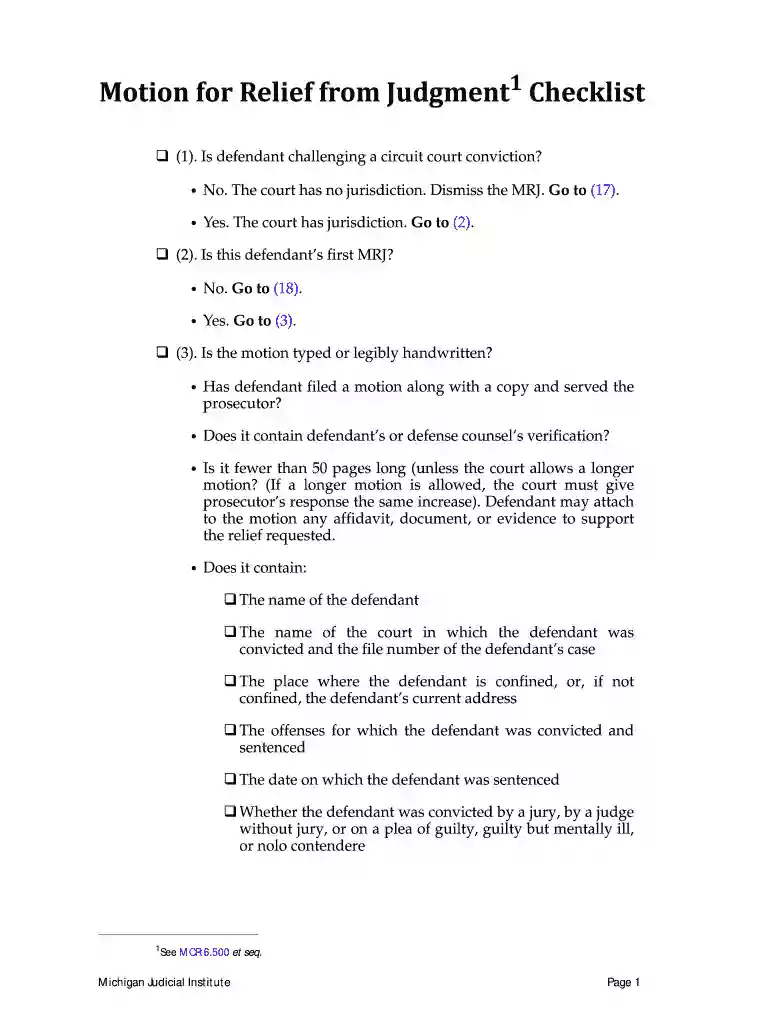
Michigan motion relief 2026

Get Form
motion for relief from judgment Preview on Page 1

Here's how it works

01. Edit your motion for relief from judgment online
Type text, add images, blackout confidential details, add comments, highlights and more.

02. Sign it in a few clicks
Draw your signature, type it, upload its image, or use your mobile device as a signature pad.

03. Share your form with others
Send it via email, link, or fax. You can also download it, export it or print it out.

How to use or fill out Michigan Motion Relief with our platform

Form edit decoration
9.5
Ease of Setup
DocHub User Ratings on G2
9.0
Ease of Use
DocHub User Ratings on G2
  1. Click ‘Get Form’ to open the Michigan Motion Relief document in the editor.
  2. Begin by confirming if you are challenging a circuit court conviction. If yes, proceed to the next section.
  3. Indicate whether this is your first motion for relief from judgment. If it is not, follow the instructions for subsequent motions.
  4. Ensure that your motion is typed or legibly handwritten and includes all necessary components such as your name, court details, and the offenses for which you were convicted.
  5. Fill in the specifics of your case including sentencing details, grounds for relief requested, and any supporting facts. Make sure to verify compliance with all requirements outlined in the checklist.
  6. Once completed, review your entries for accuracy before submitting through our platform.

Start using our platform today to easily fill out and submit your Michigan Motion Relief form for free!

See more michigan motion relief versions

We've got more versions of the michigan motion relief form. Select the right michigan motion relief version from the list and start editing it straight away!
Versions Form popularity Fillable & printable
2019 4.8 Satisfied (139 Votes)
2017 2.9 Satisfied (28024 Votes)
be ready to get more

Complete this form in 5 minutes or less

Get form

Got questions?

We have answers to the most popular questions from our customers. If you can't find an answer to your question, please contact us.
Contact us
In Michigan, arraignments must take place without unnecessary delay. If a person is not arraigned within a reasonable time, the case will be dismissed but it is subject to being reinstated at a later date.
The court must sign a properly submitted proposed judgment or order if no written objections have been filed within 7 days after service of notice, as long as the judgment or order is consistent with the courts decision. MCR 2.602(B)(3). (This is commonly referred to as the Seven-Day Rule.)
If you do not file written objections to the proposed order within 7 days of the date of this notice, the judge may sign the proposed order without a hearing. If the judge decides that a hearing is needed, you will be notified of the hearing date.
Judgment liens last for five years. But, a creditor can renew the lien until your judgment expires. Most judgments in Michigan expire after 10 years.
2.313(E) Electronically Stored Information. A court may not impose sanctions under this rule for the failure to produce information, including electronically stored information, that was destroyed under a reasonable record destruction policy unless the party violates Rule 2.302(B)(5).

Security and compliance

At DocHub, your data security is our priority. We follow HIPAA, SOC2, GDPR, and other standards, so you can work on your documents with confidence.

Learn more
ccpa2
pci-dss
gdpr-compliance
hipaa
soc-compliance
be ready to get more

Complete this form in 5 minutes or less

Get form

People also ask

A 6.500 Motion is often referred to as a Motion for Relief from Judgment and is a form of post-judgment relief. This type of motion is for a defendant who has either exhausted all of their state appeals, missed filing deadlines, or cannot lawfully appeal in the federal court system.
If you have been convicted of a crime in Michigan and believe that you have grounds for relief from the judgment, you may file a motion for relief under MCR 6.500. This motion must be filed in the circuit court where the conviction occurred.

Related links