




01. Edit your form 501 corp declaration of directors and officers online
Type text, add images, blackout confidential details, add comments, highlights and more.

Type text, add images, blackout confidential details, add comments, highlights and more.

Draw your signature, type it, upload its image, or use your mobile device as a signature pad.

Send declaration of directors and officers via email, link, or fax. You can also download it, export it or print it out.
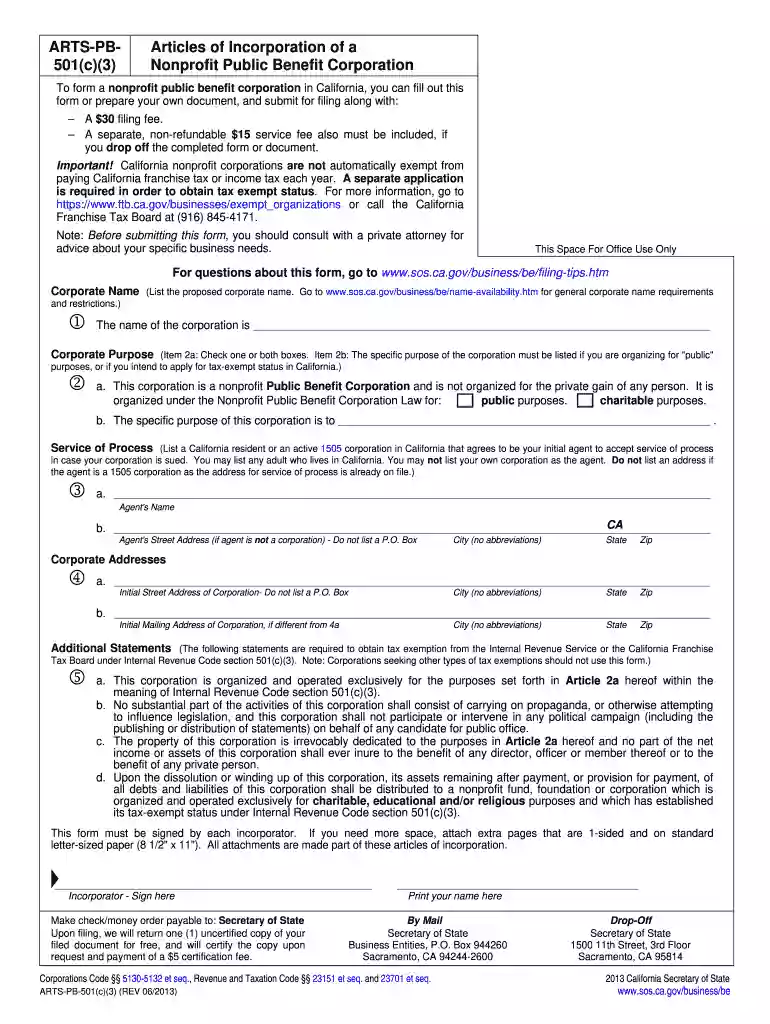
The Arts PB 501(c)(3) form serves as a crucial document for organizations seeking tax-exempt status under Internal Revenue Code section 501(c)(3). This designation is reserved for nonprofit entities that operate for charitable, educational, scientific, or religious purposes. By achieving 501(c)(3) classification, organizations can benefit from tax exemptions and provide donors with the ability to make tax-deductible contributions. The term “PB” typically refers to "Public Benefit", indicating that the organization is set up for the public's advantage rather than private gain.
Organizations must clearly establish their purpose within the application, detailing how they plan to serve the community or specific public interests. To meet the IRS requirements for arts-centric nonprofits, an organization must demonstrate a strong commitment to cultural or artistic endeavors, such as promoting the arts, organizing performances, or supporting artists through various programs.
Nonprofits must also include a detailed narrative describing their mission, the population served, and how they plan to utilize funds raised. This clear definition is essential not only for IRS approval but also for gaining the trust of potential donors and stakeholders.
Completing the Arts PB 501(c)(3) application involves several steps, each essential to ensuring compliance with IRS regulations:
Define Organizational Purpose:
Organizational Structure:
Compile Required Documentation:
Complete IRS Form 1023:
Review and Submit Application:
Await IRS Determination:
Successful completion of these steps will lead to the organization being recognized as tax-exempt under 501(c)(3), enabling it to actively pursue funding opportunities and support its mission.
Understanding specific terms related to the Arts PB 501(c)(3) is vital for compliance and operational management:
Familiarity with these terms will assist in navigating the legal and operational landscape of maintaining a successful arts-based nonprofit organization.
Awareness of filing deadlines is critical for maintaining compliance with IRS regulations and ensuring timely processing of the Arts PB 501(c)(3) application:
Tracking these deadlines ensures that organizations remain compliant and retain their tax-exempt status, allowing them to focus on their missions within the arts community.
The application process for the Arts PB 501(c)(3) can be complex and time-consuming:
Organizations should plan accordingly and be patient through this process, as obtaining 501(c)(3) status is a significant step toward accessing funding opportunities and achieving their mission.
Real-world applications of the Arts PB 501(c)(3) can vary widely, showcasing the diverse missions and impacts of arts-related nonprofits:
These examples illustrate how diverse nonprofits leverage the Arts PB 501(c)(3) designation to enhance public access to arts and culture while fulfilling their unique missions.
We've got more versions of the form 501 corp declaration of directors and officers form. Select the right form 501 corp declaration of directors and officers version from the list and start editing it straight away!
At DocHub, your data security is our priority. We follow HIPAA, SOC2, GDPR, and other standards, so you can work on your documents with confidence.
Apr 13, 2018 ARTS-PB- 501(c)(3) Incorporation of a Nonprofit Public Benefit Corporation ) The name of the corporation is Las Positas College Viticulture
Nov 6, 2020 This corporation is organized and operated exclusively for the purposes set forth in Article 4 hereof within the meaning of Internal. RevenueRead more
PM(401)-501. American languages of the United States (and Mexico). PM549 The performing arts. Show business. PN1585-1589. Centers for the performingRead more


