




01. Edit your maine health care advance directive form online
Type text, add images, blackout confidential details, add comments, highlights and more.

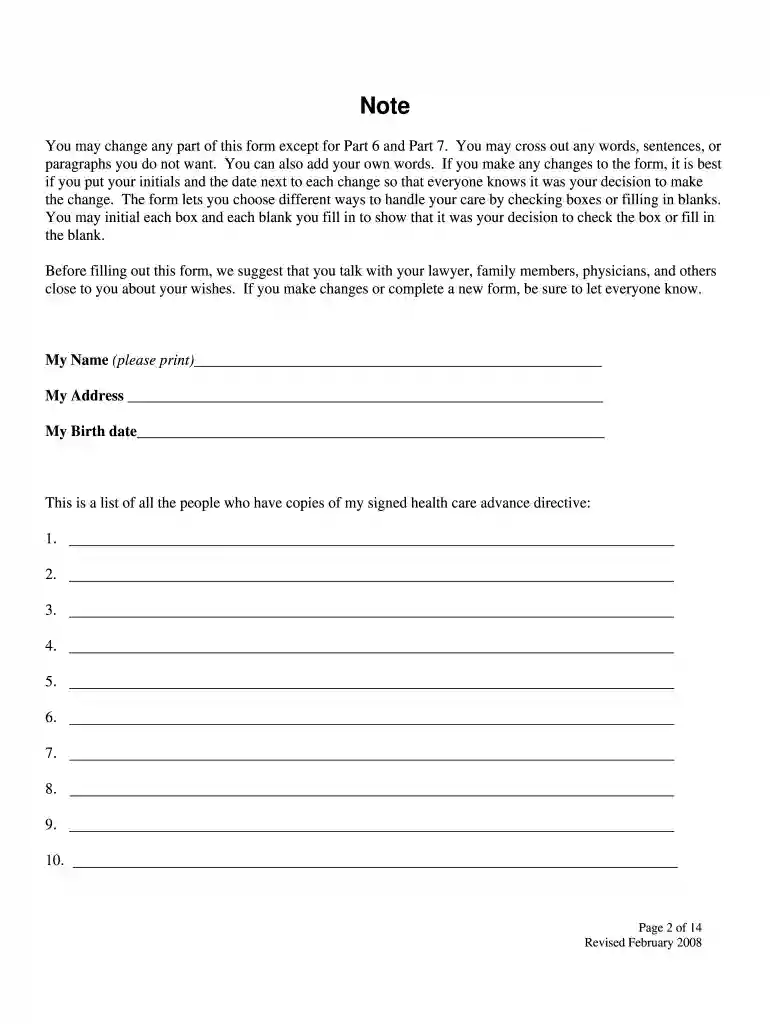
Type text, add images, blackout confidential details, add comments, highlights and more.

Draw your signature, type it, upload its image, or use your mobile device as a signature pad.

Send maine advance directive form pdf via email, link, or fax. You can also download it, export it or print it out.
The Maine Health Care Advance Directive Form is crucial for individuals wishing to outline their medical care preferences should they become unable to express their wishes due to illness or incapacity. This legally binding document primarily covers designating a health care agent, outlining decisions about life-sustaining treatments, organ donation, and funeral arrangements. By specifying these preferences, individuals can ensure that their healthcare choices are respected and followed in critical situations. The form underscores the importance of discussing these decisions with family and healthcare providers to ensure everyone understands the individual’s desires and intentions.
Utilizing the Maine Health Care Advance Directive Form involves a series of thoughtful steps to ensure it accurately reflects the individual's wishes:
Appoint a Health Care Agent: Select a trusted person to make healthcare decisions on your behalf if you cannot communicate. Discuss your medical preferences with this person thoroughly.
Detail Your Medical Treatment Preferences: Clearly outline what types of medical treatments and interventions you want or do not want. This section can include decisions about life support, resuscitation, and dialysis among others.
Include Organ Donation Wishes: Specify whether you wish to be an organ donor and detail any specific organs or tissues you wish or do not wish to donate.
Plan Funeral Arrangements: If desired, provide instructions for funeral arrangements to ease decision-making for loved ones after your passing.
Sign the Form with Witnesses: To be valid, the form must be signed by you in the presence of witnesses who affirm your mental capacity and voluntary signing.
Completing this form involves several key steps to ensure it fulfills legal requirements and personal desires:
Read the Form Thoroughly: Before filling it out, review each section to understand its implications fully.
Fill Out Personal Information: Begin by providing your full name, address, and other identifying details.
Select and Appoint a Health Care Agent: Choose a person who knows your values and desires, and provide their contact details.
Clarify Health Care Instructions: Indicate your preferences for treatments and scenarios that could arise.
Add Additional Directives if Needed: You may include extra instructions or scenarios not covered in the form's standard sections.
Ensure Proper Signing and Witnessing: Sign the form in front of witnesses and, if required, a notary public, to validate the directive legally.
The form comprises several critical components designed to comprehensively capture an individual's medical and post-life preferences:
Health Care Agent Designation: Details about the chosen representative responsible for medical decisions.
Treatment Preferences: Sections for specifying desires related to treatments like life support and artificial nutrition.
Organ Donation and Anatomical Gifts: Space for indicating organ donation choices.
Funeral and Burial Instructions: Optionally include preferences for post-mortem arrangements.
Legal Validation Requirements: Signing and witness requirements for form authenticity.
The form must comply with Maine’s laws to be enforceable:
Witness Requirements: In Maine, the form must be signed in the presence of two witnesses who are not directly involved in the person's care or inheritance.
Agent Restrictions: The person appointed as the health care agent cannot act as a witness.
Legal Age: The signatory must be at least eighteen years old and of sound mind.
Revocation Conditions: The document can be revoked or altered at any time by the signatory as long as they remain competent.
The form is a legally binding document ensuring that an individual’s healthcare preferences are respected under the law when they cannot articulate them themselves. Under the ESIGN Act, electronic signatures are legally acceptable, but it is advisable to verify local compliance requirements regarding electronic submissions and uniquely state-specific conditions.
Understanding key terms is crucial:
Advance Directive: A legal document outlining medical preferences when one can’t communicate them.
Health Care Agent: A person appointed to make healthcare decisions on behalf of someone incapacitated.
Life-Sustaining Treatment: Medical procedures that extend the life of someone terminally ill or in a persistent state of incapacity.
Organ Donation: The act of giving organs or tissues for transplants upon death.
Revocation: The act of nullifying or amending the document, possible anytime by the signatory.
Consider hypothetical scenarios that demonstrate the form’s practical application:
Scenario One: Terminal Illness: An individual diagnosed with a terminal illness uses the form to refuse aggressive treatments, opting for palliative care instead. This allows their appointed agent to communicate these wishes to healthcare providers without ambiguity.
Scenario Two: Unconsciousness from Accident: Following a severe car accident, a patient is unable to communicate. The advance directive gives the appointed health care agent authority to make critical decisions about surgical interventions per previously stated preferences.
Scenario Three: Dementia: An elderly individual with advancing dementia confirms their care preferences through the form before losing the capacity for decision-making, ensuring their autonomy over health care decisions is preserved.
These examples underscore the form’s role in upholding personal autonomy and ensuring clarity during critical health situations.
We've got more versions of the maine health care advance directive form form. Select the right maine health care advance directive form version from the list and start editing it straight away!
At DocHub, your data security is our priority. We follow HIPAA, SOC2, GDPR, and other standards, so you can work on your documents with confidence.



Sep 7, 2004 I grant to my Agent the power and authority to serve as my Personal Representative for all purposes under the Health Insurance Portability andRead more
Select your state below to find free advance directive forms for where you live. Youll find instructions on how to fill out the forms at each link.Read more


