Stormsmart coasts fencing 2026

Get Form
stormsmart coasts fencing Preview on Page 1

Here's how it works

01. Edit your form online
Type text, add images, blackout confidential details, add comments, highlights and more.

02. Sign it in a few clicks
Draw your signature, type it, upload its image, or use your mobile device as a signature pad.

03. Share your form with others
Send it via email, link, or fax. You can also download it, export it or print it out.

How to use or fill out stormsmart coasts fencing with our platform

Form edit decoration
9.5
Ease of Setup
DocHub User Ratings on G2
9.0
Ease of Use
DocHub User Ratings on G2
  1. Click ‘Get Form’ to open the stormsmart coasts fencing document in the editor.
  2. Begin by reviewing the introduction section, which outlines the importance of sand fencing for coastal protection. This will help you understand the context and significance of your project.
  3. Fill out your personal information in the designated fields, ensuring accuracy for any follow-up communications regarding your project.
  4. Proceed to the sections detailing design considerations. Here, you can input specific details about your proposed sand fencing project, including location and materials.
  5. Review any regulatory requirements mentioned in the form. Make sure to check boxes or provide notes as necessary to indicate compliance with local regulations.
  6. Finally, save your completed form and utilize our platform’s sharing features to distribute it to relevant stakeholders or submit it for approval.

Start using our platform today for free to streamline your stormsmart coasts fencing project!

See more stormsmart coasts fencing versions

We've got more versions of the stormsmart coasts fencing form. Select the right stormsmart coasts fencing version from the list and start editing it straight away!
Versions Form popularity Fillable & printable
2018 4.8 Satisfied (94 Votes)
2013 4.4 Satisfied (82 Votes)
be ready to get more

Complete this form in 5 minutes or less

Get form

Got questions?

We have answers to the most popular questions from our customers. If you can't find an answer to your question, please contact us.
Contact us
Description. Wind fences (also called sand fences) are barriers made of permeable fabric or small, evenly spaced wooden slats. Construction staff wind fences to reduce wind velocity and to trap blowing sand.
Sand fences are widely applied to prevent soil erosion by wind in areas affected by dedocHubcation. Sand fences also provide a way to reduce the emission rate of dust particles, which is triggered mainly by the impacts of wind-blown sand grains onto the soil and affects the Earths climate.
Building semi-permeable fences along the seaward or the prevailing wind side of dunes encourages windblown sand to accumulate, reduces trampling, and protects both existing and newly planted vegetation. Various fencing materials can effectively enhance natural dune recovery.
Dune fencing: construction of fences along the seaward face of the dune to reduce wind speed on the surface and encourage foredune deposition of transported sediment. Fences are often constructed of wood. Depending on local circumstances they can also use other material (including, for example, used fish netting).
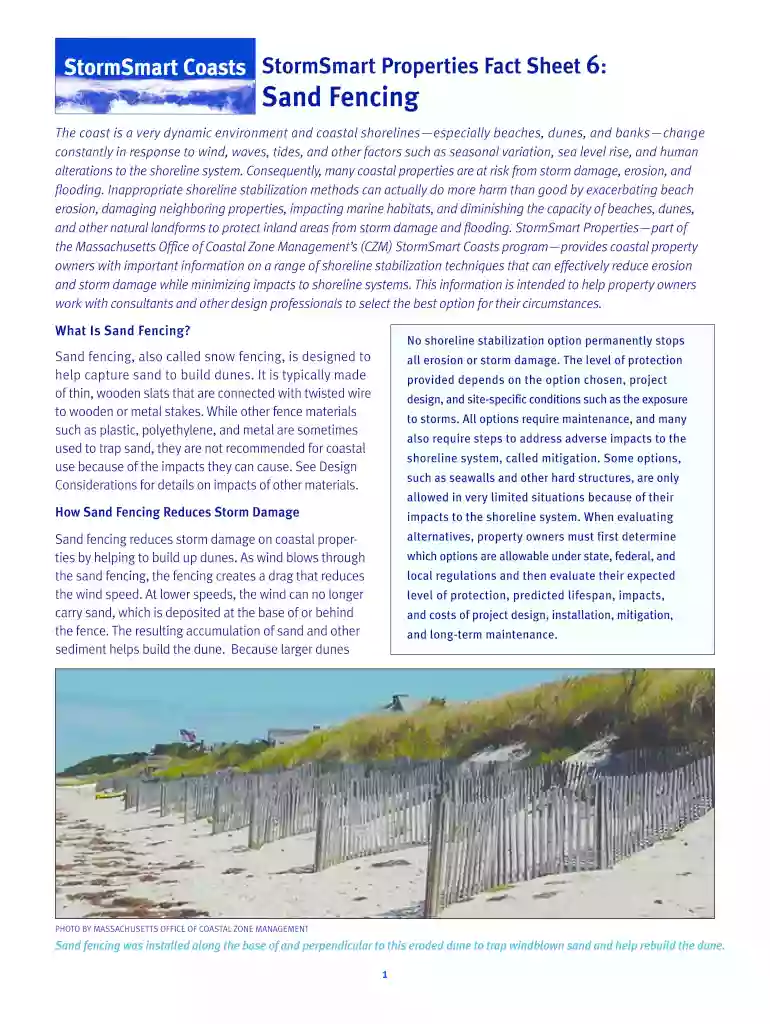
Sand fencing on a beach or dune can assist in building a new foredune or fill gaps in dune ridges. The fence reduces local wind speed and traps sand, with different fence configurations creating different dune forms and heights.

Security and compliance

At DocHub, your data security is our priority. We follow HIPAA, SOC2, GDPR, and other standards, so you can work on your documents with confidence.

Learn more
ccpa2
pci-dss
gdpr-compliance
hipaa
soc-compliance

People also ask

Erosion: Sand dunes are delicate ecosystems that can be easily damaged by human activity. Walking on them can cause erosion, leading to the loss of vegetation and the destabilization of the dune structure.
Sand dunes provide natural coastal protection against storm surge and high waves, preventing or reducing coastal flooding and structural damage, as well as providing important ecological habitat. They also act as sand storage areas, supplying sand to eroded beaches.

Related links