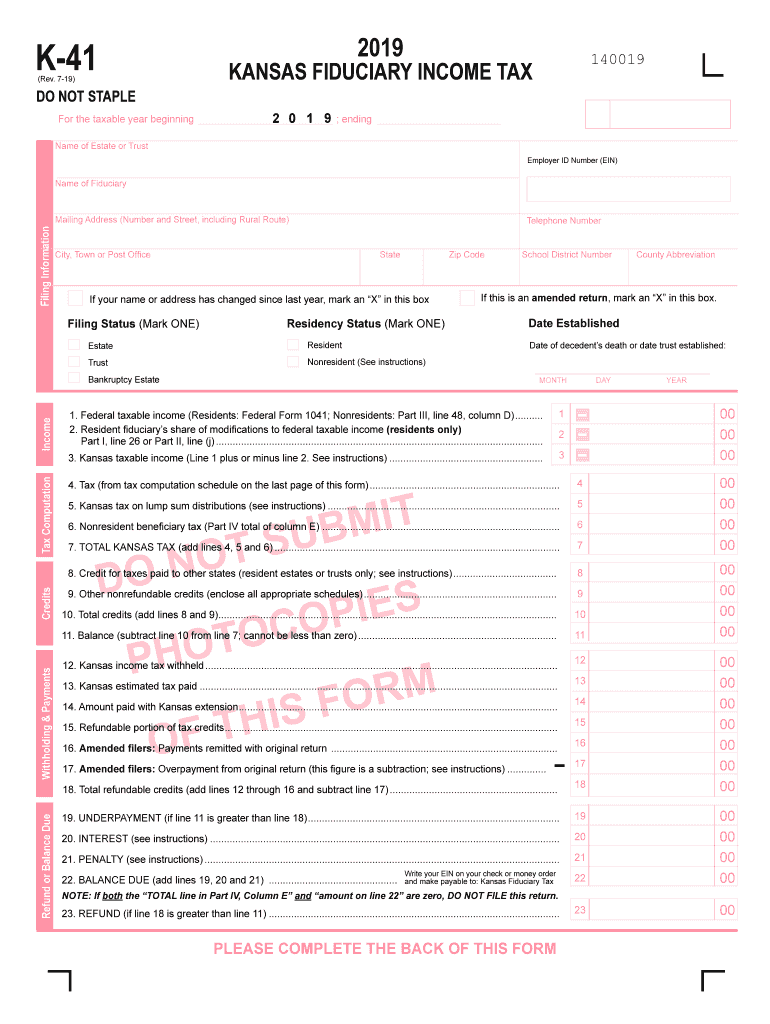
2019 k 41-2026

Get Form
2019 k 41 Preview on Page 1

Here's how it works

01. Edit your form online
Type text, add images, blackout confidential details, add comments, highlights and more.
02. Sign it in a few clicks
Draw your signature, type it, upload its image, or use your mobile device as a signature pad.
03. Share your form with others
Send it via email, link, or fax. You can also download it, export it or print it out.

How to use or fill out 2019 K-41 with our platform

Form edit decoration
9.5
Ease of Setup
DocHub User Ratings on G2
9.0
Ease of Use
DocHub User Ratings on G2
  1. Click ‘Get Form’ to open the 2019 K-41 in the editor.
  2. Begin by entering the taxable year at the top of the form. Fill in the name of the estate or trust and its Employer ID Number (EIN).
  3. Complete the fiduciary's name, mailing address, and contact information. If there have been any changes since last year, mark the appropriate box.
  4. Indicate residency status and filing status by marking one option for each section.
  5. Proceed to Part I for income tax computation. Enter federal taxable income and any modifications as instructed. Calculate Kansas taxable income accordingly.
  6. Continue filling out subsequent lines for tax credits, payments, and any balance due or refund expected.
  7. Finally, ensure all signatures are completed before submitting your form as directed on our platform.

Start using our platform today to fill out your 2019 K-41 easily and for free!

See more 2019 k 41 versions

We've got more versions of the 2019 k 41 form. Select the right 2019 k 41 version from the list and start editing it straight away!
Versions Form popularity Fillable & printable
2023 4.3 Satisfied (34 Votes)
2022 4.6 Satisfied (34 Votes)
2021 4.8 Satisfied (47 Votes)
2020 4.3 Satisfied (133 Votes)
2019 4.3 Satisfied (71 Votes)
2018 4.3 Satisfied (165 Votes)
2014 4.2 Satisfied (74 Votes)
2013 3.9 Satisfied (34 Votes)
2011 4 Satisfied (63 Votes)
be ready to get more

Complete this form in 5 minutes or less

Get form

Got questions?

We have answers to the most popular questions from our customers. If you can't find an answer to your question, please contact us.
Contact us
If you are the beneficiary of a trust or estate and you receive a K-1, you need to include the amounts from the K-1 on your personal income tax return. Your K-1 will report each type, or character, of income, deductions, and credits you receive in various boxes of the form.
Schedule K-1 (Form 1041), Beneficiarys Share of Income, Deductions, Credits, etc. Use Schedule K-1 to report a beneficiarys share of the estates or trusts income, credits, deductions, etc., on your Form 1040, U.S. Individual Income Tax Return.
Are K-1 distributions taxable? Sometimes the distribution reported on a K-1 is taxable to the recipient, but that determination depends on the type of distribution. For example, if the distribution is a return of capital, it is not taxable. However, if the distribution is income from the business, it is taxable.
Schedule K-1 is a tax document that reports a beneficiarys share of income, deductions and credits from a trust or estate. Capital gains and losses are often not distributed to beneficiaries since they are considered part of the trust corpus.
Inheritances are not considered income for federal tax purposes, whether you inherit cash, investments or property. However, any subsequent earnings on the inherited assets are taxable, unless it comes from a tax-free source.
be ready to get more

Complete this form in 5 minutes or less

Get form

People also ask

Schedule K-1 (Form 1041) is an official IRS form thats used to report a beneficiarys share of income, deductions and credits from an estate or trust. Its full name is U.S. Income Tax Return from Estates and Trusts The estate or trust is responsible for filing Schedule K-1 for each listed beneficiary with the IRS.
Use Schedule K-1 to report a beneficiarys share of the estates or trusts income, credits, deductions, etc., on your Form 1040 or 1040-SR. Keep it for your records. Dont file it with your tax return, unless backup withholding was reported in box 13, code B.

Related links