




Rtp 8 2026

Get Form
rtp 8 lease Preview on Page 1

Here's how it works

01. Edit your rtp 8 lease online
Type text, add images, blackout confidential details, add comments, highlights and more.
02. Sign it in a few clicks
Draw your signature, type it, upload its image, or use your mobile device as a signature pad.
03. Share your form with others
Send rtp 8 renewal lease via email, link, or fax. You can also download it, export it or print it out.

Definition & Meaning of RTP 8

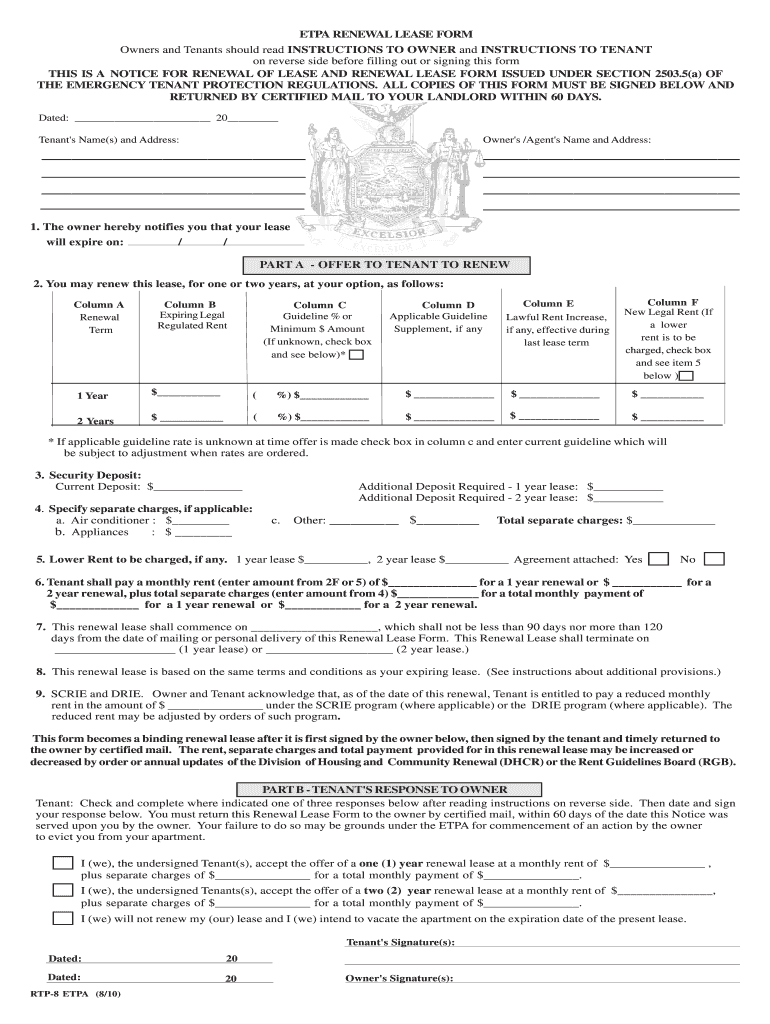
RTP 8, or the Renewal Lease Form, is associated with the Emergency Tenant Protection Act. It's a crucial document for tenants seeking to renew their leases. This form serves as a renewal agreement, detailing the conditions under which a tenant can extend their lease term. It provides a structured way for tenants and landlords to agree on lease terms, rent adjustments, and other related charges. The RTP 8 ensures transparency and provides a legal framework for both parties in the renewal process.

How to Use the RTP 8 Form

To effectively utilize the RTP 8 form, both tenants and landlords must follow a systematic approach:

  1. Review the Form: Before filling out the form, both parties should thoroughly examine its contents to understand their responsibilities and options.

  2. Complete Required Sections: The tenant must fill out personal and property details, while the landlord records their offer for lease renewal terms and rent adjustments.

  3. Submit Responses: Tenants must confirm their decision to accept or negotiate the terms within the specified timeframe to ensure compliance and continuation of tenancy.

  4. Sign the Agreement: Once both parties agree on the terms, the form requires signatures from both tenant and landlord to validate the lease renewal.

Steps to Complete the RTP 8

Filling out the RTP 8 form involves a few key steps:

  1. Information Verification: Ensure all personal and lease-related information is accurate.

  2. Lease Terms Review: Analyze the new lease terms proposed by the landlord, including rent adjustments and duration.

  3. Fill Each Section Thoroughly: Carefully complete each section, ensuring clarity and correctness to avoid misunderstandings.

  4. Submission Deadline Awareness: Complete and return the form within the mandatory 60-day period to avoid a lapse in lease renewal.

Key Elements of the RTP 8

The RTP 8 form consists of several critical components:

  • Tenant and Landlord Details: Basic information about both parties for identification.
  • Proposed Lease Terms: Specific terms of the lease renewal offered by the landlord, including rent alterations.
  • Tenant's Acceptance or Request for Changes: Area for tenants to accept the renewal terms or propose modifications.
  • Agreement for Lease Renewal: Space for both parties to sign, confirming mutual consent to the terms outlined.

Who Typically Uses the RTP 8 Form

The primary users of the RTP 8 form include:

  • Tenants: Individuals seeking to renew their lease agreements under the Emergency Tenant Protection Act.
  • Landlords and Property Managers: Responsible for offering lease renewal terms to existing tenants and ensuring compliance with regulations.
  • Legal and Housing Consultants: Who assist in preparing and reviewing the form to ensure accuracy and adherence to legal standards.

decoration image ratings of Dochub

Legal Use of the RTP 8

In the United States, the RTP 8 form holds legal significance as it ensures both tenant and landlord rights are recognized under tenant protection laws. Legally, it is essential that:

  • Timely Submission: Tenants must adhere to the deadline of 60 days to ensure their rights to renew their lease.
  • Compliance with Tenant Protection Laws: Landlords must draft the terms within the bounds of local and federal tenant protection regulations.
  • Proper Documentation: Both parties must retain copies of the completed form for future reference and legal protection.

State-Specific Rules for the RTP 8

While the RTP 8 form serves a general purpose, state-specific rules can affect its application:

  • Regulatory Differences: Different states might have unique elements and additional clauses in their tenant protection acts.
  • Varying Rent Control Laws: Rent increase regulations vary, affecting the terms landlords can propose.
  • Compliance with Local Amendments: Both tenants and landlords need to adapt to any state-specific amendments that modify the renewal process's legal requirements.

Penalties for Non-Compliance with RTP 8

Failure to adhere to guidelines associated with the RTP 8 form can lead to several penalties:

  • Risk of Eviction: Tenants may face eviction proceedings if renewal terms are not agreed upon within 60 days.
  • Legal Consequences: Both parties could encounter disputes and legal actions for non-compliance or improper documentation.
  • Financial Liabilities: Landlords might face fines or sanctions for violating tenant protection statutes with inappropriate terms or mismanagement of the renewal process.

See more rtp 8 versions

We've got more versions of the rtp 8 form. Select the right rtp 8 version from the list and start editing it straight away!
Versions Form popularity Fillable & printable
2010 4.9 Satisfied (40 Votes)
be ready to get more

Complete this form in 5 minutes or less

Get form

Got questions?

We have answers to the most popular questions from our customers. If you can't find an answer to your question, please contact us.
Contact us

Electronic document approval demands a software solution that works in compliance with data protection and eSignature standards. DocHub is an excellent tool for that, as it meets all the above mentioned requirements. Whatever method you prefer to sign your rtp8 in DocHub, your eSignature will be legally binding and court-admissible.

Document editing with DocHub is equally convenient on desktop and mobile devices. You just need an internet browser to revise your etpa lease renewal form on Android. Open our site and sign in to access the tools you require. Add your document and introduce your intended modifications. Next, you can keep your form in your document storage or send it out instantly.

Section 8 pays the difference between your portion (usually 30% of adjusted income) and the Payment Standard, which is the maximum amount your local Public Housing Agency (PHA) will cover for rent and utilities, typically set around Fair Market Rent (FMR). While the PHA pays a DocHub portion, often up to 70% or more, they wont always cover 100% unless the rent is very low; tenants can choose more expensive units but pay the extra cost, though usually not exceeding 40% of their income. How Its Calculated Your Share (Tenant Contribution): This is generally 30% of your adjusted monthly income (gross income minus certain deductions), but can be up to 40%. Payment Standard: Your local PHA sets this maximum amount based on the number of bedrooms and local Fair Market Rents (FMRs), usually between 90% and 110% of the FMR. Housing Assistance Payment (HAP): The PHA pays this to the landlord, calculated as: Payment Standard - Your Share. Example Scenario Payment Standard: $1,500 for a 2-bedroom unit. Your Adjusted Income: $1,000/month. Your Share: $300 (30% of $1,000). PHA Pays (HAP): $1,200 ($1,500 - $300). Key Factors Location Matters: FMRs and Payment Standards vary DocHubly by zip code and metropolitan area, so what Section 8 pays in one city can be very different from another. Unit Choice: You can rent a unit above the payment standard, but you pay the difference, as long as your total housing cost doesnt exceed 40% of your adjusted income. Utility Allowances: The payment standard often includes an allowance for utilities, reducing the amount the tenant pays for them. To find the exact maximum payment for your area, you need to check the Payment Standards for your specific local housing authority. AI can make mistakes, so double-check responsesHousing Choice Voucher Tenants | HUD.gov / U.S. Department of Your local housing agency calculates your Family Rent Portion, sometimes referred to as Total Tenant Payment (TTP), which is the mU.S. Department of Housing and Urban Development (HUD) (.gov)About Section 8 - NYCHA - NYC.govEligibility for this program is based on a familys gross annual income and family size. The program works as a rental subsidy thaNYC.gov
Cons of Section 8 housing involve administrative burdens for landlords (paperwork, inspections, rent caps), delays in tenant placement, potential for tenant issues like damage or late payments, and systemic challenges for tenants such as shortage of affordable units, discrimination, and a feeling of being trapped or stigmatized, despite the programs benefits for many. For Landlords Bureaucracy Paperwork: DocHub administrative tasks, lease approvals, and ongoing communication with the Public Housing Authority (PHA). Inspections: Strict initial and annual inspections, which can delay move-ins and require unexpected, sometimes costly, repairs to meet housing standards. Rent Caps: Rent amounts are set by the PHA based on local fair market rates, potentially limiting income compared to market-rate rentals. Delayed Payments: The first rent payment might be delayed until all paperwork and inspections are complete. Tenant Responsibility: PHAs dont cover security deposits, and landlords must still manage tenant-specific issues like late portions of rent or property damage. For Tenants Shortage of Housing: Difficulty finding landlords who accept vouchers due to program complexities or discrimination, leading to long waits. Stigma Discrimination: Tenants can face discrimination from landlords or perceive a social stigma associated with receiving assistance. Feeling Trapped: The program can feel like a trap, making it hard to move up financially or escape due to lack of other options, as noted in. Complex Portability: Moving to a new jurisdiction with a voucher (portability) can be a bureaucratic nightmare. Inadequate Funding: Federal funding is insufficient, meaning many eligible families never receive help, creating housing hardship. AI can make mistakes, so double-check responsesWhat are the pros and cons of renting to Section 8 tenants?May 23, 2024 Here are some of the things I noticed, keep in mind, its not all of them but it is a hefty portion: * May not pay thRReddit r/PropertyManagementThe Advantages and Risks of Becoming a Section 8 Landlord - InnagoSep 18, 2025Innago
Yes, your boyfriend can live with you on Section 8, but you must get approval from your local Public Housing Agency (PHA) first, as failing to do so is fraud and can lead to losing benefits; he will need to be screened, and his income will be counted, potentially changing your rent, so always notify the PHA before he moves in to avoid severe penalties like losing your voucher or owing money. Steps to add your boyfriend to your Section 8 voucher: Notify the PHA: Contact your housing authority (like the Boston Housing Authority or NYC Housing Authority) immediately to report the change in your household composition. Submit a Request: Complete the required forms (like the Section 8 Request for Interim Change form in NYC) to add him to your household. Screening: Your boyfriend must undergo a background check and screening by the PHA, just like other household members. Income Rent Calculation: His income will be added to your total household income, which will likely increase the portion of rent you pay (as rent is typically 30% of adjusted income). Approval: Wait for official approval from the PHA before he moves in, or at least until the process begins, to avoid unauthorized occupancy issues. Key Considerations: Its the Law: Unauthorized occupants violate the Housing Assistance Payment (HAP) contract and can lead to serious consequences, including being banned from the program. Income Changes: Adding a partners income can DocHubly affect your subsidy, potentially reducing it or even making you ineligible if your total income becomes too high. Lease Agreement: Your boyfriend will likely need to be added to the lease, becoming a co-tenant or an other occupant, depending on the PHAs rules. AI can make mistakes, so double-check responsesCan my boyfriend live with me on Section 8? - QuoraAug 2, 2019 Adding Household Member: Adding a boyfriend as a household member on Section 8 typically requires notifying the HousingQuoraShould you allow a boyfriend to move in with a Section 8 tenant? - FacebookApr 3, 2025 Section 8 Occupancy Rules: Allowing an unauthorized person, such as a boyfriend or fiance, to move in with a Section 8 Facebook Section 8 Open Waiting lists

Security and compliance

At DocHub, your data security is our priority. We follow HIPAA, SOC2, GDPR, and other standards, so you can work on your documents with confidence.

Learn more
ccpa2
pci-dss
gdpr-compliance
hipaa
soc-compliance
be ready to get more

Complete this form in 5 minutes or less

Get form

People also ask

Tenant Damages Section 8 tenants often have a bad reputation of being careless, due to the fact that they are not generally responsible for paying for any damages they cause.
Section 8 Housing Termination of Tenancy The landlord may not terminate the tenancy except for: serious or repeated violation of the terms and conditions of the lease (e.g., failure to pay rent); violation of federal, state, or local laws; or. other good cause.
If the tenant does not accept the renewal offer within the prescribed time, the landlord may refuse to renew the lease and seek to evict the tenant through court proceedings. If the tenant accepts the renewal offer, the landlord has 30 days to return the fully executed lease to the tenant.
The maximum rent increase depends heavily on location, but many areas with rent control or tenant protection laws cap increases at a formula like 5% plus the local Consumer Price Index (CPI), with an overall cap (often 10%). Some places have fixed caps, while others follow market rates if not covered by specific laws, meaning theres no universal maximum, but statewide laws (like Californias) and local ordinances set clear limits where they apply. Key Factors Determining Your Max Increase: State Laws (e.g., California): Laws like the Tenant Protection Act cap increases at 5% plus CPI, or 10% maximum, for many units. Local Ordinances: Cities like Berkeley, Alameda, or Los Angeles have their own rules, often based on CPI with caps, overriding general state rules if stricter. Unit Age/Type: Some laws only apply to older buildings or exempt certain types of housing. Market Rate: If your unit isnt covered by rent control, the landlord can often increase rent to the market rate, though they still need to provide proper notice, notes DoorLoop and OpenRent. How to Find Your Specific Limit: Check Your States Attorney Generals Website: For California, the State DOJ offers resources. Visit Your Citys Rent Board/Housing Department: Sacramento (City of Sacramento), Berkeley Rent Board (Berkeley), and LA County DCBA (LA County) provide calculators and rules. Use the CPI: Look up your local or regional CPI (e.g., West Region for Oregon) to see how it affects the formula. Consult Legal Resources: Check local tenant rights groups or the California DOJs guide on local laws. Example (California Tenant Protection Act): Formula: 5% + Local CPI. Maximum Cap: 10%. Result: If CPI is 3%, your max increase is 8%. If CPI is 6%, your max increase is 10% (not 11%). AI can make mistakes, so double-check responsesRent Increases Consumer BusinessCOUNTY OF LOS ANGELES (.gov)Know Your Rights as a California Tenant - English - Consumer AlertStatewide Rent-Increase Caps Under the California Tenant Protection Act Through July 31, 2026. The California Tenant Protection AcState of California - Department of Justice (.gov)

rtp 8 2024