






Definition and Purpose of Form VTR-266
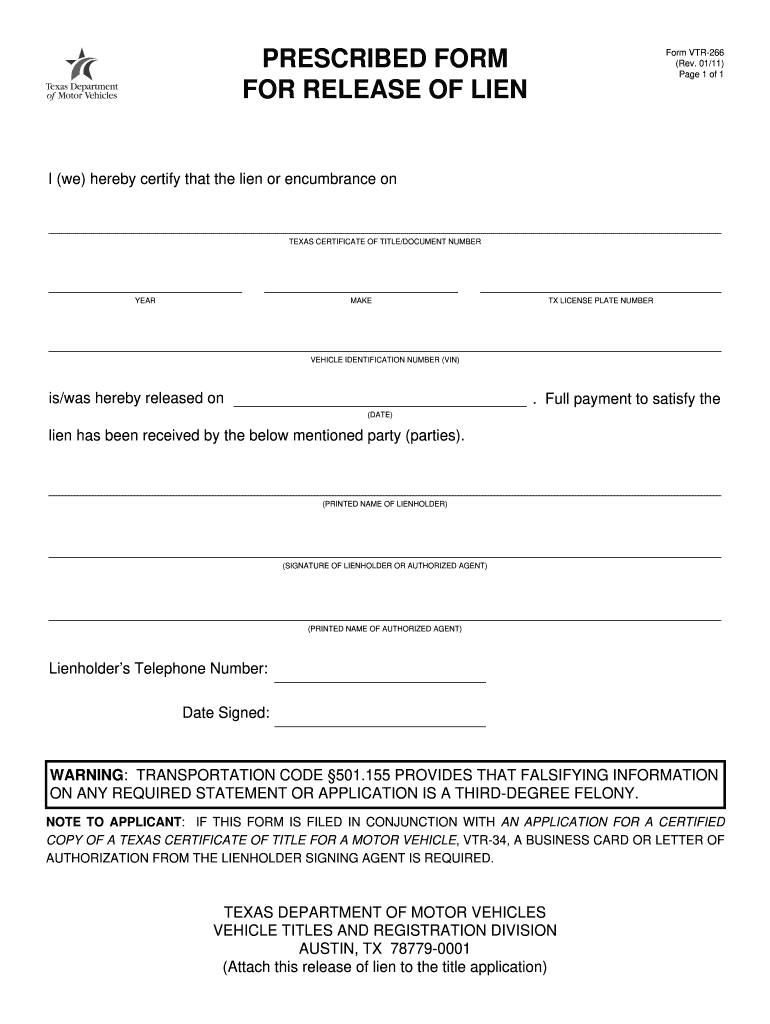
Form VTR-266 is a prescribed document issued by the Texas Department of Motor Vehicles, utilized for the formal release of a lien on a vehicle. This document serves as a legal declaration that the lienholder certifies the full payment has been received, allowing the vehicle owner to maintain clear title without any encumbrances. The form captures essential vehicle data, including:
- Title number
- Vehicle identification number (VIN)
- Make and model
- License plate number
This verification is crucial for financial institutions and private lenders as it confirms the completion of payment obligations, hence facilitating the vehicle registration process under a clean title.
Steps to Complete the VTR-266 Form
Completing the VTR-266 form involves several detailed steps, ensuring all necessary information is adequately captured. The process can be outlined as follows:
- Obtain the Form: Access the VTR-266 from the Texas Department of Motor Vehicles’ website or request it from the lienholder.
- Provide Vehicle Information: Fill in the required details, including the title number, VIN, make, model, and license plate number.
- Include Lienholder Information: The lienholder or authorized agent must provide their name, address, and contact information, verifying their role in the transaction.
- Certify the Payment: Indicate that full payment has been made. This section typically requires a signature from the lienholder or authorized agent, confirming that no further claims exist against the vehicle.
- Submit the Form: After completing the form, submit it to the Texas Department of Motor Vehicles, along with any additional required documentation if applicable.
Completing this form accurately is crucial to prevent potential future disputes regarding vehicle ownership.
Important Elements of VTR-266
Several key elements define the VTR-266 form, ensuring its effectiveness in the lien release process:
- Signature Requirement: The authorized representative of the lienholder must sign the document, validating the release.
- Unique Vehicle Identifiers: The inclusion of the VIN and title number is essential to precisely identify the vehicle in question, minimizing confusion with other titles.
- Liability Warning: The form contains explicit warnings against falsification of information, underscoring the legal implications of inaccurate submissions.
- Additional Documentation: If the form is filed with a request for a certified copy of the vehicle title, supplementary documentation may be required to complete the process.
These details collectively reinforce the form's integrity and validity in legal situations related to vehicle ownership.
Who Typically Uses Form VTR-266
Form VTR-266 is primarily utilized by various stakeholders involved in vehicle financing and ownership. Key parties include:
- Lienholders: Banks, credit unions, and other financial institutions that provide loans against a vehicle utilize this form to formally release their claim after full payment.
- Vehicle Owners: Individuals seeking to obtain clear title for their vehicles post-loan payment rely on this document to prove they own the vehicle outright.
- Automotive Dealerships: When trade-ins and sales occur, dealerships may also use the VTR-266 to manage lien releases to facilitate owner exchanges.
- Insurance Companies: These entities may require evidence of lien release when a vehicle is being insured for full value, confirming that the company bears no contractual obligations.
Understanding the typical users of this form helps clarify its relevance in vehicle ownership transfer scenarios.
Legal Implications of Form VTR-266
The legal standing of Form VTR-266 is significant. It operates as an official declaration that a lien has been released, thereby granting the vehicle owner clear title. The document holds several legal implications:
- Enforceability: Once the form is completed and submitted, it serves as a binding agreement that the lien is no longer in effect, providing protection against future claims.
- Fraud Prevention: The emphasis on accurate information helps mitigate risks of fraud and protects all parties involved in vehicle transactions.
- Financial Responsibility: Failing to release a lien correctly can lead to legal disputes between the vehicle owner and lienholder, highlighting the necessity for compliance with state regulations.
These legal aspects underscore the importance of the VTR-266 process within Texas vehicle transactions.
How to Obtain Form VTR-266
Obtaining the VTR-266 form is a straightforward process, ensuring accessibility for both lienholders and vehicle owners. Here are the methods for obtaining the form:
- Texas Department of Motor Vehicles Website: Most commonly, users can download the VTR-266 from the official DMV website, where it is available in a PDF format.
- Direct Request from Lienholder: Lienholders often have copies of the form available and may provide it upon request.
- Visit Local DMV Office: Individuals may also visit their local Texas DMV office to request the form in person and receive assistance if needed.
This accessibility ensures that all involved parties can easily complete and submit the necessary documentation for lien release.