
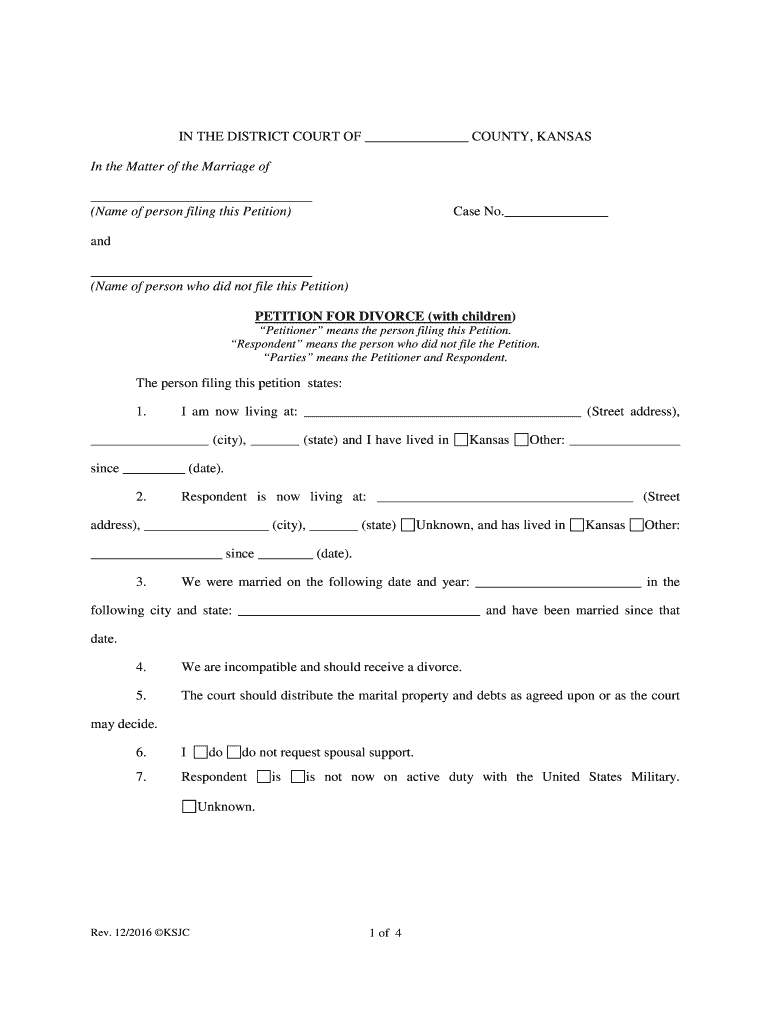







Definition and Meaning of the Kansas Petition for Divorce
The Kansas Petition for Divorce is a formal legal document filed in a Kansas District Court to initiate divorce proceedings between two parties. This document outlines essential details of the marriage, including the petitioner's residency status, information about any children involved, and requests related to property distribution and spousal support.
- Petitioner's Information: The document requires the petitioner to provide their full name, address, and contact information. This is critical for official court records and communication.
- Response Requirement: Upon receiving the petition, the respondent has a designated time frame to respond, usually within thirty days, to either agree or contest the terms of the divorce.
Steps to Complete the Kansas Petition for Divorce
Completing the Kansas Petition for Divorce involves several steps to ensure that the document is correctly filled out and submitted.
- Gather Required Information: Compile details about the marriage, including dates, children’s names and ages, and any community property.
- Fill Out the Petition: Using either pre-designed forms or templates, accurately complete each section. It's recommended to state grounds for the divorce clearly, such as incompatibility or irreconcilable differences.
- Attach Supporting Documents: Include any necessary attachments, such as financial affidavits and parenting plans, particularly if children are involved.
- Review and Sign: Before submission, double-check all information for accuracy. The petitioner must sign the document where indicated.
- File with the Court: Submit the completed petition either online or in person at the local District Court.
Important Terms Related to the Kansas Petition for Divorce
Understanding the particular terminology associated with divorce filings in Kansas can assist in navigating the legal process more effectively.
- Petitioner: The individual filing for divorce.
- Respondent: The spouse receiving the divorce petition.
- Uncontested Divorce: A situation where both parties agree on all terms of the divorce, which can simplify the process.
- Custody Arrangements: Legal terms specifying how custody of children is determined, addressing both physical and legal custody.
- Alimony: Financial support paid to one spouse by the other after divorce.
Legal Use of the Kansas Petition for Divorce
The Kansas Petition for Divorce serves as a legally binding document that triggers the jurisdiction of the court to adjudicate divorce matters. It must be properly executed to ensure compliance with state law.
- Grounds for Divorce: Kansas allows for both fault and no-fault grounds for divorce, but no-fault is the most commonly used by petitioners.
- Jurisdiction: The petition must be filed in the county where one or both spouses reside, establishing the court's jurisdiction.
- Filing Fees: There are generally associated filing fees that vary by county, and fee waivers may be available for low-income individuals.
State-Specific Rules for the Kansas Petition for Divorce
Kansas has specific rules governing the divorce process that must be followed when filing a Petition for Divorce.
- Residency Requirement: At least one spouse must have resided in Kansas for at least sixty days prior to filing for divorce.
- Mandatory Parenting Classes: If children are involved, parents may be required to attend co-parenting classes.
- Division of Property: Kansas follows equitable distribution laws, meaning property is divided fairly, though not necessarily equally, based on various factors.
Required Documents for Filing a Kansas Petition for Divorce
When filing the Kansas Petition for Divorce, specific documents are required to support the petition.
- Kansas Petition for Divorce Form: The primary form required to initiate proceedings.
- Financial Affidavit: This document outlines both spouses’ financial status, including income, expenses, and assets.
- Parenting Plan: In cases involving children, this plan details proposed custody and visitation arrangements.
Who Typically Uses the Kansas Petition for Divorce?
Primarily, individuals facing the end of their marriage file the Kansas Petition for Divorce. However, other parties may also use it in specific scenarios.
- Married Individuals: Couples who wish to legally dissolve their marriage.
- State Agencies: In some cases, state welfare agencies may require a divorce to process benefits that involve child custody or support.
- Mediators and Legal Professionals: They may assist clients in filling out the petition correctly to ensure all necessary information is included.


Examples of Using the Kansas Petition for Divorce
Understanding how to navigate the divorce process can be enhanced by reviewing specific examples.
- Example 1: A couple decides to divorce amicably after agreeing on all terms, filing an uncontested divorce petition. This process is swift, often taking just a few months.
- Example 2: One spouse contests the divorce in court, leading to a more complex legal process involving additional hearings and negotiations regarding property division and child custody.
- Example 3: A petitioner includes specific requests in the petition for shared custody of children based on previous arrangements, demonstrating foresight and consideration for the children's best interests.




