Pc 577 2026

Get Form
pc 577 Preview on Page 1

Here's how it works

01. Edit your pc 577 online
Type text, add images, blackout confidential details, add comments, highlights and more.

02. Sign it in a few clicks
Draw your signature, type it, upload its image, or use your mobile device as a signature pad.

03. Share your form with others
Send form pc 577 via email, link, or fax. You can also download it, export it or print it out.

How to use or fill out pc 577 with our platform

Form edit decoration
9.5
Ease of Setup
DocHub User Ratings on G2
9.0
Ease of Use
DocHub User Ratings on G2
  1. Click ‘Get Form’ to open the pc 577 in the editor.
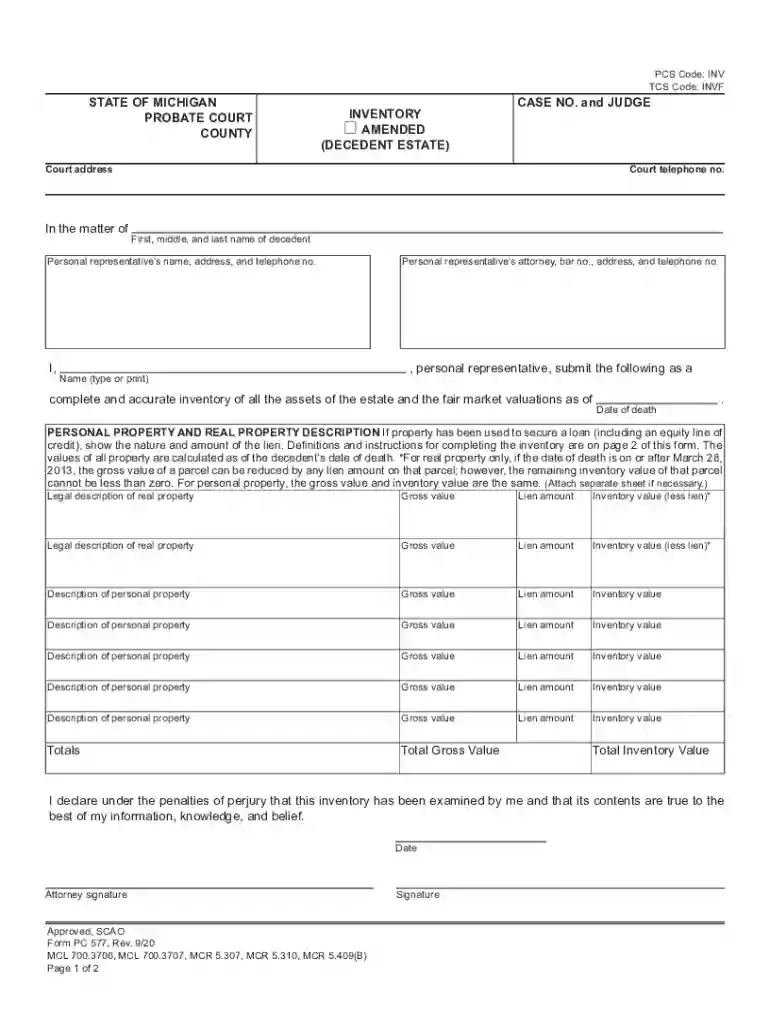
  2. Begin by entering the decedent's full name, including first, middle, and last names, along with the case number and judge's name.
  3. In the 'Personal Property and Real Property Description' section, list all assets. For real property, provide a legal description and any lien details.
  4. For each item of personal property, include a detailed description and its gross value. If applicable, indicate any liens but do not deduct them from the gross value.
  5. Ensure you complete the totals section accurately by summing up total gross and inventory values.
  6. Finally, sign and date the form to declare its accuracy under penalties of perjury.

Start using our platform today for free to streamline your document editing and form completion!

See more pc 577 versions

We've got more versions of the pc 577 form. Select the right pc 577 version from the list and start editing it straight away!
Versions Form popularity Fillable & printable
2020 4.9 Satisfied (21 Votes)
2013 4.4 Satisfied (440 Votes)
2011 4.3 Satisfied (70 Votes)
be ready to get more

Complete this form in 5 minutes or less

Get form

Got questions?

We have answers to the most popular questions from our customers. If you can't find an answer to your question, please contact us.
Contact us
6 types of non probate assets Property. Most personal property, such as real estate, jewelry, or furniture will become probate assets by default. Bank accounts. Retirement benefits. Life insurance policies. Any other assets that are owned jointly with others. Any other assets that have post-death designation in place.
Probate Inventory Guide: Step-by-Step Step 1: Identify All Assets. It is critical to understand how each asset is titled. Step 2: Determine Proper Valuation. Each asset must be assessed a value as of the date of death. Step 3: Organize the Information. Step 4: Complete the Probate Inventory Form. Step 5: Review for Accuracy.
The purpose of Inventory and Appraisal during the probate process is to take inventory of a deceased persons assets and property, as well as determine the value of these assets. Thus, it is an important process that both defines what makes up the decedents estate, and the value of the estate as a whole.
California law requires the executor to provide a comprehensive inventory before probate can continue. This list gives the court a clear breakdown of all matters involved in the decedents estate. It also provides the decedents heirs a better understanding of the debts that must be paid before assets are distributed.
What are Inventories? Inventories are detailed lists of the personal estate belonging to the deceased so do not include any real estate (land and property). They are often arranged room-by-room.

Security and compliance

At DocHub, your data security is our priority. We follow HIPAA, SOC2, GDPR, and other standards, so you can work on your documents with confidence.

Learn more
ccpa2
pci-dss
gdpr-compliance
hipaa
soc-compliance

People also ask

A probate estate inventory is a document that lists all of a decedents assets and debts that are obligated to go through probate. It must also include the valuation of all assets and debts.

scao probate forms