
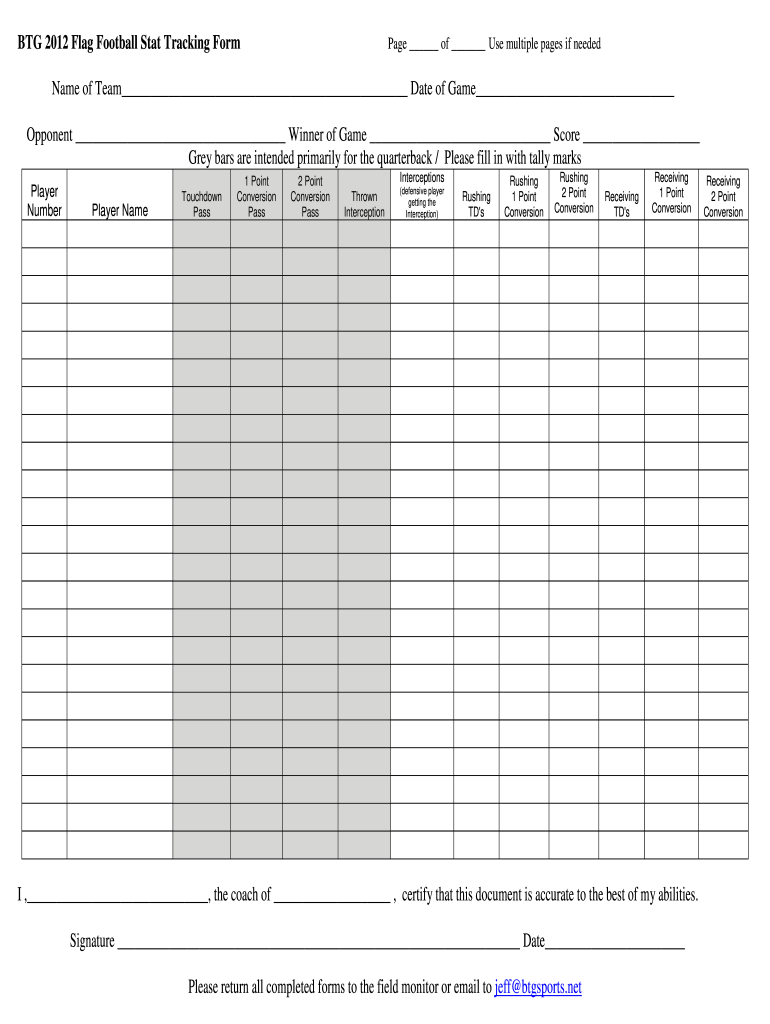







Definition and Meaning of Flag Football Stat Sheet
A flag football stat sheet is an essential tool used to track and analyze player performance during flag football games. This stat sheet captures critical game metrics such as touchdowns, passes completed, interceptions, and conversions. Coaches and players can use these statistics to assess individual contributions and improve team strategies over the course of a season.
The primary goal of a flag football stats sheet is to provide an accurate and organized record of game performance. It helps in fostering accountability among players and enables coaches to identify strengths and areas for improvement. While the stat sheet can vary in format and detail, most will include sections dedicated to player names, positions, and the various statistics being tracked.
In addition to tracking individual performances, the flag football stat sheet can serve as a historical document, helping teams compare past games and analyze how team dynamics evolve throughout the season. This historical analysis can be beneficial for crafting training sessions focused on specific skills or strategies, thus ultimately leading to improved performance on the field.
Key Elements of the Flag Football Stat Sheet
Understanding the key components of a flag football stat sheet is crucial for effective utilization. Typically, a comprehensive stat sheet will include:
- Player Information: Includes player names, jersey numbers, and positions to clearly identify each athlete's contributions.
- Game Statistics: A range of metrics may be included, such as:
- Touchdowns (TDs): Number of touchdowns scored by each player.
- Passing Attempts and Completions: Tracking a quarterback’s performance.
- Interceptions (INTs): Instances where a player throws an interception.
- Rushing Yards: Total yards gained by players rushing the ball.
- Receiving Yards: Yardage gained by receivers after reception.
- Game Context: Details such as date, opponent, score, and venue which help to contextualize the performance statistics.
Accurate recording of these elements can provide valuable insights into both individual and team performance, aiding coaches in decision-making processes regarding player development and game tactics.
How to Use the Flag Football Stat Sheet
Using a flag football stat sheet effectively requires a systematic approach. Here are the steps to ensure thorough documentation of game performance:
-
Prepare Before the Game: Ensure the stat sheet is printed or accessible digitally before the game starts. Familiarize yourself with the layout so you can record stats efficiently during gameplay.
-
Designate a Stat Keeper: Assign someone to be responsible for filling out the sheet during the game. This person should be well-versed in the game’s rules and key metrics to track.
-
Track in Real Time: As the game progresses, record stats in real time. Note every significant play, including touchdowns and other key statistics. This helps in reducing errors and omissions that might occur when trying to recall events afterward.
-
Review After the Game: After the game, take time to summarize the stats and review them with players. This discussion can lead to insights for the upcoming games.
-
Use for Analysis and Planning: After compiling statistics for multiple games, use the information for analysis. Identifying trends in player performance can help inform practice focuses and game strategies.
By following this systematic approach, coaches can maximize the utility of the stat sheet while enhancing player development through informed feedback.
Steps to Complete the Flag Football Stat Sheet
Filling out the flag football stat sheet involves several specific steps to ensure accurate and comprehensive data capture:
-
Gather Necessary Information: Prepare to collect fundamental details such as player lineups, positions, and the context of the game including date and opponent.
-
Use Clear Labels: Clearly label the sections of the stat sheet to avoid confusion. Each statistical category should be thoroughly defined to guide the recording process.
-
Record Each Play: With every play that occurs during the game, notate the corresponding stats immediately. For example, if a player scores a touchdown, mark it down right away including the player’s name and the scoring play.
-
Double-Check Entries: Frequently verify statistics by cross-referencing entries during the game. After the game, review the sheet with fellow coaches to confirm accuracy.
-
Summarize Statistics: After the game, total the statistics and generate summaries for each player. This summary can highlight standout performances or key areas needing improvement.
-
Store for Future Reference: Keep a digital copy of stat sheets for ease of access in future games. This allows for longitudinal comparisons and historical analysis.
Utilizing this structured approach to complete a flag football stat sheet enables coaches to create valuable player reports that inform better decision-making in training and game planning.
Who Typically Uses the Flag Football Stat Sheet
The target audience for flag football stat sheets encompasses a diverse group involved in the game, including:
- Coaches: Often the primary users, coaches rely on stat sheets to develop training plans and game strategies based on player performance.
- Players: Athletes themselves may utilize stat sheets for personal assessment, helping them understand their contributions and areas needing improvement.
- Parents: In youth leagues, parents often review stat sheets to monitor their child's performance and progress throughout the season.
- League Officials: For organized leagues, officials or administrators might require stat sheets to ensure compliance with league standards and for distributing awards.
There is a shared interest in gathering and analyzing performance data across these groups, making the flag football stat sheet an invaluable resource in youth sports and organized adult leagues alike.


Examples of Using the Flag Football Stat Sheet
Flag football stat sheets can be utilized in various scenarios to track and analyze player and team performance effectively. Here are some practical examples:
-
Youth Level Coaching: A youth coach uses the stat sheet during practices and games to monitor players’ skill development, focusing on areas like passing accuracy and defensive plays. This allows the coach to tailor practice sessions to improve specific weaknesses among players.
-
Player Performance Review: A high school team features a dedicated stat keeper who meticulously fills out the stat sheet each game. Post-game meetings to discuss performance based on collected stats help foster continuous improvement individually and as a team.
-
Team Strategy Adjustment: An adult league team compiles stats over an entire season to analyze scoring trends against various opponents. By reviewing data like rushing yards and passing completions, the coaches can adjust strategies to counter specific team strengths in future games.
-
Injury Management: A coach observes that a player consistently shows fewer receptions on game days following a prior injury. The stats sheet indicates a drop in performance; thus, the coach can address this with modified training sessions or adjust in-game strategies to better support the player’s needs.
These examples highlight how effectively utilizing a flag football stat sheet can enhance performance assessments, strategy development, and overall game enjoyment for everyone involved.




