Type text, add images, blackout confidential details, add comments, highlights and more.
02. Sign it in a few clicks
Draw your signature, type it, upload its image, or use your mobile device as a signature pad.
03. Share your form with others
Send it via email, link, or fax. You can also download it, export it or print it out.
How to use or fill out Quitclaim Deed from Individual to Corporation - Maryland with our platform
Ease of Setup
DocHub User Ratings on G2
Ease of Use
DocHub User Ratings on G2
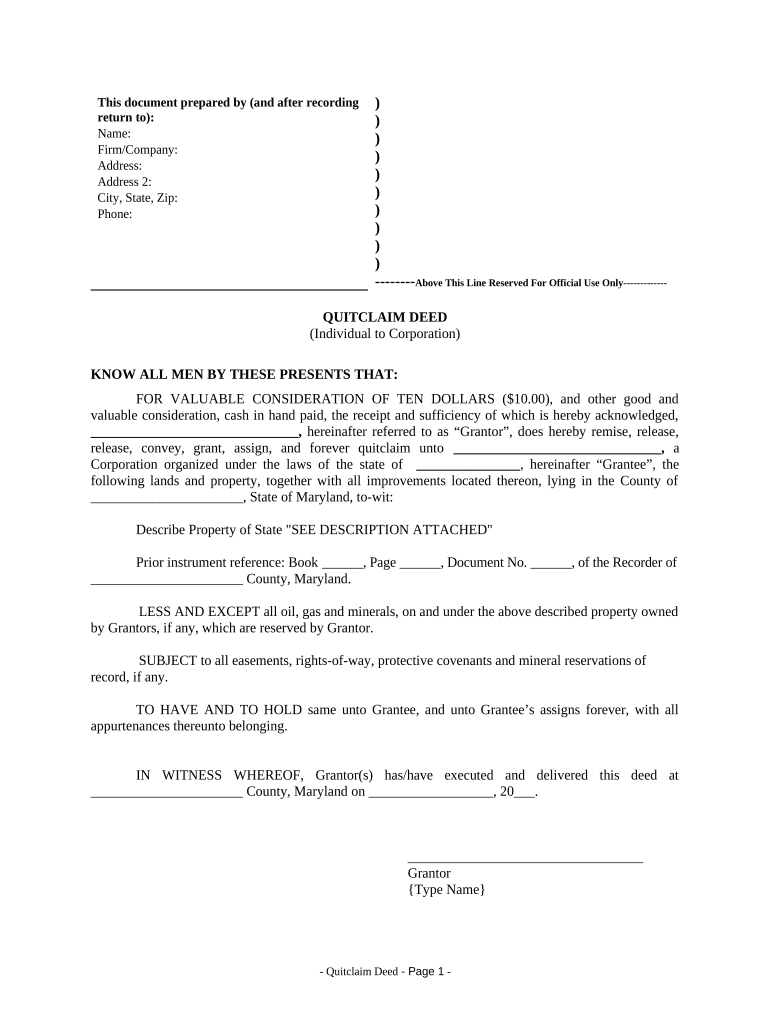
Click ‘Get Form’ to open the Quitclaim Deed in the editor.
Begin by entering the Grantor's name, firm/company, address, and contact information in the designated fields. This identifies who is transferring the property.
In the section labeled 'KNOW ALL MEN BY THESE PRESENTS THAT', specify the Grantee's name (the corporation receiving the property) and its state of incorporation.
Describe the property being transferred in detail. If there is an attachment with a description, indicate 'SEE DESCRIPTION ATTACHED'.
Fill in any prior instrument references, including Book, Page, and Document Number as applicable for record keeping.
Complete the execution section by having the Grantor sign and date it. Ensure that all necessary certifications are filled out correctly.
Finally, have a Notary Public witness the signing and complete their section to validate the deed.
Start using our platform today to easily fill out your Quitclaim Deed for free!
Fill out Quitclaim Deed from Individual to Corporation - Maryland online It's free
In a quitclaim deed, the grantor makes no promises that they have a good title to the property. The grantor does not even promise that they own the property. Instead, the grantor only transfers whatever interest, if any, they have in the property.
How much does it cost to file a quit claim deed in Maryland?
You should never use a quitclaim deed when buying property from someone you dont know well or in a regular home sale. Since there are no guarantees with a quitclaim deed, you could end up with a property that has liens, unpaid taxes, or other ownership problems that become your responsibility to solve.
Are quitclaim deeds legal in Maryland?
In Maryland, a quitclaim deed is a legal instrument used to transfer a grantors interest in a property to a grantee without any warranties of title. This means that the grantor does not guarantee that they hold a valid title or that the property is free from liens or other encumbrances.
How do I transfer ownership of a property in Maryland?
To change the names on a real estate deed, you will need to file a new deed with the Division of Land Records in the Circuit Court for the county where the property is located. The clerk will record the new deed.
What are the risks of a quitclaim?
However, this approach has certain risks, so its not always the best option. Using a quitclaim deed might create tax issues or result in a loss of control of the property after the transfer. Additionally, the property could still require probate if you dont handle the transfer correctly.
Related Searches
Quitclaim deed from individual to corporation maryland templateQuitclaim deed from individual to corporation maryland sampleQuitclaim deed from individual to corporation maryland pdfQuitclaim deed from individual to corporation maryland onlineQuitclaim deed from individual to corporation maryland formQuitclaim deed from individual to corporation maryland exampleQuitclaim deed from individual to corporation maryland costQuitclaim deed Maryland cost
Security and compliance
At DocHub, your data security is our priority. We follow HIPAA, SOC2, GDPR, and other standards, so you can work on your documents with confidence.
Quitclaim deeds transfer ownership without any guarantees, which means the grantee could inherit problems like unpaid taxes, liens, or title defects. Since the deed offers no legal protection, there is little recourse if issues arise after the transfer.
Who benefits the most from a quitclaim deed?
The quitclaim deed simply transfers any interest they may have to the other party. Because of the lack of title guarantees, quitclaim deeds are most often used to transfer property between two parties who know and trust each other, such as family members.
Related links
Maryland Statutory Modifications of the Common Law of
Corporations now act by attorneys who state in their deed that they are Quit Claim Deeds. Although in many states these deeds take the place of
Cookie consent notice
This site uses cookies to enhance site navigation and personalize your experience.
By using this site you agree to our use of cookies as described in our Privacy Notice.
You can modify your selections by visiting our Cookie and Advertising Notice.