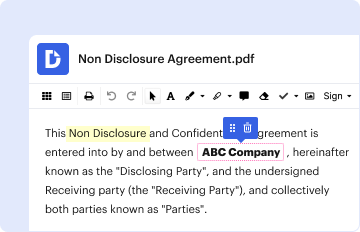
Type text, add images, blackout confidential details, add comments, highlights and more.
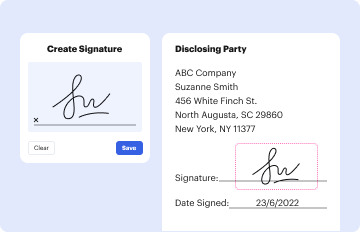
02. Sign it in a few clicks
Draw your signature, type it, upload its image, or use your mobile device as a signature pad.
03. Share your form with others
Send it via email, link, or fax. You can also download it, export it or print it out.
How to use or fill out Quitclaim Deed from Corporation to Two Individuals - Oregon with our platform
Ease of Setup
DocHub User Ratings on G2
Ease of Use
DocHub User Ratings on G2
Click ‘Get Form’ to open the Quitclaim Deed in the editor.
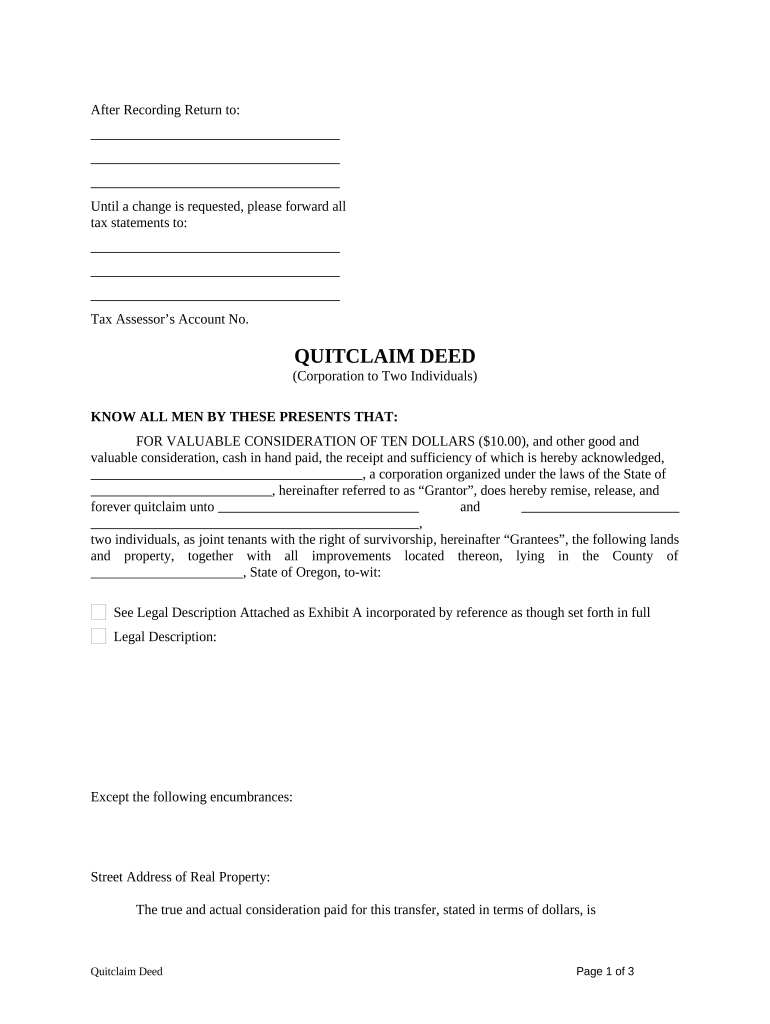
Begin by entering the name of the corporation as the Grantor, along with its state of incorporation. This establishes the entity transferring property rights.
Next, fill in the names of the two individuals who will be Grantees. Ensure you specify their joint tenancy status for clarity on property rights.
Provide a detailed legal description of the property being transferred. If necessary, attach Exhibit A for comprehensive details.
Indicate any encumbrances on the property and specify how taxes will be prorated between Grantor and Grantees.
Complete the execution section by signing and dating the document, ensuring that it is notarized as required by Oregon law.
Start using our platform today to streamline your Quitclaim Deed process for free!
Fill out Quitclaim Deed from Corporation to Two Individuals - Oregon online It's free
The simplest way to remove a co-owner is through a voluntary deed transfer. This involves the co-owner signing a deed (such as a quitclaim deed or general warranty deed) that transfers their interest to you or another party.
How to get a co-owner off a deed?
To remove a co-owner from a property deed, the current owners typically execute a quitclaim deed or similar document transferring interest. Both parties must agree and sign the deed, which is then recorded with the county recorders office.
How to remove co-owner from house title?
The short answer is that creating, signing, and recording a new deed will usually be required, except in very special circumstances. The two most common options for removing a person from a deed are for the relinquishing party to sign a Quitclaim deed or for all owners to sign a Warranty deed.
How much does it cost to remove someone from the deed?
The price to eliminate names from deeds is contingent on many factors like where you live, the legal fees, and the difficulty of the procedure. Generally, it could vary from one hundred to a few thousand dollars. If both parties agree on the removal and there are no legal complications, the cost might be lower.
How many people can be on a quitclaim deed?
You can put as many people as you want as grantees on a quit claim deed. However, the problem with putting all of your children on the property as 1% owners is that you would be giving each of your children a veto power if you want to sell or mortgage the condo.
Related Searches
Quitclaim deed from corporation to two individuals oregon templateQuitclaim deed from corporation to two individuals oregon sampleQuitclaim deed from corporation to two individuals oregon onlineQuitclaim deed from corporation to two individuals oregon formQuitclaim deed from corporation to two individuals oregon exampleOregon Quit claim deed instructionsOregon quit claim Deed PDFQuitclaim deed from corporation to two individuals oregon cost
Security and compliance
At DocHub, your data security is our priority. We follow HIPAA, SOC2, GDPR, and other standards, so you can work on your documents with confidence.
Can you remove someone from a deed without their knowledge?
Generally speaking, a person cannot be removed from a deed without their knowledge and consent. It is possible to remove someone from a deed illegally by recording a new deed with a forged signature. However, such a deed resulting from fraud or forgery is void and can be easily removed by a court.
How does a quitclaim deed work in Oregon?
So the quitclaim deed transfers to the grantee any and all of the legal rights the grantor has in the parcel of real property and deed makes no warranty about the extent of the grantors interest in the parcel of real property.
What are common quitclaim deed mistakes?
Failing to Verify the Titles Condition. One of the biggest mistakes people make when using a quitclaim deed is assuming that the propertys title is free and clear. A quitclaim deed transfers ownership, but it does not guarantee that the property is free from encumbrances such as liens, judgments, or unpaid taxes.
Related links
jea industrial community solar final
The final approach path is defined as two (2) miles from fifty (50) feet above the landing threshold using a standard three (3) degree glidepath. a. Green
93.110 Quitclaim deed sufficient to pass estate. A deed of quitclaim and release, of the form in common use, is sufficient to pass all the estate which the
(35) Quitclaim Deed is a form of deed in which any interest the grantor possesses in the property described in the deed is conveyed to the grantee without
Cookie consent notice
This site uses cookies to enhance site navigation and personalize your experience.
By using this site you agree to our use of cookies as described in our Privacy Notice.
You can modify your selections by visiting our Cookie and Advertising Notice.