Marital Domestic Separation and Property Settlement Agreement Minor Children Parties May have Joint Property or Debts effective Immediately - Nevada 2026

Get Form
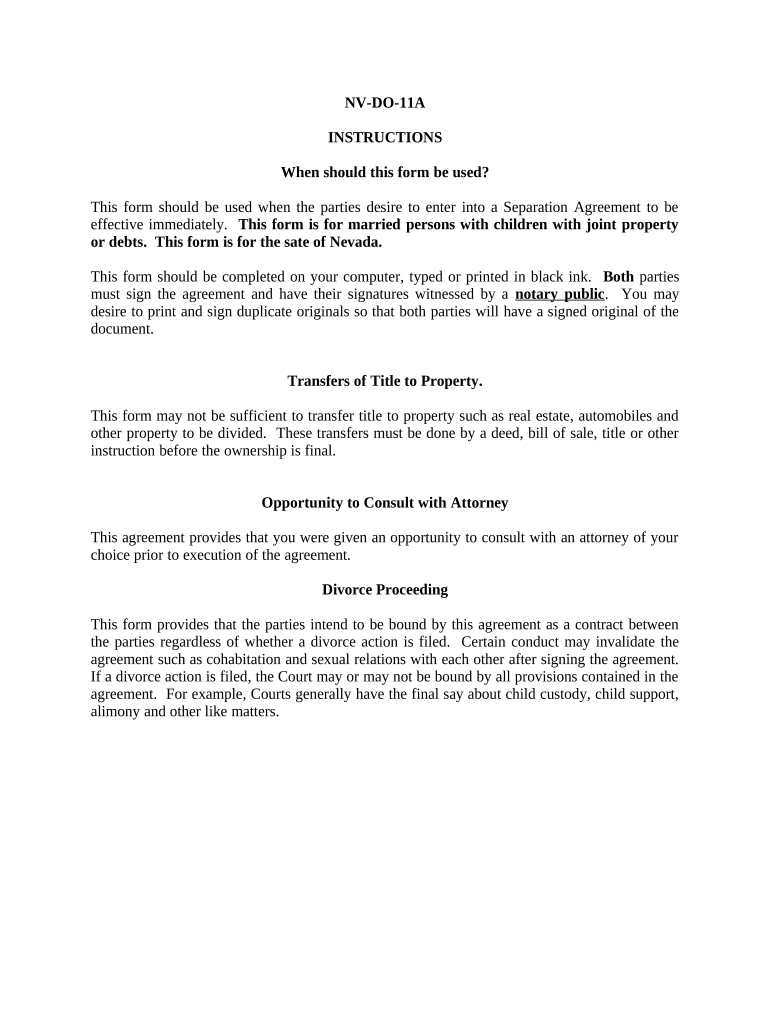
Marital Domestic Separation and Property Settlement Agreement Minor Children Parties May have Joint Property or Debts effective Immediately - Nevada Preview on Page 1

Here's how it works

01. Edit your form online
Type text, add images, blackout confidential details, add comments, highlights and more.
02. Sign it in a few clicks
Draw your signature, type it, upload its image, or use your mobile device as a signature pad.
03. Share your form with others
Send it via email, link, or fax. You can also download it, export it or print it out.

How to use or fill out Marital Domestic Separation and Property Settlement Agreement Minor Children Parties May have Joint Property or Debts effective Immediately - Nevada

Form edit decoration
9.5
Ease of Setup
DocHub User Ratings on G2
9.0
Ease of Use
DocHub User Ratings on G2
  1. Click ‘Get Form’ to open it in the editor.
  2. Begin by entering the full legal names of both parties at the top of the form, ensuring accuracy for legal purposes.
  3. In Section 1, outline the separation details, including the date of separation and any relevant circumstances that led to this agreement.
  4. Proceed to Section 2 to disclose financial information. Each party should list their assets and liabilities honestly to ensure a fair settlement.
  5. In Section 3, detail the division of assets. Clearly describe each item being awarded to either party along with its current fair market value.
  6. Section 4 requires you to specify how debts will be divided. List all debts and assign responsibility for payment accordingly.
  7. Complete Sections 5 through 8 regarding future earnings, spousal support, child custody arrangements, and child support obligations.
  8. Finally, review all sections for completeness and accuracy before signing. Ensure both parties sign in front of a notary public as required.

Start using our platform today to streamline your document editing and signing process for free!

be ready to get more

Complete this form in 5 minutes or less

Get form

Got questions?

We have answers to the most popular questions from our customers. If you can't find an answer to your question, please contact us.
Contact us
In Nevada, marital property is all property acquired during the marriage by either spouse. Both spouses have property rights to marital property during a divorce. It doesnt matter which spouses name is on the assets title if the couple used community funds to purchase or improve the property.
Nevada adheres to community property principles when dividing assets during a divorce. This means that all property acquired by either spouse during the marriage is considered jointly owned and is subject to equal division upon divorce.
If one of you bought the house before you got married, it might be treated as separate property and wouldnt be divided. The same goes if the house was inherited or given as a gift specifically to one spouse. In these situations, the spouse who owns the separate property might get to keep the house after the divorce.
Generally, separate property is: Anything you earned or owned (or a debt) from before you married or after the date of separation. Anything you buy with separate property or you earn from separate property. Gifts or inheritance (to one of you) even if it was given or inherited when you were married.
In Nevada, marital property is any property or debt that was acquired during the marriage. This means that even if one party earned the money or purchased the property, it is still considered marital property and subject to division in a divorce.

Security and compliance

At DocHub, your data security is our priority. We follow HIPAA, SOC2, GDPR, and other standards, so you can work on your documents with confidence.

Learn more
ccpa2
pci-dss
gdpr-compliance
hipaa
soc-compliance
be ready to get more

Complete this form in 5 minutes or less

Get form

People also ask

Nevada is a community property state. This means that while you are married, all property and debts you and your spouse acquired are presumed to belong equally to both of you. During a divorce, community property and community debt are equally divided.

Related links