Warranty Deed for Separate or Joint Property to Joint Tenancy - New Jersey 2026

Get Form
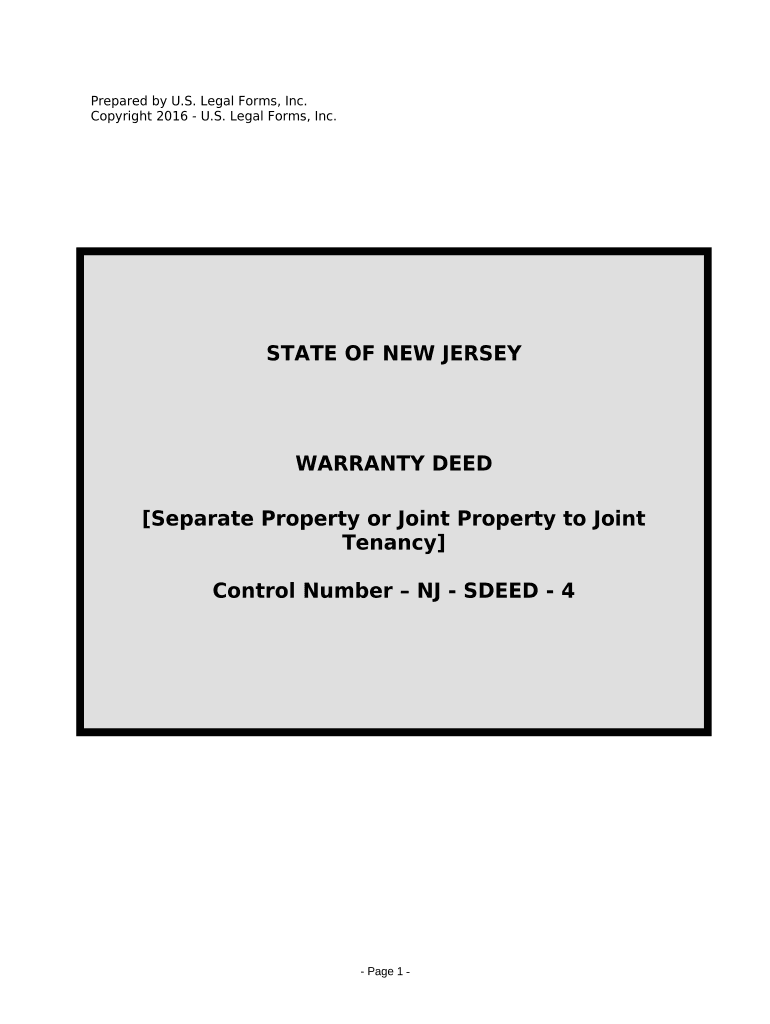
joint tenancy deed Preview on Page 1

Here's how it works

01. Edit your joint tenancy deed online
Type text, add images, blackout confidential details, add comments, highlights and more.
02. Sign it in a few clicks
Draw your signature, type it, upload its image, or use your mobile device as a signature pad.
03. Share your form with others
Send joint tenancy deed form via email, link, or fax. You can also download it, export it or print it out.

How to use or fill out Warranty Deed for Separate or Joint Property to Joint Tenancy - New Jersey

Form edit decoration
9.5
Ease of Setup
DocHub User Ratings on G2
9.0
Ease of Use
DocHub User Ratings on G2
  1. Click ‘Get Form’ to open it in the editor.
  2. Begin by entering the names of the Grantors in the designated fields. Ensure you specify their marital status as either married or unmarried.
  3. Next, input the names of the Grantees, again indicating their marital status. This section is crucial as it defines ownership rights.
  4. Describe the property being conveyed in detail. If there is an attachment with a description, ensure it is referenced correctly.
  5. Fill in any prior instrument references and details about taxes, specifying how they will be prorated or paid.
  6. Complete the acknowledgment section by providing notary information and ensuring all signatures are obtained where required.

Start using our platform today to easily complete your Warranty Deed for Separate or Joint Property to Joint Tenancy - New Jersey for free!

be ready to get more

Complete this form in 5 minutes or less

Get form

Got questions?

We have answers to the most popular questions from our customers. If you can't find an answer to your question, please contact us.
Contact us
A form of deed that transfers fee title and legal interests in New Jersey real property. A special warranty deed requires a grantor to warrant to the grantee and defend the property on the grantees behalf only against claims arising by, through, or under the grantor.
A co-owner buys the share (Transfer of Equity) The most straightforward method is often for one or more of the existing co-owners to buy out your share of the house. This process involves a Transfer of Equity, where the legal and/or beneficial ownership is formally transferred to the remaining owner(s).
Real estate and other property owned jointly by husband and wife are automatically owned by the surviving spouse. Bank and brokerage accounts, CDs, retirement accounts (IRAs, 401Ks) and property with a beneficiary designation go to the person designated as the beneficiary.
If your co-owner is married, there is a risk of the property being subject to divorce proceedings. With something like a bank account, there is the risk that the co-owner could go on a spending spree and drain the account. In some situations, creating a joint ownership can also create gift tax or income tax problems.
Joint tenants must receive their interest in the property from the same source, such as a deed or title. Equal interest. Joint tenants must possess an equal share of the property.

Security and compliance

At DocHub, your data security is our priority. We follow HIPAA, SOC2, GDPR, and other standards, so you can work on your documents with confidence.

Learn more
ccpa2
pci-dss
gdpr-compliance
hipaa
soc-compliance
be ready to get more

Complete this form in 5 minutes or less

Get form

People also ask

Each party has a full ownership interest in the property. The property will pass instantly to the survivor upon the death of the other without probate. Conveyance by one party without the other breaks the joint tenancy. Seller warrants that he/she has good title and will warrant and defend title.
Cohabitants who are joint owners are referred to in legal terms as joint tenants at law (the use in this context of the word tenant has nothing to do with rented property). This means that they are each entitled to possession of the whole of the land and the right to occupy it.
Downsides of Joint Tenancy If a couple or business partners disagree, neither party can sell or encumber the asset without the consent of all parties. This restriction is intended to prevent abuses. However, the need to get agreement from all parties can make it difficult to take necessary actions.

Related links