Residential condominium wi 2026

Get Form
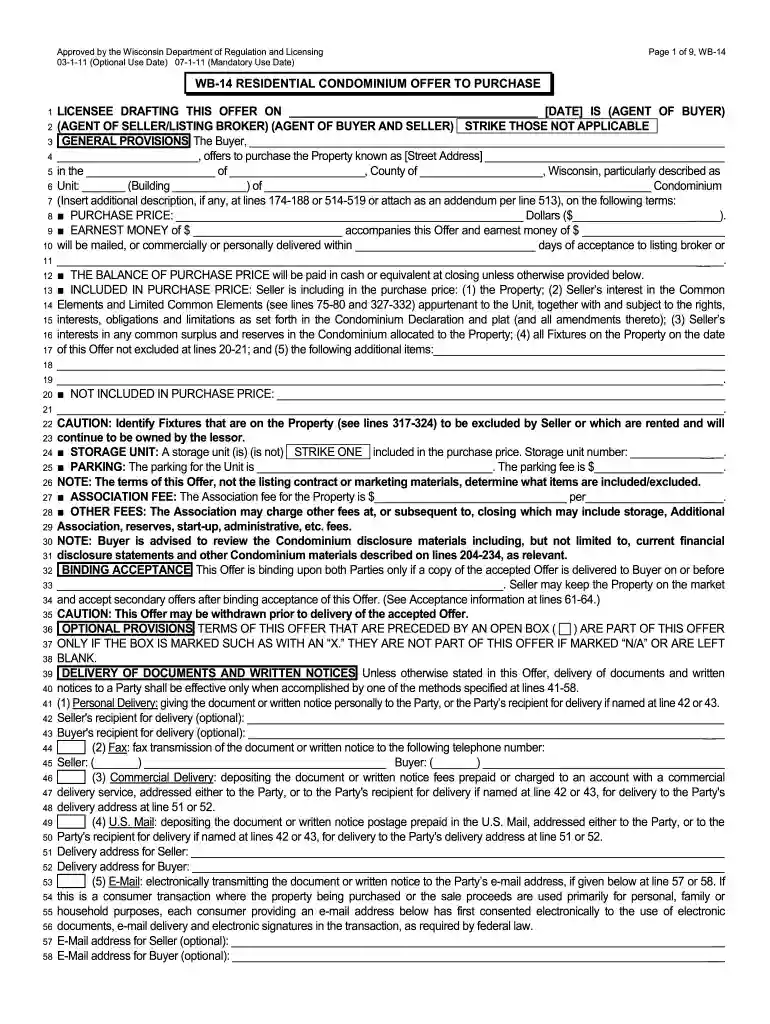
residential offer to purchase wisconsin Preview on Page 1

Here's how it works

01. Edit your residential offer to purchase wisconsin online
Type text, add images, blackout confidential details, add comments, highlights and more.

02. Sign it in a few clicks
Draw your signature, type it, upload its image, or use your mobile device as a signature pad.

03. Share your form with others
Send wb 11 residential offer to purchase via email, link, or fax. You can also download it, export it or print it out.

Definition & Meaning

The WB-14 Residential Condominium Offer to Purchase is a standard form utilized in Wisconsin for conducting real estate transactions specifically involving condominium units. This document outlines the various terms and conditions that both the buyer and seller agree to adhere to during the course of the sale. It essentially functions as a mutual agreement detailing essential elements such as purchase price, earnest money terms, and conditions around property inspections and contingencies. This form is sanctioned by the Wisconsin Department of Regulation and Licensing, ensuring it meets the state's legal and regulatory requirements for real estate agreements.

How to Use the Residential Condominium WI Form

The Residential Condominium Offer to Purchase is used during the negotiation phase between a buyer and seller. Buyers must complete the form by filling out sections that stipulate the offer details, including financial terms, contingencies, and deadlines. It is paramount that each section is correctly filled to ensure all conditions are clearly understood by both parties. The form serves as an initial binding agreement that, upon acceptance, moves forward subject to conditions such as financing approval and satisfactory inspection outcomes.

Key Steps for Buyers

  1. Review the Property: Conduct preliminary inspections and engage due diligence on the property.
  2. Fill in Buyer Information: Complete the sections pertaining to buyer’s personal details.
  3. Offer and Pricing Details: Clearly state the offer price, deposit amounts, and any contingencies involved, such as loan approvals or property inspection outcomes.
  4. Sign and Submit Offer: Upon completion, sign the document and submit it to the seller for consideration.

Steps to Complete the Residential Condominium WI

Completing the WB-14 form involves several steps that necessitate attention to detail to ensure compliance with Wisconsin real estate requirements. The process commences with the buyer expressing interest in a specific condominium property and continues through several key procedural steps.

  1. Initial Buyer-Seller Communication: Engage a dialogue to discuss potential terms and pricing.
  2. Document Preparation: Prepare the offer by accurately completing buyer-related information and listing specific contingencies.
  3. Earnest Money Deposit: Determine the amount of earnest money that will accompany the offer as a show of good faith.
  4. Contingency Statements: Formulate any necessary contingencies that protect the buyer’s interests, such as satisfactory home inspection conditions or financing arrangements.
  5. Final Review: Carefully review all entries for precision and correctness.
  6. Offer Submission: Submit the signed offer to the seller for acceptance or counter-offer negotiations.

Why Use the Residential Condominium WI Form

Utilizing the WB-14 form provides numerous advantages for both buyers and sellers involved in Wisconsin condominium transactions. The form lays out a clear legal framework that mitigates misunderstandings and provides legal recourse.

  • Standardization: Ensures uniformity in condominium transactions across the state.
  • Legal Protection: Provides legal credibility as it is approved by the Wisconsin Department of Regulation and Licensing.
  • Clarity and Transparency: Outlines detailed terms and expectations regarding the transaction, enhancing transparency for both parties.

Important Terms Related to the Residential Condominium WI

Understanding key terms within the Residential Condominium WI is crucial for accurately completing and interpreting the document. These terms define the legal and financial obligations of the parties involved.

  • Earnest Money: A deposit made by the buyer to demonstrate their serious intent in the property.
  • Contingencies: Specific conditions that must be met for the transaction to proceed, such as satisfactory inspections or financing arrangements.
  • Condominium Disclosure Materials: Documentation provided to the buyer outlining the condominium association rules, financial health, and other pertinent community details.
  • Financing Contingency: A clause that allows the buyer to back out of the purchase if they cannot secure adequate financing.

Legal Use of the Residential Condominium WI

The WB-14 form is legally binding and serves as an official offer once both parties have signed it. Its use is mandated for ensuring compliance with Wisconsin real estate laws when purchasing a residential condominium.

Key Legal Considerations

  • Binding Agreement: Once accepted, it obligates both parties to adhere to the stipulated terms.
  • Condominium Disclosure: Buyers are entitled to receive and review all relevant condominium association documents before finalizing their purchase.
  • Real Estate Professional Involvement: Both parties are encouraged to utilize the services of licensed real estate professionals to ensure compliance and advisement.

Key Elements of the Residential Condominium WI

The form encompasses several critical elements that must be precisely filled out to form a valid offer. These include financial terms, property specifications, and procedural stipulations.

  • Purchase Price and Payment Terms: The agreed price and any pertinent financial arrangements.
  • Property Description: A detailed appraisal of the condominium unit, specifying layout, fixtures, and amenities.
  • Inspection Clauses: Provisions for inspections and the buyer’s right to request repairs or withdraw based on the findings.
  • Closing Date: The predetermined date when ownership will be transferred, assuming all conditions are met.

Required Documents

Completing a Residential Condominium Offer to Purchase involves the aggregation of several documents to ensure an informed buying decision. These documents support the due diligence process and confirm the details outlined in the WB-14 form.

  • Condominium Disclosure Documents: Include community bylaws, financial statements, and meeting minutes, providing insights into the association's governance.
  • Financing Pre-approval Letter: Demonstrating the buyer's financial capability and intent.
  • Inspection Reports: From professionals evaluating the condition of the property.

Understanding and gathering the necessary documentation is vital for both legal compliance and informed decision-making throughout the condominium purchase process.

See more residential condominium wi versions

We've got more versions of the residential condominium wi form. Select the right residential condominium wi version from the list and start editing it straight away!
Versions Form popularity Fillable & printable
2020 4.4 Satisfied (52 Votes)
2011 4.9 Satisfied (45 Votes)
be ready to get more

Complete this form in 5 minutes or less

Get form

Got questions?

We have answers to the most popular questions from our customers. If you can't find an answer to your question, please contact us.
Contact us
Yes, you can live in a condo forever in terms of ownership, as its typically freehold property you can pass to heirs, but the buildings physical life, HOA decisions, and your ability to afford maintenance (like special assessments) are factors that could end your residency, though modern construction and HOA management can allow for very long-term stays. While ownership of the unit itself is indefinite, the shared structures condition and the collective decisions of owners (HOA) can influence long-term livability, potentially leading to major renovations or even a buildings sale and demolition, though this is rare and requires DocHub owner consensus. Ownership Permanence You own the unit: You own the interior of your unit and a share in common areas, not the land, which is owned by the condo corporation. Inheritance: Your ownership can be passed down through your estate, just like a house. Long-Term Realities Maintenance: Youll pay condo fees for upkeep, but major repairs (roof, elevators, etc.) often trigger expensive special assessments, potentially costing thousands and impacting affordability. Building Lifespan: With good management and modern materials, buildings can last a very long time, but aging infrastructure presents challenges. HOA Decisions: A majority of owners (sometimes 80% or more) can vote to sell the land or demolish the building, although its uncommon and requires DocHub agreement. When it might end Financial Strain: If you cant afford special assessments or rising fees. Building Obsolescence: If the building becomes too costly to maintain or is deemed unsafe, owners might vote to sell or rebuild. Condemnation: If the building is condemned, it becomes worthless, and owners lose their investment, as seen in extreme cases like the Surfside collapse, notes a Quora post. In essence, your condo ownership is permanent, but living there forever depends on the buildings condition, your HOAs financial health, and your ability to navigate ongoing costs and collective decisions. AI can make mistakes, so double-check responsesHow does condo ownership work in the long term? : r/RealEstate - RedditFeb 17, 2014 Generally, condos will do basic maintenance using your fee. Periodically they are remodeled or major repairs are done,RReddit r/RealEstateIs it possible/wise to live on a condo forever? - RedditJan 10, 2023 It is up to the Board to raise such funds via condo fees. An incompetent board will fail to raise such funds and then Reddit
Wisconsin Condos Townhouses For Sale - Latest Listings! condo listings for sale have an average price of $255 per square foot, based on condo listings with an average of 2.3 bedrooms, 2.1 bathrooms, and 1,579 square feet of living space.
A residential condominium (condo) means you individually own a private living unit within a larger property, while sharing ownership of common areas like pools, gyms, and grounds with other owners, managed by a homeowners association (HOA) funded by mandatory fees, allowing for private living with shared amenities and responsibilities. Key Characteristics Individual Ownership: You own the title to your specific unit, including the interior space within its walls. Shared Ownership: You co-own common elements like roofs, hallways, pools, and land with other unit owners. Homeowners Association (HOA): An organization of owners governs the complex, collects fees (condo fees), and maintains common areas. Rules Fees: Owners pay regular fees to the HOA and must follow rules (covenants) about unit use and exterior appearance. vs. Apartment: Unlike apartments (rented from one owner), condos are individually owned units within a complex. What You Own vs. Share Own: The interior of your unit (walls, floors, ceilings, fixtures). Share: The building structure, grounds, amenities (pools, gyms), and exterior maintenance. In Simple Terms Its a form of ownership where you get the benefits of a single-family home (your own space) but share the costs and responsibilities for the buildings upkeep with neighbors through an association. AI can make mistakes, so double-check responsesCondominium - WikipediaTechnically, a condominium is a collection of individual units and common areas along with the land upon which they sit. IndividuaWikipediaCondominium: Definition, How It Works Compared with an ApartmentWhat Does Condo Mean? A condo, short for condominium, is an individually owned residential unit in a building or complex composed Investopedia
However, potential downsides include HOA fees, limited outdoor space, noise from neighbors, pet restrictions, and parking challenges. Additionally, condo values may appreciate more slowly than single-family homes, and storage space can be limited.Sep 30, 2025
A condo allows you to own the place youre living without some of the disadvantages of single-family homes or apartments. Building equity: Unlike renting an apartment, buying a condo allows you to build home equity. This lets you take advantage of any appreciation in the value of your condo.Sep 10, 2025

Security and compliance

At DocHub, your data security is our priority. We follow HIPAA, SOC2, GDPR, and other standards, so you can work on your documents with confidence.
Learn more
ccpa2
pci-dss
gdpr-compliance
hipaa
soc-compliance
be ready to get more

Complete this form in 5 minutes or less

Get form

People also ask

A condominium, usually shortened to simply condo, is a privately owned, individual residential unit within a community of other units. In general, the owner usually owns the interior of their unit and the structural components of exterior walls.Mar 4, 2025
A condominium (or condo for short) is an ownership regime in which a building (or group of buildings) is divided into multiple units that are either each separately owned, or owned in common with exclusive rights of occupation by individual owners.

wi residential offer to purchase