01. Edit your new hampshire quitclaim deed form online
Type text, add images, blackout confidential details, add comments, highlights and more.
02. Sign it in a few clicks
Draw your signature, type it, upload its image, or use your mobile device as a signature pad.
03. Share your form with others
Send how to be added to a deed via email, link, or fax. You can also download it, export it or print it out.
How to use or fill out nh quitclaim deed with our platform
Ease of Setup
DocHub User Ratings on G2
Ease of Use
DocHub User Ratings on G2
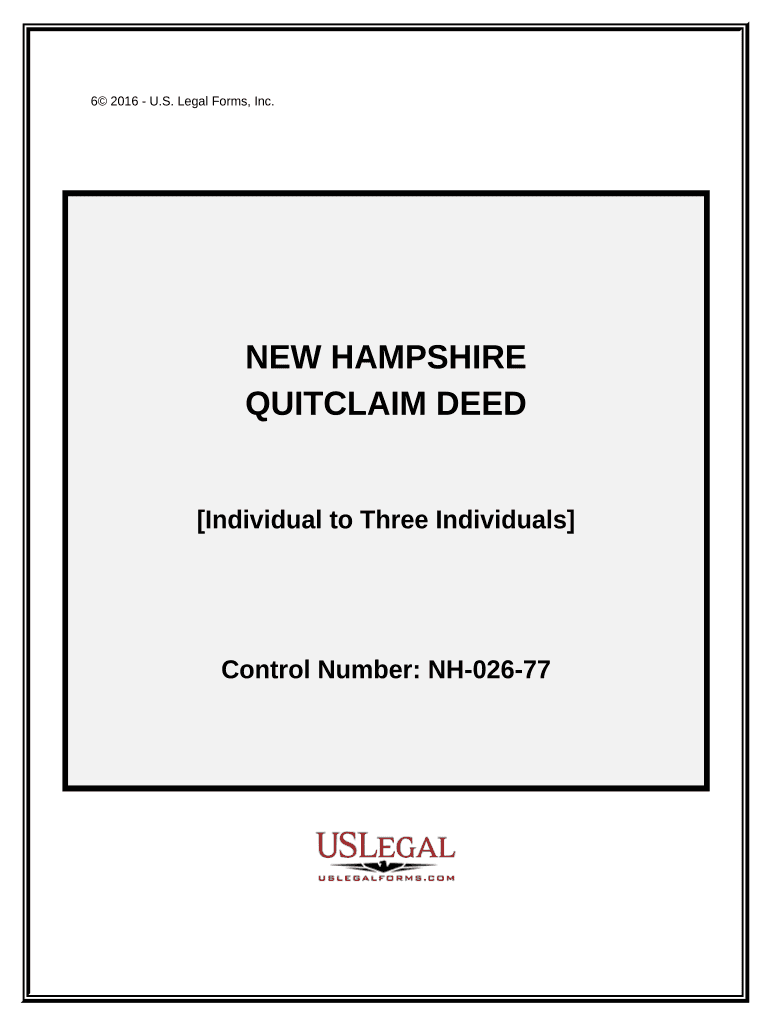
Click ‘Get Form’ to open the nh quitclaim deed in the editor.
Begin by entering the Grantor's name and address in the designated fields. Ensure accuracy as this identifies the individual transferring property rights.
Next, input the Grantees' names and addresses. This section should list all individuals receiving the property, ensuring they are noted as joint tenants with rights of survivorship.
In the legal description section, provide a detailed account of the property being transferred. If necessary, attach an Exhibit A for additional details.
Finally, have the Grantor sign and date the document. A notary public must also acknowledge this signature to validate the deed.
Start using our platform today to easily complete your nh quitclaim deed online for free!
How much does it cost to do a quit claim deed in NH?
The average cost (i.e., legal fees) for a lawyer to prepare and file a quitclaim deed is $510.00.
What do you need for a quitclaim deed in NH?
To transfer New Hampshire real estate property using a quitclaim deed, both the grantor and grantee must each submit a declaration of consideration form and an inventory of property transfer form [1] within 30 days. These documents serve as evidence of payment of the real estate transfer tax, consistent with N.H. Rev.
Who benefits the most from a quitclaim deed?
The quitclaim deed simply transfers any interest they may have to the other party. Because of the lack of title guarantees, quitclaim deeds are most often used to transfer property between two parties who know and trust each other, such as family members.
How to get a quitclaim deed in NH?
To sign and file a quit claim deed in New Hampshire, the form must be filed at the County Recorders Office where the real estate is located. Additionally, the deed must be signed in the presence of a notary public by the grantor(s) only, as per N.H. Rev. Stat. 477:3-a and N.H. Rev.
What are the disadvantages of a quit claim deed?
Using a quitclaim deed could trigger unwanted tax consequences, such as gift taxes or capital gains taxes. Additionally, a quitclaim deed can introduce confusion about who truly owns a property after a transfer, which could lead to disputes later.
nh quitclaim deed
Nh quitclaim deed templateNh quitclaim deed pdfNh quitclaim deed formNh quitclaim deed sampleNh quitclaim deed exampleNh quitclaim deed form pdfNh quitclaim deed costNh quitclaim deed for sale
Security and compliance
At DocHub, your data security is our priority. We follow HIPAA, SOC2, GDPR, and other standards, so you can work on your documents with confidence.
Nov 27, 2019 Quit Claim Deed from Commerce Park Realty, LLC dated December 6, 2012. B. By letter dated June 30, 2016, Lessee wishes to extend the Term of
Cookie consent notice
This site uses cookies to enhance site navigation and personalize your experience.
By using this site you agree to our use of cookies as described in our Privacy Notice.
You can modify your selections by visiting our Cookie and Advertising Notice.