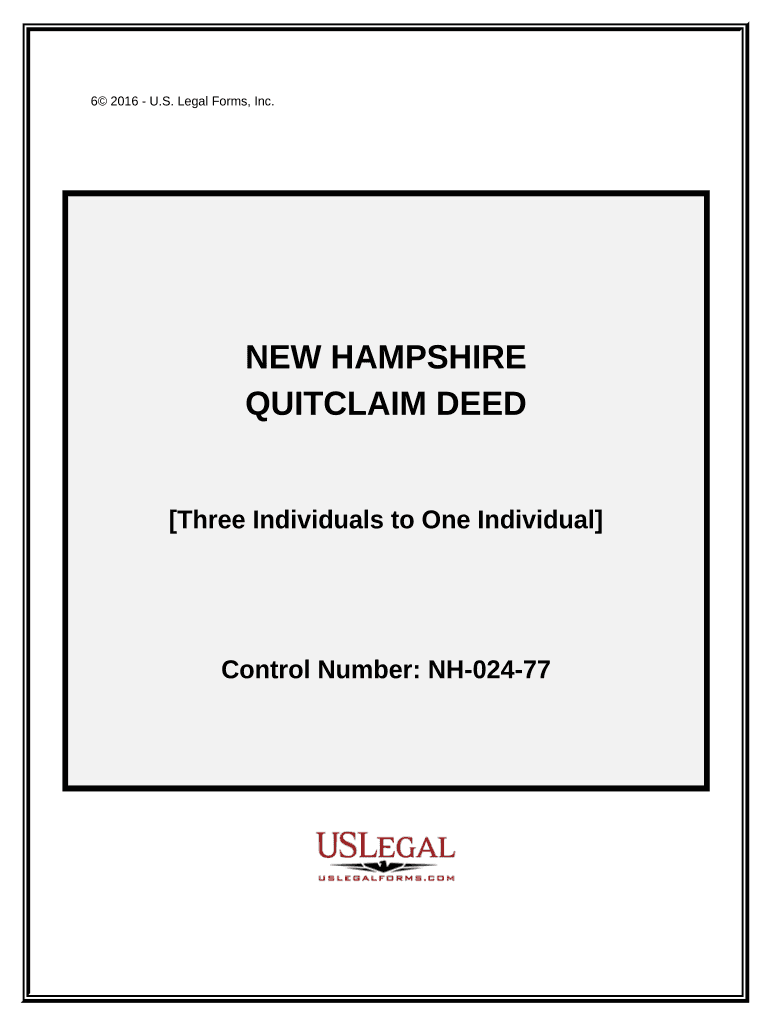
Quitclaim Deed - Three Individuals to One Individual - New Hampshire 2026

Get Form
what is a quitclaim deed Preview on Page 1

Here's how it works

01. Edit your what is a quitclaim deed online
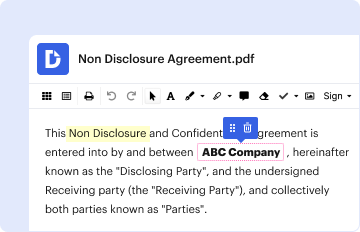
Type text, add images, blackout confidential details, add comments, highlights and more.
02. Sign it in a few clicks
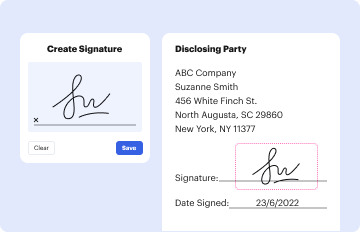
Draw your signature, type it, upload its image, or use your mobile device as a signature pad.
03. Share your form with others
Send it via email, link, or fax. You can also download it, export it or print it out.

How to use or fill out Quitclaim Deed - Three Individuals to One Individual - New Hampshire with DocHub

Form edit decoration
9.5
Ease of Setup
DocHub User Ratings on G2
9.0
Ease of Use
DocHub User Ratings on G2
  1. Click ‘Get Form’ to open it in the editor.
  2. Begin by entering the names and addresses of the three individuals (Grantors) in the designated fields. Ensure that all information is accurate and complete.
  3. Next, input the name and address of the individual receiving the property (Grantee). This section is crucial for establishing ownership transfer.
  4. In the legal description section, provide a detailed description of the property being transferred. If necessary, attach an Exhibit A with this information.
  5. Each Grantor must sign and date the document in their respective fields. Make sure to type or print their names clearly beneath each signature.
  6. Finally, ensure that a Notary Public or Justice of Peace acknowledges each Grantor's signature as required by New Hampshire law.

Start using our platform today to easily complete your Quitclaim Deed for free!

be ready to get more

Complete this form in 5 minutes or less

Get form

Got questions?

We have answers to the most popular questions from our customers. If you can't find an answer to your question, please contact us.
Contact us
The average cost (i.e., legal fees) for a lawyer to prepare and file a quitclaim deed is $510.00.
To sign and file a quit claim deed in New Hampshire, the form must be filed at the County Recorders Office where the real estate is located. Additionally, the deed must be signed in the presence of a notary public by the grantor(s) only, as per N.H. Rev. Stat. 477:3-a and N.H. Rev.
However, this approach has certain risks, so its not always the best option. Using a quitclaim deed might create tax issues or result in a loss of control of the property after the transfer. Additionally, the property could still require probate if you dont handle the transfer correctly.
To transfer New Hampshire real estate property using a quitclaim deed, both the grantor and grantee must each submit a declaration of consideration form and an inventory of property transfer form [1] within 30 days. These documents serve as evidence of payment of the real estate transfer tax, consistent with N.H. Rev.
Using a quitclaim deed could trigger unwanted tax consequences, such as gift taxes or capital gains taxes. Additionally, a quitclaim deed can introduce confusion about who truly owns a property after a transfer, which could lead to disputes later.

Security and compliance

At DocHub, your data security is our priority. We follow HIPAA, SOC2, GDPR, and other standards, so you can work on your documents with confidence.

Learn more
ccpa2
pci-dss
gdpr-compliance
hipaa
soc-compliance

People also ask

The only way to change or add a name to a deed is by having a new deed prepared. We cannot do this for you. We suggest that you consult a lawyer to prepare the document.
The quitclaim deed simply transfers any interest they may have to the other party. Because of the lack of title guarantees, quitclaim deeds are most often used to transfer property between two parties who know and trust each other, such as family members.

Related links