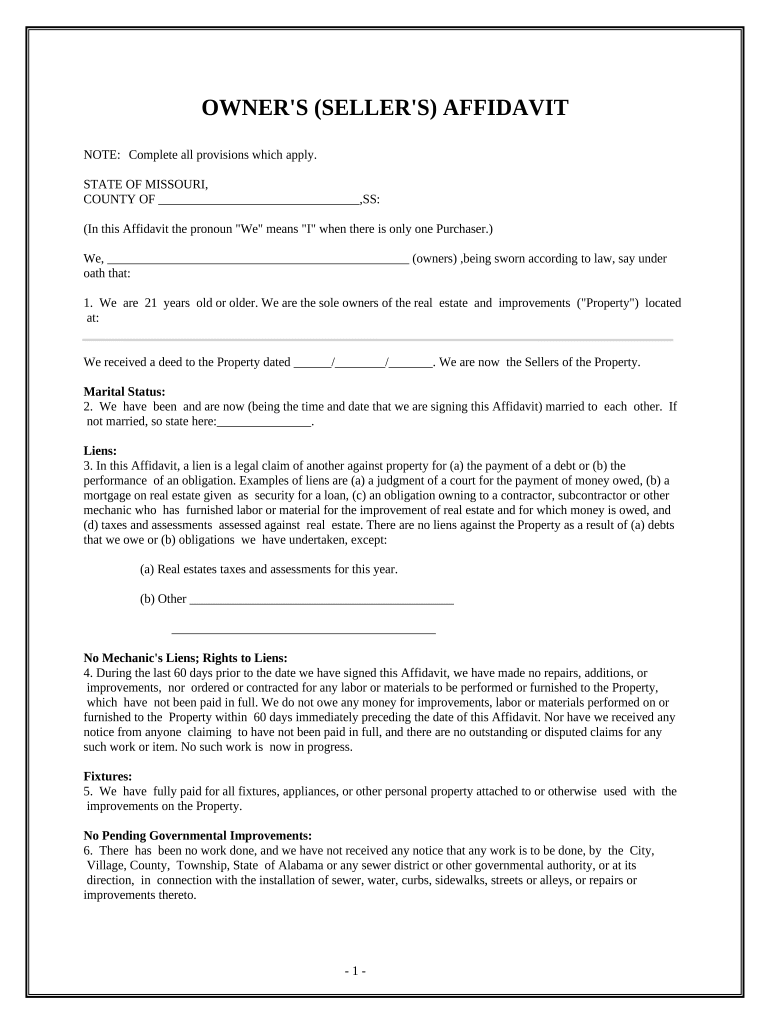
Owner's or Seller's Affidavit of No Liens - Missouri 2026

Get Form
Owner's or Seller's Affidavit of No Liens - Missouri Preview on Page 1

Here's how it works

01. Edit your form online
Type text, add images, blackout confidential details, add comments, highlights and more.
02. Sign it in a few clicks
Draw your signature, type it, upload its image, or use your mobile device as a signature pad.
03. Share your form with others
Send it via email, link, or fax. You can also download it, export it or print it out.

How to use or fill out Owner's or Seller's Affidavit of No Liens - Missouri with our platform

Form edit decoration
9.5
Ease of Setup
DocHub User Ratings on G2
9.0
Ease of Use
DocHub User Ratings on G2
  1. Click ‘Get Form’ to open the Owner's or Seller's Affidavit of No Liens in the editor.
  2. Begin by filling in your name as the owner(s) and confirm you are at least 21 years old. Specify the property address and date of the deed.
  3. Indicate your marital status. If applicable, state if you are married to each other; otherwise, provide your current status.
  4. In the liens section, declare any existing liens against the property. Be specific about real estate taxes and any other obligations.
  5. Confirm that no repairs or improvements have been made within the last 60 days that remain unpaid. This ensures there are no mechanic’s liens.
  6. Complete sections regarding fixtures, governmental improvements, nuisances, structural defects, boundary lines, lawsuits, bankruptcy status, easements, and any similar name liens.
  7. Finally, sign and print your name at the bottom of the affidavit. Ensure a notary public witnesses your signature for validation.

Start using our platform today to easily complete your Owner's or Seller's Affidavit of No Liens for free!

be ready to get more

Complete this form in 5 minutes or less

Get form

Got questions?

We have answers to the most popular questions from our customers. If you can't find an answer to your question, please contact us.
Contact us
Steps to File a Lien Secure a Preliminary Notice. Depending on your state laws, you may be required to notify the debtor that a lien will be filed if nonpayment persists. Review Deadlines. Research the Property. Draft a Lien. File the Lien. Notify All Parties. Enforce the Lien.
The Uniform Commercial Code Division is the central filing office for the perfection of personal property liens. These liens are perfected by filing a UCC-1 Financing Statement showing the name and address of the debtor and the secured party along with a description of the collateral.
Lien Filing Deadline In Missouri, timing is everything when it comes to filing your mechanics lien. You generally have six months from the last date you provided labor or materials to the project to file your lien.
Timely filing Typically, the right to seek a mechanics lien ends six months after the completion of work on the project or the delivery of the materials. After securing a lien, there is another six-month deadline that applies to enforcing it, a process that often involves foreclosure.
A No-Lien Affidavit is a legal statement provided by a contractor, subcontractor, or supplier affirming that they have been fully paid and that no liens have been or will be placed against the property for the work performed or materials supplied.

Security and compliance

At DocHub, your data security is our priority. We follow HIPAA, SOC2, GDPR, and other standards, so you can work on your documents with confidence.

Learn more
be ready to get more

Complete this form in 5 minutes or less

Get form

People also ask

Yes, it is possible. Certain liens, such as tax liens, judgment liens, or mechanics liens, do not require a direct contract with the homeowner to be valid. For example, a court judgment or unpaid taxes can result in an involuntary lien being filed against your property even without your agreement.
At its core, an affidavit lien is a binding legal document that could introduce complexities into real estate transactions. Typically, such a lien is recorded against a property by an individual or entity claiming a financial debt owed by the property owner.

Related links