Minnesota Forest Products Timber Sale Contract - Minnesota 2026

Get Form
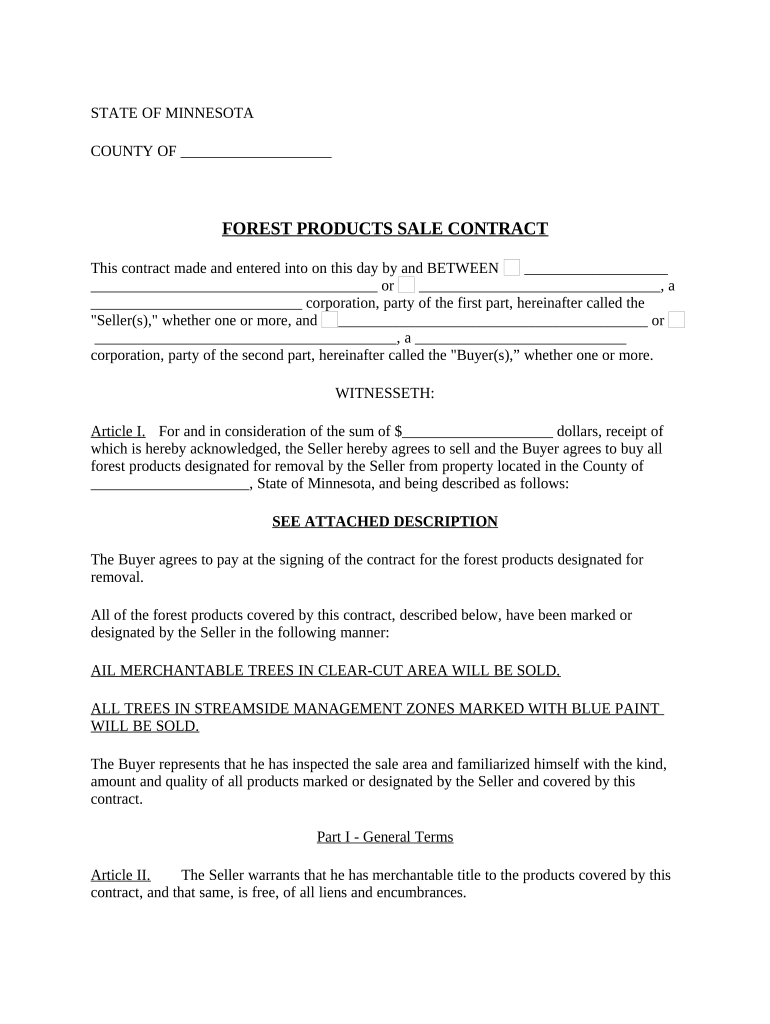
Minnesota Forest Products Timber Sale Contract - Minnesota Preview on Page 1

Here's how it works

01. Edit your form online
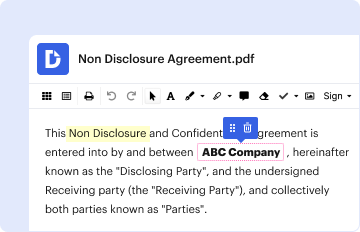
Type text, add images, blackout confidential details, add comments, highlights and more.
02. Sign it in a few clicks
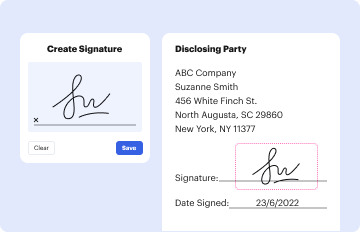
Draw your signature, type it, upload its image, or use your mobile device as a signature pad.
03. Share your form with others
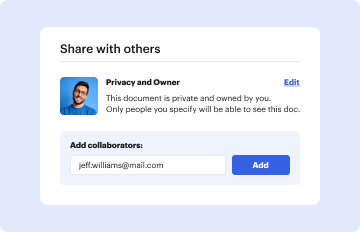
Send it via email, link, or fax. You can also download it, export it or print it out.

How to use or fill out Minnesota Forest Products Timber Sale Contract - Minnesota with our platform

Form edit decoration
9.5
Ease of Setup
DocHub User Ratings on G2
9.0
Ease of Use
DocHub User Ratings on G2
  1. Click ‘Get Form’ to open the Minnesota Forest Products Timber Sale Contract in the editor.
  2. Begin by filling in the date of the contract and the names of both the Seller(s) and Buyer(s) in the designated fields. Ensure that you accurately represent your corporation or individual status.
  3. In Article I, specify the total sale amount for forest products and provide a detailed description of the property from which these products will be removed. Attach any necessary documentation as indicated.
  4. Proceed to Part I - General Terms, where you will need to confirm your understanding of merchantable title and rights granted for ingress and egress. Fill in any required details regarding your technical agent if applicable.
  5. Complete Article V by indicating the duration of the contract and any specific periods during which harvesting is not permitted.
  6. Review Articles VII through XI carefully, ensuring compliance with performance requirements, fire prevention measures, and insurance obligations. Fill in any rates for timber as specified.
  7. Finally, ensure all parties sign where indicated, including witnesses if necessary. Use our platform’s signing feature to facilitate this process seamlessly.

Start using our platform today to fill out your Minnesota Forest Products Timber Sale Contract easily and for free!

be ready to get more

Complete this form in 5 minutes or less

Get form

Got questions?

We have answers to the most popular questions from our customers. If you can't find an answer to your question, please contact us.
Contact us
Standing timber can comprise a substantial portion of a rural propertys valuetimber values can range from a few hundred dollars per acre to over $5,000 per acre, depending on markets, species, product type, access, and total volume.
Timber harvesting offers several advantages for landowners looking to generate income from their timberland. One of the primary benefits is the significant revenue potential, as mature trees can be sold for high market prices, providing a substantial financial return.
How Much Money is an Acre of Timber Worth? Pine Timber Values/Acre YearPlantation*Natural 2017 $1,542 $1,618 2018 $1,694 $1,738 2019 $1,566 $2,0551 more row
Understand timber sale income and capital gains tax When you have a timber sale, you pay federal income taxes on the net income rather than the gross proceeds. You can subtract selling expenses, timber depletion allowance, and yield tax from the revenue to get the net taxable gain.
Averaging $8.00 $13.00/ton * On average, market value and demand for timber products may vary by location and market conditions at harvest.

Security and compliance

At DocHub, your data security is our priority. We follow HIPAA, SOC2, GDPR, and other standards, so you can work on your documents with confidence.

Learn more
ccpa2
pci-dss
gdpr-compliance
hipaa
soc-compliance

People also ask

Through timber sale contracts, the Forest Service sells the right to harvest timber to a purchaser, generally through an open and competitive bidding process. Through stewardship contracts and agreements, the Forest Service exchanges goods (e.g., timber) for services (e.g., wildlife habitat improvements). 16 U.S.C.
How to report sale of lumber using Capital Gains - Schedule D: You may receive income by cutting timber and opting to treat that cutting as a sale, or by disposing of standing timber, which is known as stumpage. In this case the income is treated as a Capital Gain and is reported by the taxpayer on their Schedule D.
Timber sale contracts usually include provisions that outline who, what, where, when, and how a timber sale will occur. Contracts will also spell out remedies in the event of a dispute. Contracts that are more stringent may result in fewer bidders and, potentially, lower bids.

Related links