Letter to Attorney Opposite regarding Return Admission of Service - Minnesota 2026

Get Form
Letter to Attorney Opposite regarding Return Admission of Service - Minnesota Preview on Page 1

Here's how it works

01. Edit your form online
Type text, add images, blackout confidential details, add comments, highlights and more.
02. Sign it in a few clicks
Draw your signature, type it, upload its image, or use your mobile device as a signature pad.
03. Share your form with others
Send it via email, link, or fax. You can also download it, export it or print it out.

How to use or fill out Letter to Attorney Opposite regarding Return Admission of Service - Minnesota with DocHub

Form edit decoration
9.5
Ease of Setup
DocHub User Ratings on G2
9.0
Ease of Use
DocHub User Ratings on G2
  1. Click ‘Get Form’ to open it in the editor.
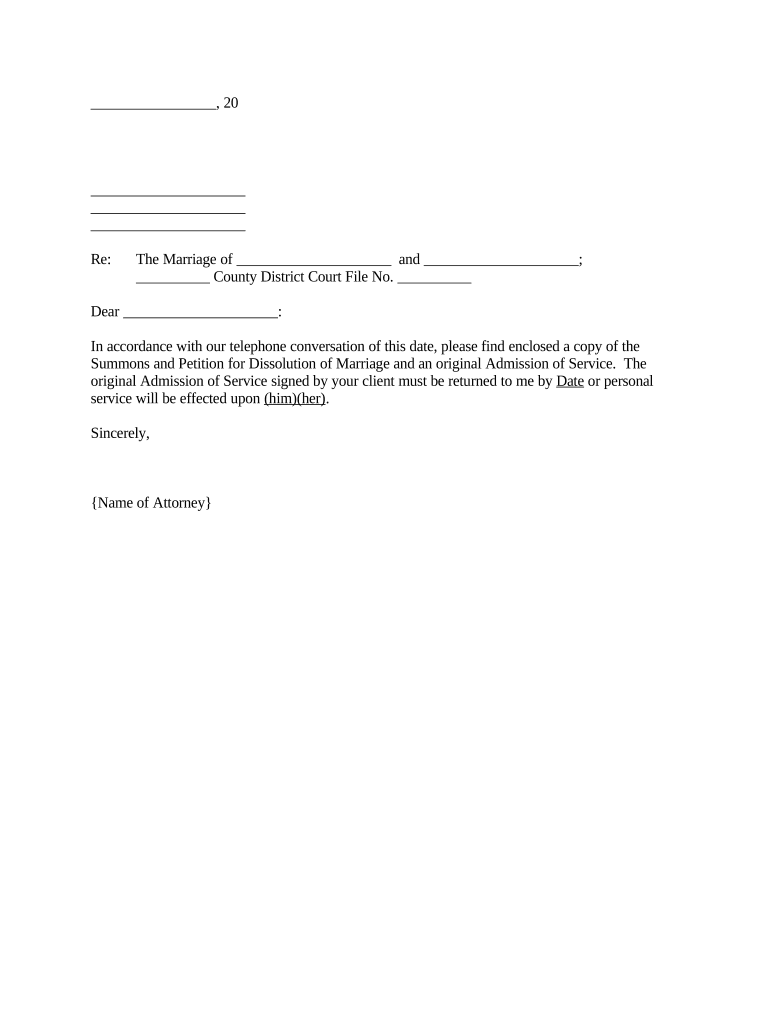
  2. Begin by entering the date at the top of the document. This is crucial for record-keeping and ensures all parties are aware of the timeline.
  3. Fill in the names of both parties involved in the marriage under 'The Marriage of'. This section establishes who the letter pertains to.
  4. Input the county and district court file number. This information is essential for referencing your case accurately.
  5. Address the letter by filling in the recipient's name, ensuring it is correctly spelled to maintain professionalism.
  6. In accordance with your previous conversation, specify any details about enclosed documents, such as 'Summons and Petition for Dissolution of Marriage'.
  7. Clearly state that the original Admission of Service must be returned by a specific date, emphasizing its importance to avoid personal service.
  8. Finally, sign off with your name as the attorney, ensuring that all necessary information is included for clarity.

Start using our platform today to streamline your document editing and signing process for free!

be ready to get more

Complete this form in 5 minutes or less

Get form

Got questions?

We have answers to the most popular questions from our customers. If you can't find an answer to your question, please contact us.
Contact us
Rule 69. In aid of the judgment or execution, the judgment creditor, or successor in interest when that interest appears of record, may obtain discovery from any person, including the judgment debtor, in the manner provided by these rules.
Summary Judgment. (a) Motion for Summary Judgment or Partial Summary Judgment. A party may move for summary judgment, identifying each claim or defense or the part of each claim or defense on which summary judgment is sought.
Rule 68 uses the term offer to include offers to settle made by any party. Thus, both an offer by a defendant to pay a sum in return for a dismissal of a claim and an offer by a claimant to accept a sum in return for dismissal - often termed a demand and not an offer - are offers for the purposes of the rule.
A party against whom a claim, counterclaim, or cross-claim is asserted or a declaratory judgment is sought may, at any time, move with or without supporting affidavits for a summary judgment in the partys favor as to all or any part thereof. (c) Motion and Proceedings Thereon.
(1)(A) A party may through interrogatories require any other party to identify each person whom the other party expects to call as an expert witness at trial, to state the subject matter on which the expert is expected to testify, and to state the substance of the facts and opinions to which the expert is expected to

Security and compliance

At DocHub, your data security is our priority. We follow HIPAA, SOC2, GDPR, and other standards, so you can work on your documents with confidence.

Learn more
ccpa2
pci-dss
gdpr-compliance
hipaa
soc-compliance

People also ask

Rule 56. Summary Judgment The court shall grant summary judgment if the movant shows that there is no genuine issue as to any material fact and the movant is entitled to judgment as a matter of law. The court shall state on the record or in a written decision the reasons for granting or denying the motion.
Rule 56. Summary Judgment A party may move for summary judgment, identifying each claim or defense - or the part of each claim or defense - on which summary judgment is sought.

Related links