




01. Edit your sf 8 online
Type text, add images, blackout confidential details, add comments, highlights and more.

Type text, add images, blackout confidential details, add comments, highlights and more.

Draw your signature, type it, upload its image, or use your mobile device as a signature pad.

Send sf 8 form via email, link, or fax. You can also download it, export it or print it out.
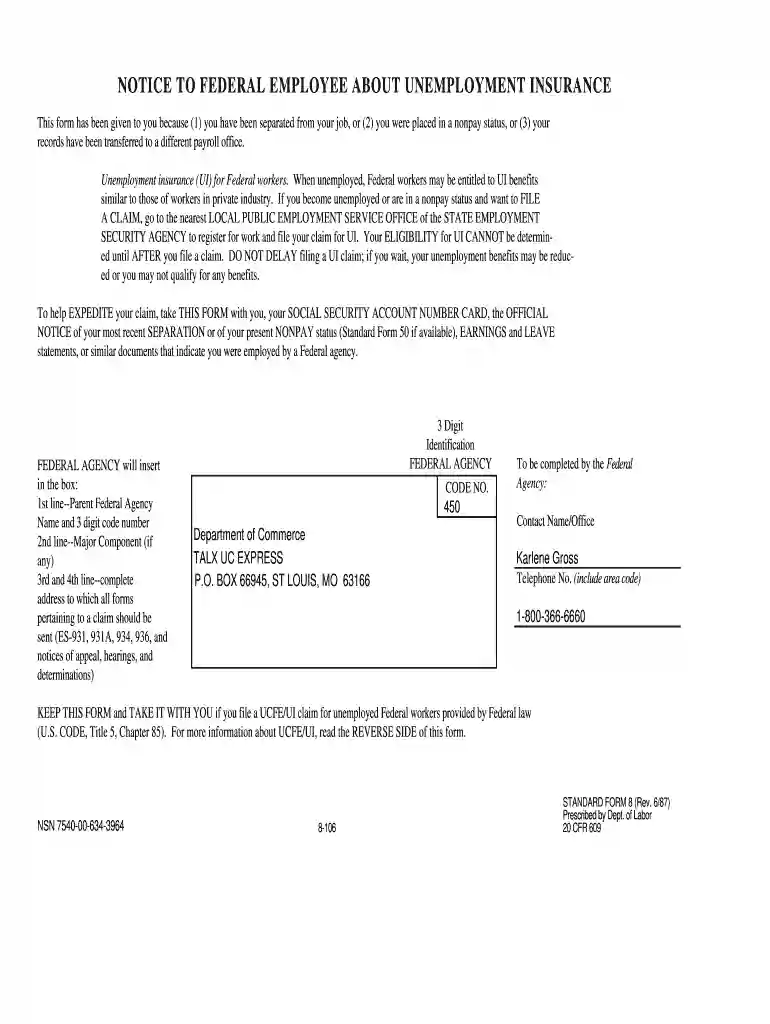
The SF-8, officially known as the Standard Form 8, is a crucial document used primarily for unemployment insurance purposes within the federal employment sector. This form serves as a notification to federal employees about their eligibility for unemployment benefits following separation from their jobs or when placed in a non-pay status. The SF-8 form plays a vital role in the claims process by providing the necessary information to both employees and the unemployment office.
Filing a claim for unemployment benefits involves several steps, and the SF-8 simplifies this process:
When completing the SF-8 form, it's essential to follow outlined procedures to ensure accurate and timely submission.
Understanding specific terminology associated with the SF-8 can enhance clarity during the unemployment claims process.
Timeliness is essential when dealing with the SF-8 form and subsequent unemployment claims.
The SF-8 form can be submitted in several ways, depending on individual preferences and state requirements.
It is crucial to understand the legal context in which the SF-8 is employed.
While the SF-8 is specifically designed for federal employees, there are other forms related to unemployment benefits that may be used under different circumstances.
This rich exploration of the SF-8 form highlights its importance in navigating the unemployment insurance landscape for federal employees, ensuring that all necessary steps are taken for a successful claims process.
We've got more versions of the sf 8 form. Select the right sf 8 version from the list and start editing it straight away!
| Versions | Form popularity | Fillable & printable |
|---|---|---|
| 1987 | 4.7 Satisfied (63 Votes) |
At DocHub, your data security is our priority. We follow HIPAA, SOC2, GDPR, and other standards, so you can work on your documents with confidence.
To help EXPEDITE your claim, take THIS FORM with you, your SOCIAL SECURITY ACCOUNT NUMBER CARD, the OFFICIAL NOTICE of your most recent employed by a FederalRead more
To help EXPEDITE your claim, take THIS FORM with you, your SOCIAL SECURITY ACCOUNT NUMBER CARD, the OFFICIAL NOTICE of your most recent. SEPARATION or of yourRead more
1 day ago 26.1 Release Candidate 3 (known as 26.1-rc-3 in the launcher) is the third release candidate for Java Edition 26.1, released on March 23,


