Motion to Make Specific Findings of fact - Mississippi 2026

Get Form
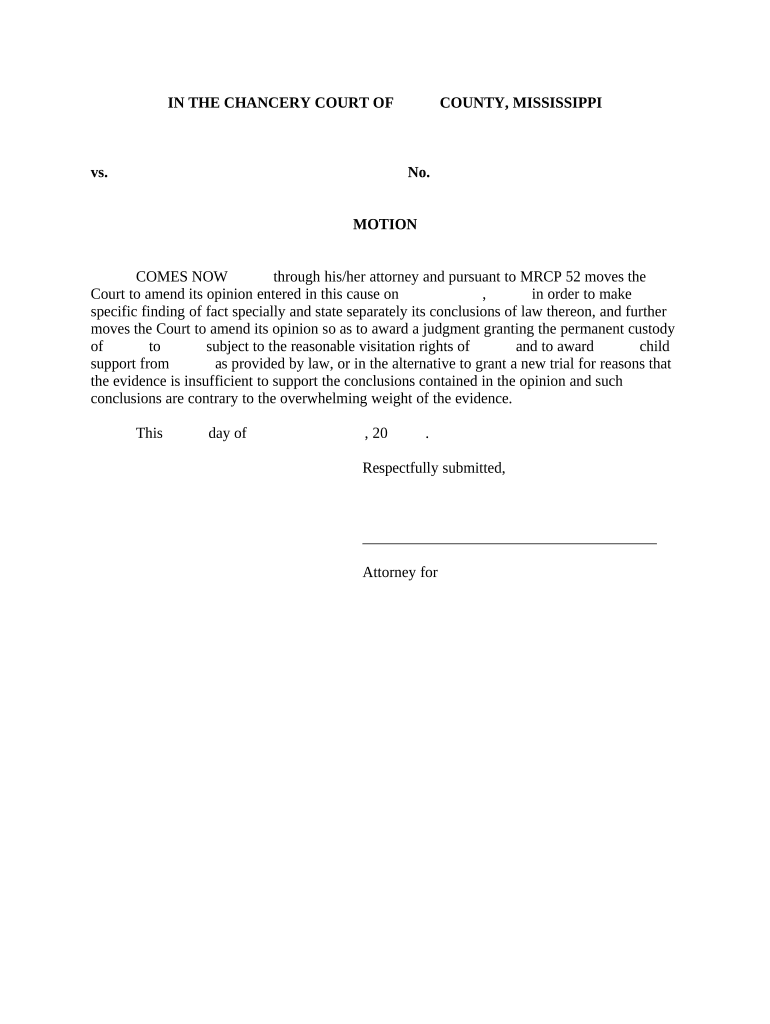
Motion to Make Specific Findings of fact - Mississippi Preview on Page 1

Here's how it works

01. Edit your form online
Type text, add images, blackout confidential details, add comments, highlights and more.
02. Sign it in a few clicks
Draw your signature, type it, upload its image, or use your mobile device as a signature pad.
03. Share your form with others
Send it via email, link, or fax. You can also download it, export it or print it out.

How to use or fill out Motion to Make Specific Findings of fact - Mississippi with our platform

Form edit decoration
9.5
Ease of Setup
DocHub User Ratings on G2
9.0
Ease of Use
DocHub User Ratings on G2
  1. Click ‘Get Form’ to open the Motion to Make Specific Findings of fact - Mississippi in the editor.
  2. Begin by filling in the case number at the top of the form. This is essential for identifying your motion within court records.
  3. In the section labeled 'COMES NOW', enter the name of the party making the motion, followed by their attorney's name if applicable.
  4. Specify the date when you are submitting this motion in the designated field. Ensure accuracy as this may affect deadlines.
  5. Clearly state your request for specific findings of fact and conclusions of law, detailing any custody arrangements and child support requests as necessary.
  6. Conclude by signing your name in the provided space, ensuring that all information is complete and accurate before submission.

Start using our platform today to easily fill out and manage your legal documents for free!

be ready to get more

Complete this form in 5 minutes or less

Get form

Got questions?

We have answers to the most popular questions from our customers. If you can't find an answer to your question, please contact us.
Contact us
In a Motion in Limine, a defendant asks the court to exclude highly prejudicial evidence (for example, the defendants criminal history) or evidence that violates the rules of evidence. An experienced, seasoned attorney in Mississippi will know what to file in your particular circumstance.
The court shall grant summary judgment if the movant shows that there is no genuine dispute as to any material fact and the movant is entitled to judgment as a matter of law. The court should state on the record the reasons for granting or denying the motion.
For federal courts, Rule 56 of the Federal Rules of Civil Procedure governs summary judgment. Under Rule 56, in order to succeed in a motion for summary judgment, a movant must show: There is no genuine issue of material fact, and. The movant is entitled to judgment as a matter of law.
Among bills passed during the 2025 legislative regular and special sessions, Senate Bill 2242 authorizes the MDOC to establish an inmate work program where eligible inmates may perform services for the Mississippi Department of Transportation.
Not later than 10 days after entry of judgment the court of its own initiative, on notice to the parties and hearing, may order a new trial for any reason for which it might have granted a new trial on motion of a party, and in the order shall specify the grounds therefor. (e) Motion to alter or amend a judgment.

Security and compliance

At DocHub, your data security is our priority. We follow HIPAA, SOC2, GDPR, and other standards, so you can work on your documents with confidence.

Learn more
ccpa2
pci-dss
gdpr-compliance
hipaa
soc-compliance

People also ask

Rule 56. Summary Judgment A party against whom a claim, counter-claim, or cross- claim is asserted or a declaratory judgment is sought may, at any time, move with or without supporting affidavits for a summary judgment in his favor as to all or any part thereof.
Sales Use Tax the bill amends code to reduce the grocery tax to 5% from and after 7/1/2025 and to revise various sales tax diversion percentages for revenue collected from the sales of groceries. It also revises the distribution of use tax revenue due to the grocery tax reduction.
Rule 81 requires use of a special summons which commands that the defendant appear and defend at a specific time and place set by order of the court and informs him or her that no answer is necessary.

Related links